Integration of 3D Vision in LNG Tank Fillet Welding
The construction of Liquefied Natural Gas (LNG) storage tanks represents one of the most demanding challenges in modern industrial engineering. These structures, often utilizing 9% Nickel steel or specialized stainless alloys, require high-integrity joints capable of withstanding cryogenic temperatures. Among the various joining requirements, the tank fillet welding of the shell-to-bottom annular plate is critical. Traditional manual welding methods often struggle with consistency due to the sheer scale of the tanks and the fluctuating environmental conditions of field sites. The introduction of 3D vision positioning systems on specialized crawlers has transformed this process from a labor-intensive craft into a high-precision automated operation.
Unlike standard workshop environments, LNG project sites are characterized by surface irregularities, thermal expansion variables, and logistical constraints. Utilizing a 3D vision positioning system allows the equipment to map the joint geometry in real-time. This spatial data is essential for maintaining the correct torch angle and wire placement relative to the fillet vertex. By capturing a three-dimensional cloud of the weld path, the system compensates for plate misalignment or variations in the root gap, ensuring that the deposited weld metal meets the stringent volumetric requirements of international pressure vessel codes.
Mechanical Design and Magnetic Crawler Stability
The primary vehicle for this technology is the magnetic crawler. In the context of LNG tank construction, the crawler must navigate large-diameter circumferences while maintaining a constant velocity and distance from the weld joint. Magnetic adhesion is the preferred method for maintaining contact with the vertical shell plates. High-flux permanent magnets or switchable magnetic blocks are integrated into the chassis to provide the necessary downforce. This force must be carefully balanced to prevent slippage while minimizing the friction that the drive motors must overcome.
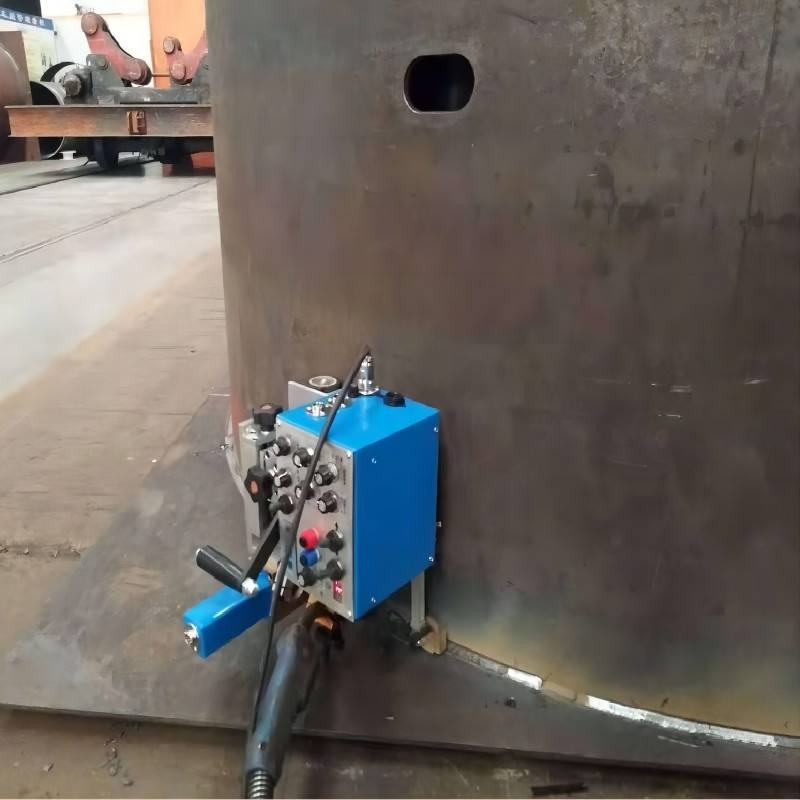
Stability in the field is not merely about staying on the wall; it is about vibration dampening and traction control. Wind loads and the weight of the welding umbilical—which includes power cables, shielding gas hoses, and water-cooling lines—exert significant external forces on the crawler. Engineering the drive system involves high-torque stepper motors coupled with precision gearboxes to ensure smooth, pulse-free movement. Any stutter in the crawler’s motion would result in a localized heat increase, potentially compromising the Heat Affected Zone (HAZ) of the cryogenic steel. The synergy between the magnetic grip and the drive control loop is what allows for the continuous, multi-pass welding required for thick annular plate fillets.
Optical Path Correction and Weld Profile Management
The core advantage of using 3D vision over mechanical probes lies in its non-contact nature and data density. Digital imaging sensors capture the profile of the fillet joint ahead of the welding arc. The software algorithms analyze this profile to identify the precise intersection of the vertical shell and the horizontal annular plate. This information is fed back to a cross-slide actuator system that makes micro-adjustments to the torch position.
In LNG storage tanks, the fillet weld profile must be slightly concave or flat to minimize stress concentrations. The vision system monitors the fill level of the weld bead in real-time. If the system detects a change in the groove geometry, it can signal the controller to adjust the travel speed or wire feed rate. This level of closed-loop control is impossible to achieve with manual welding, where the operator’s vision is often obscured by smoke and the intensity of the arc. By automating the positioning, the engineer ensures that the leg length and throat thickness of the fillet weld remain within the specified tolerances for the entire circumference of the tank.
Thermal Management and Metallurgical Integrity
When working with 9% Nickel steel, heat input control is a primary engineering concern. Excessive heat can lead to grain growth and a reduction in low-temperature notch toughness. The automated crawler provides a distinct advantage here by maintaining a highly consistent travel speed. Because the 3D vision system handles the tracking, the parameters—voltage, current, and speed—can be locked into a narrow window that has been pre-qualified through Weld Procedure Specifications (WPS).
Furthermore, the stability provided by the magnetic crawler allows for the use of high-deposition processes such as Flux-Cored Arc Welding (FCAW) or Gas Metal Arc Welding (GMAW) in positions that would be physically exhausting for a manual welder. The consistency of the automated pass reduces the likelihood of inter-pass defects such as lack of fusion or slag inclusions. In a project where a single weld failure can lead to weeks of costly repairs and ultrasonic testing (UT) delays, the reliability of the automated crawler is an essential risk-mitigation tool.
Field Construction Efficiency and Safety Protocols
The deployment of these machines significantly alters the workflow on an LNG construction site. Instead of multiple welding stations with individual operators, a single technician can oversee several automated crawlers. This shift reduces the “man-hours per meter” metric, which is a key performance indicator in industrial project management. The reduction in personnel near the immediate weld zone also enhances safety, as operators are less exposed to welding fumes and the ergonomic strain of working in awkward positions for extended periods.
Field construction stability is further enhanced by the ruggedized nature of the 3D vision components. These sensors are housed in protective enclosures with air-cooled jackets and spatter shields. The control software is designed to handle the “noise” of a construction site, such as ambient light changes and surface oxidation on the steel. The ability of the vision system to differentiate between a true joint and a surface scratch is a testament to the sophistication of modern image processing algorithms used in heavy industry.
Data Logging and Quality Assurance
Every centimeter of the weld performed by a 3D vision-equipped crawler can be logged and indexed. The system records the 3D profile of the joint before welding and the resulting bead profile after the pass. This digital record provides a level of traceability that is becoming mandatory for large-scale energy infrastructure projects. If a quality audit is performed, the engineers can produce data logs showing that every segment of the tank fillet was welded within the required parameters.
This data-centric approach also allows for predictive maintenance of the equipment. By monitoring the torque requirements of the crawler’s motors, the system can alert the operator to potential mechanical issues or the buildup of debris on the magnetic tracks. In the context of a multi-year LNG project, these incremental gains in reliability and data transparency contribute significantly to the overall success and safety of the facility.
Technical Conclusion for Field Engineering
The application of 3D vision positioning to magnetic crawlers for tank fillet welding is not just an incremental improvement; it is a fundamental shift in how LNG tanks are constructed. By focusing on mechanical stability, precise optical tracking, and stringent thermal control, industrial engineers can ensure that these massive structures are built to the highest possible standards. The elimination of manual variability through automation ensures that the integrity of the cryogenic containment system is maintained, protecting both the investment and the environment.
-


LT240S tube laser cutting machine
-
LT120S tube laser cutting machine
-
Sale

Tank Fillet Welding Machine
Original price was: $1,000.00.$900.00Current price is: $900.00. -
Sale

MAK100 tube laser cutting machine
Original price was: $5,500.00.$5,000.00Current price is: $5,000.00. -

portable plasma air cutting machine
$1,200.00 -

2in1 fiber laser cutting machine
-

Air cooling Laser welding machine
-

HF h beam laser cutting machine
-

LT240 laser cutting machine
-

Laser welding machine
-


Cobot Welding Station
-

Gantry welding robot solution
-

Tracked Wheeled AGV Welding robot
-

LFH6020 Fiber laser cutting machine
-
LFP6020
-

robotic welidng machine
Advanced Fiber Laser Tube Processing Technology
Our CNC Fiber Laser Tube Cutting systems revolutionize metal fabrication by integrating high-precision cutting, punching, and profiling into a single automated workflow. Designed for versatility, this technology handles a wide array of profiles including Round, Square, Rectangular, and Oval tubes, as well as complex L-shaped and U-shaped channels.
- Precision Punching: High-speed hole punching with micron-level accuracy, eliminating the need for mechanical drilling or die-stamping.
- Complex Profiling: Advanced 3D pathing allows for intricate interlocking joints and specialized notch cuts, ideal for structural frames.
- High Material Efficiency: Intelligent nesting software minimizes scrap, reducing raw material costs across large production runs.
- Clean Finish: Delivers oxide-free, burr-free edges that require zero secondary grinding before welding.

Seamlessly processing multiple profiles with consistent precision.
Global Delivery & Logistics



From our high-tech manufacturing facility directly to your global site. PCL WeldCut ensures secure packaging, professional handling, and reliable international logistics to safeguard your equipment throughout the entire journey.