Optimizing Tank Fillet Welding via 3D Vision and Magnetic Crawlers
In the domain of heavy construction machinery and large-scale infrastructure, the transition from manual welding to automated systems is driven by the need for precision and safety. One of the most critical joints in storage tank fabrication is the fillet weld, particularly the shell-to-bottom connection. Traditional methods rely heavily on the dexterity of human operators, which introduces variability in weld bead geometry and penetration depth. The introduction of 3D vision positioning combined with magnetic crawler technology offers a robust solution for field construction, ensuring that the welding torch maintains the correct orientation and offset despite surface irregularities.
Industrial engineering principles dictate that for any automated system to be viable in a field environment, it must account for environmental variables such as wind, surface oxidation, and non-linear paths. The magnetic crawler serves as the mobile platform, providing the necessary adhesion to vertical and horizontal steel surfaces. By integrating high-resolution visual sensors, the system can map the joint profile in real-time, adjusting the torch position to compensate for plate warping or fit-up gaps that exceed nominal tolerances.
Mechanical Foundation of Magnetic Crawler Systems
Traction and Magnetic Adhesion Mechanics
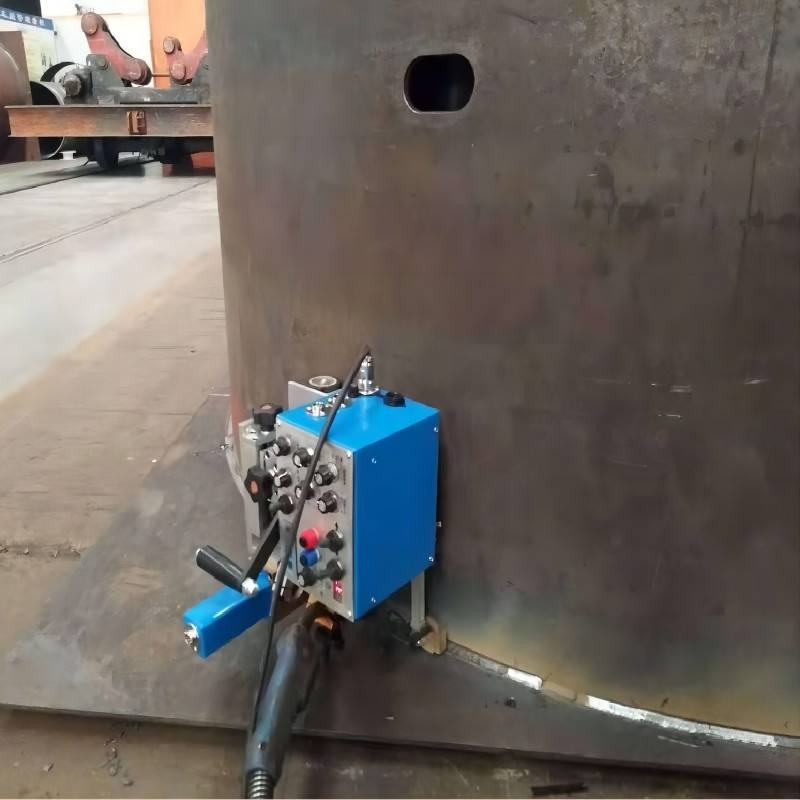
The core of the system is the magnetic drive mechanism. For tank construction, the crawler must navigate vertical shells or internal circumferences. Permanent neodymium magnets or switchable magnetic tracks are utilized to provide a high pull-off force-to-weight ratio. This ensures that the crawler remains stable while carrying the welding torch, wire feeder, and sensor payload. From an engineering perspective, the friction coefficient between the crawler wheels and the steel plate is the primary constraint. Engineers must calculate the torque requirements to overcome both gravity and the magnetic drag to maintain a constant travel speed, which is essential for a uniform heat input.
Chassis Stability in Field Conditions
Unlike factory-based automation, field construction involves uneven surfaces. The crawler chassis must feature a degree of mechanical compliance or a suspension system to ensure that all drive wheels maintain contact with the plate. In tank fillet welding, the crawler often travels along the corner joint where the shell meets the floor. A dual-drive system allows for differential steering, enabling the crawler to follow the curvature of the tank wall with high precision. Stability is further enhanced by low-center-of-gravity designs that prevent tipping or sliding during vertical climbs.
The Role of 3D Vision in Joint Alignment
Real-Time Seam Profiling
The primary challenge in automated welding is the deviation between the programmed path and the actual joint location. 3D vision sensors utilize structured light or stereo imaging to capture the topography of the fillet joint. By projecting a light pattern onto the intersection of the two plates, the system calculates the exact coordinates of the root. This data is processed through a control loop that adjusts the cross-slide actuators. The result is a dynamic correction of the torch position, ensuring the arc is always centered in the joint, which is critical for achieving the required leg length and throat thickness in a fillet weld.
Compensation for Fit-Up Variations
In large-scale tank construction, fit-up gaps are inevitable. Plates may not be perfectly square, or the floor may have slight undulations. A 3D vision-guided system can detect the volume of the gap and automatically adjust the welding parameters, such as travel speed or wire feed rate, to fill the joint adequately. This level of adaptability reduces the rate of weld defects like undercut or lack of fusion, which are common when using fixed-track automation or manual processes.
Process Parameters for Construction Machinery Fabrication
Optimizing Heat Input and Penetration
For the construction of heavy machinery components and tanks, the weld must meet stringent structural codes (e.g., API 650 or AWS D1.1). The automated crawler allows for precise control over the heat input. By maintaining a steady travel speed, the system prevents overheating the base metal, which can lead to grain coarsening and reduced toughness in the heat-affected zone (HAZ). Field construction stability is maintained by shielding the arc from environmental drafts using localized shrouds, ensuring that the gas coverage remains consistent even in outdoor settings.
Multi-Pass Fillet Welding Strategies
When thick plates are involved, a single pass may not suffice to meet the required fillet size. The 3D vision system facilitates multi-pass welding by recording the position of the previous bead and calculating the necessary offset for the subsequent layer. This “teach-and-repeat” capability, enhanced by visual verification, ensures that each layer is deposited with the correct overlap, resulting in a structurally sound and aesthetically uniform weld stack.
Stability and Reliability in Field Construction
Weatherproofing and Durability
Equipment used in tank construction must be ruggedized. The electronic components, specifically the 3D sensors and control units, are housed in IP65-rated enclosures to protect against dust and moisture. The magnetic crawler must also be resistant to the spatter and heat generated during the welding process. Thermal shielding and cooling fins are often integrated into the crawler body to prevent electronic failure during long-duty cycles. Industrial engineers focus on the Mean Time Between Failures (MTBF) to ensure that the automation does not become a bottleneck in the construction timeline.
Operator Safety and Ergonomics
By delegating the welding task to a vision-guided crawler, the operator is removed from the immediate vicinity of the arc and fumes. Monitoring is performed via a remote interface that displays the 3D profile and a live feed of the weld pool. This not only improves safety but also allows a single technician to oversee multiple crawlers, significantly increasing the square footage of welded joints per man-hour. The reduction in physical strain associated with manual welding in confined or elevated spaces leads to higher overall productivity and better quality control.
Implementation Challenges and Technical Solutions
Surface Preparation and Magnetic Interference
One potential issue in field welding is the presence of mill scale, rust, or primer on the steel surface. While the magnetic crawler provides strong adhesion, the 3D vision system must be calibrated to distinguish between the joint and surface irregularities. Advanced filtering algorithms are used to ignore optical noise caused by reflections or surface debris. Additionally, the magnetic field from the crawler must be shielded or positioned such that it does not cause “arc blow,” a phenomenon where the welding arc is deflected by magnetic forces, leading to porosity or poor bead shape.
Integration with Existing Workflows
Successful implementation requires the crawler system to be lightweight enough for manual transport to the work site yet robust enough for continuous operation. Modular designs allow for quick setup and breakdown. The software interface must be intuitive, allowing field engineers to define the weld start and end points without extensive programming knowledge. By focusing on a “plug-and-play” architecture, construction firms can integrate 3D-guided welding into their existing project schedules with minimal downtime.
Conclusion: The Future of Automated Construction
The integration of 3D vision positioning with magnetic crawler technology represents a significant leap forward for construction machinery and tank fabrication. By prioritizing mechanical stability and visual accuracy, this system overcomes the limitations of manual welding in harsh field environments. The ability to maintain consistent weld quality, adapt to fit-up variations, and improve operator safety makes this a high-ROI investment for any industrial construction project. As projects grow in scale and complexity, the reliance on such automated solutions will become the standard for ensuring structural integrity and project efficiency.
-


LT240S tube laser cutting machine
-
LT120S tube laser cutting machine
-
Sale

Tank Fillet Welding Machine
Original price was: $1,000.00.$900.00Current price is: $900.00. -
Sale

MAK100 tube laser cutting machine
Original price was: $5,500.00.$5,000.00Current price is: $5,000.00. -

portable plasma air cutting machine
$1,200.00 -

2in1 fiber laser cutting machine
-

Air cooling Laser welding machine
-

HF h beam laser cutting machine
-

LT240 laser cutting machine
-

Laser welding machine
-


Cobot Welding Station
-

Gantry welding robot solution
-

Tracked Wheeled AGV Welding robot
-

LFH6020 Fiber laser cutting machine
-
LFP6020
-

robotic welidng machine
Advanced Fiber Laser Tube Processing Technology
Our CNC Fiber Laser Tube Cutting systems revolutionize metal fabrication by integrating high-precision cutting, punching, and profiling into a single automated workflow. Designed for versatility, this technology handles a wide array of profiles including Round, Square, Rectangular, and Oval tubes, as well as complex L-shaped and U-shaped channels.
- Precision Punching: High-speed hole punching with micron-level accuracy, eliminating the need for mechanical drilling or die-stamping.
- Complex Profiling: Advanced 3D pathing allows for intricate interlocking joints and specialized notch cuts, ideal for structural frames.
- High Material Efficiency: Intelligent nesting software minimizes scrap, reducing raw material costs across large production runs.
- Clean Finish: Delivers oxide-free, burr-free edges that require zero secondary grinding before welding.

Seamlessly processing multiple profiles with consistent precision.
Global Delivery & Logistics



From our high-tech manufacturing facility directly to your global site. PCL WeldCut ensures secure packaging, professional handling, and reliable international logistics to safeguard your equipment throughout the entire journey.