Advanced Positioning for Tank Fillet Welding in Construction Machinery
In the sector of construction machinery manufacturing, the structural integrity of large-scale tanks and pressure vessels is paramount. The shift from manual welding to automated systems has been driven by the need for consistency, safety, and throughput. Specifically, tank fillet welding represents a significant portion of the assembly process, requiring precise torch orientation and travel speeds to ensure deep penetration and leak-proof seams. The integration of 3D vision positioning into pipe profile cutting and welding machinery has redefined how these joints are processed, moving away from rigid templates toward dynamic, sensor-driven execution.
The Role of 3D Vision in Spatial Coordinate Mapping
Traditional automated welding systems often struggle with the dimensional variances found in large-diameter pipes and tanks. Material warping, pre-weld fit-up gaps, and ovality in cylindrical sections create a non-linear path that a standard pre-programmed sequence cannot follow accurately. 3D vision systems mitigate these issues by utilizing structured light or stereo-vision sensors to map the actual workpiece geometry in real-time. This spatial data is then processed to calculate the exact centerline of the fillet joint.
From an industrial engineering perspective, the 3D vision system acts as the feedback loop for the motion control unit. Before the welding arc is struck, the sensor scans the joint, identifying the root opening and the angle of the vertical and horizontal members. This allows the machine to adjust the torch position to maintain the optimal work angle and lead angle, ensuring the heat input is distributed evenly across the fillet faces. By eliminating the “teach-and-repeat” method, manufacturers reduce setup times and improve the duty cycle of the equipment.
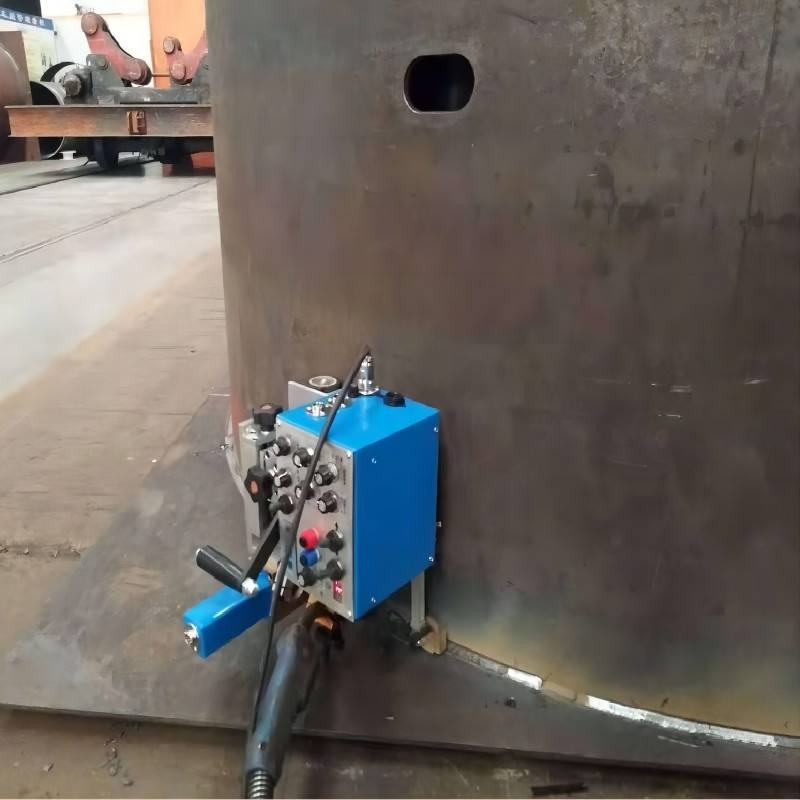
Magnetic Crawler Technology: Ensuring Field Construction Stability
Field construction presents environmental variables that are absent in a controlled factory setting. Wind, uneven terrain, and gravity-induced sag in large structures require a delivery system that is both mobile and stable. The magnetic crawler has emerged as the industry standard for transporting welding heads along the circumference or longitudinal seams of tanks. These crawlers use high-strength permanent magnets or switchable electromagnets to adhere to the ferromagnetic substrate, providing the necessary traction to carry the welding payload without slipping.
The stability of the magnetic crawler is critical when performing fillet welds on curved surfaces. Any vibration or deviation in the crawler’s path directly translates to defects in the weld bead, such as undercut or lack of fusion. Modern crawlers are designed with independent drive wheels that can compensate for surface irregularities. When paired with 3D vision, the crawler does not need to follow a physical guide rail; instead, it follows a virtual path generated by the vision system, allowing for greater flexibility in navigating complex tank geometries and intersecting pipe profiles.
Optimizing Weld Parameters for Heavy Construction Equipment
Construction machinery, such as excavators and cranes, utilizes tanks that must withstand high internal pressures and external vibrations. Fillet welds in these components are often multi-pass operations. The industrial engineer must balance the deposition rate with the cooling rate to manage the grain structure of the weld metal. 3D vision positioning allows for precise multi-pass layering by recording the profile of the previous bead and adjusting the offset for the subsequent pass.
This level of precision ensures that the effective throat thickness of the fillet weld meets the design specifications across the entire length of the joint. Furthermore, by maintaining a consistent arc length through automated voltage control (AVC) integrated with vision data, the system minimizes spatter and post-weld cleaning requirements. This optimization leads to a direct reduction in man-hours per unit and lowers the overall cost of quality.
Mechanical Integrity and Adherence Factors
The physics of magnetic adherence is a key consideration in the design of these machines. The pull-out force of the magnets must exceed the combined weight of the crawler, the welding torch, the wire feeder, and the umbilical cables, while also accounting for a safety factor required by site safety regulations. Engineers must calculate the magnetic flux density required to penetrate through paint or mill scale, which can act as a non-magnetic gap, reducing the holding force.
In field construction stability, the crawler’s center of gravity is kept as low as possible to prevent tipping during vertical or overhead maneuvers. The synchronization between the 3D vision sensor and the crawler’s drive motors is managed through a real-time operating system (RTOS). If the vision system detects a deviation that exceeds the mechanical reach of the torch slides, the crawler itself can be commanded to steer back onto the optimal path, ensuring the weld remains within the specified tolerance zone.
Industrial Engineering Benefits: Throughput and Reliability
The implementation of automated pipe profile cutting and welding systems focused on fillet joints provides a measurable increase in production efficiency. In manual operations, welder fatigue and limited visibility often lead to inconsistencies, especially in long-seam tank construction. An automated system can operate at a higher duty cycle, maintaining peak performance throughout a shift. This consistency reduces the rate of non-destructive testing (NDT) failures, which are costly to repair in field environments.
Moreover, the data collected by the 3D vision system during the welding process can be used for digital twin integration and quality documentation. Every inch of the weld can be logged with its corresponding parameters, such as travel speed, heat input, and joint geometry. This provides a comprehensive traceability record that is increasingly required in the construction of critical infrastructure and heavy machinery.
Conclusion of Process Integration
By focusing on the synergy between 3D vision positioning and magnetic crawler stability, manufacturers of construction machinery can achieve a level of precision in tank fillet welding that was previously unattainable in the field. The removal of complex rail systems in favor of vision-guided mobility allows for faster deployment and greater adaptability to various tank diameters and wall thicknesses. As the industry continues to evolve, the reliance on these automated, sensor-driven systems will be the cornerstone of high-efficiency structural fabrication, ensuring that the demands for durability and performance in construction equipment are met with surgical accuracy.
-


LT240S tube laser cutting machine
-
LT120S tube laser cutting machine
-
Sale

Tank Fillet Welding Machine
Original price was: $1,000.00.$900.00Current price is: $900.00. -
Sale

MAK100 tube laser cutting machine
Original price was: $5,500.00.$5,000.00Current price is: $5,000.00. -

portable plasma air cutting machine
$1,200.00 -

2in1 fiber laser cutting machine
-

Air cooling Laser welding machine
-

HF h beam laser cutting machine
-

LT240 laser cutting machine
-

Laser welding machine
-


Cobot Welding Station
-

Gantry welding robot solution
-

Tracked Wheeled AGV Welding robot
-

LFH6020 Fiber laser cutting machine
-
LFP6020
-

robotic welidng machine
Advanced Fiber Laser Tube Processing Technology
Our CNC Fiber Laser Tube Cutting systems revolutionize metal fabrication by integrating high-precision cutting, punching, and profiling into a single automated workflow. Designed for versatility, this technology handles a wide array of profiles including Round, Square, Rectangular, and Oval tubes, as well as complex L-shaped and U-shaped channels.
- Precision Punching: High-speed hole punching with micron-level accuracy, eliminating the need for mechanical drilling or die-stamping.
- Complex Profiling: Advanced 3D pathing allows for intricate interlocking joints and specialized notch cuts, ideal for structural frames.
- High Material Efficiency: Intelligent nesting software minimizes scrap, reducing raw material costs across large production runs.
- Clean Finish: Delivers oxide-free, burr-free edges that require zero secondary grinding before welding.

Seamlessly processing multiple profiles with consistent precision.
Global Delivery & Logistics



From our high-tech manufacturing facility directly to your global site. PCL WeldCut ensures secure packaging, professional handling, and reliable international logistics to safeguard your equipment throughout the entire journey.