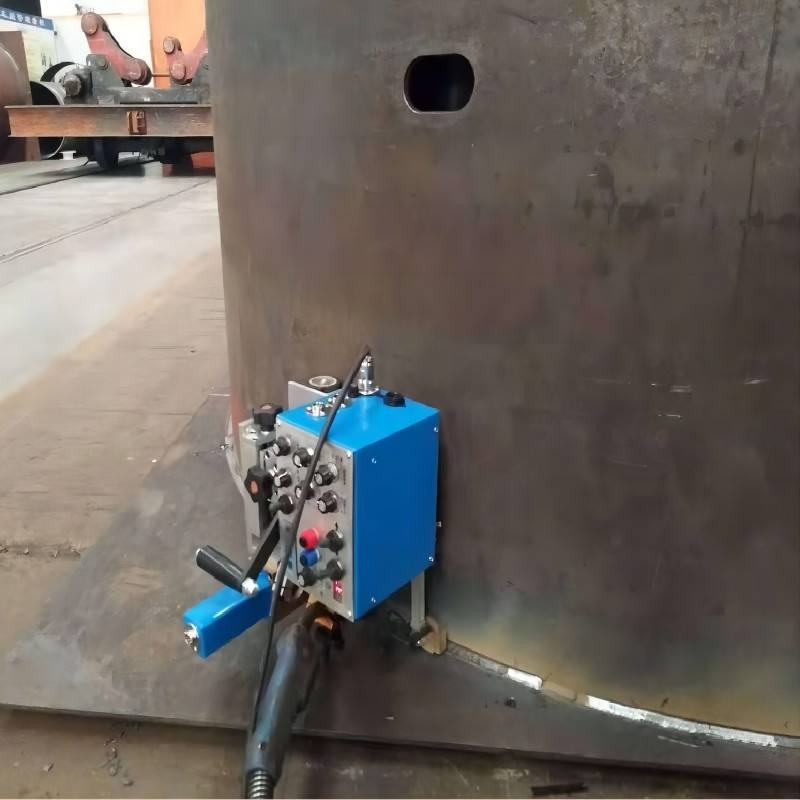
Optimizing Field Construction via 3D Vision Positioning in Tank Fillet Welding
In the heavy construction machinery and large-scale storage sector, the transition from manual welding to automated systems is driven by the requirement for consistency in harsh environments. The application of a Pipe Profile Cutting Machine infrastructure—adapted for welding—leverages sophisticated 3D vision positioning to solve the persistent issue of fit-up variance. Tank fillet welding, particularly where large diameter pipes meet flat or curved tank walls, demands a high degree of precision that manual operators struggle to maintain over long duty cycles. By utilizing specialized Magnetic Crawler technology, manufacturers can achieve workshop-level weld quality in the field.
The Role of 3D Vision in Surface Mapping and Seam Tracking
Field construction is inherently imprecise. Large steel plates and pipe sections often exhibit dimensional deviations due to thermal expansion, transport stresses, or initial fabrication tolerances. Traditional mechanized tractors follow a fixed path, which leads to weld defects when the seam deviates from the programmed trajectory.
3D vision positioning systems mitigate this by performing real-time spatial analysis of the joint. The system employs structured light or stereoscopic sensors to create a high-resolution point cloud of the fillet area. This data is processed through an onboard controller to calculate the exact centerline of the joint. In the context of Tank Fillet Welding, the vision system identifies the root gap and the angle of the vertical member relative to the base plate. This allows for dynamic adjustment of the torch position (Y and Z axes) and the travel speed to ensure optimal penetration and bead morphology.
Compensating for Fit-up Gaps
In large tank construction, the gap between the pipe profile and the tank shell can vary by several millimeters. A vision-guided system detects these fluctuations ahead of the arc. The controller adjusts the oscillation width and dwell time of the welding torch to bridge larger gaps without compromising the structural integrity of the fillet. This closed-loop feedback mechanism ensures that the volume of filler metal deposited is commensurate with the joint geometry, preventing undercut or excessive reinforcement.
Mechanical Stability: The Magnetic Crawler Framework
For field operations, stability is the primary challenge. Unlike stationary workshop positioners, a crawler must navigate the workpiece itself. The use of high-strength permanent magnets or switchable electromagnets allows the crawler to adhere to carbon steel surfaces in vertical, horizontal, or overhead positions.
Magnetic Adhesion and Traction
The traction system of a Magnetic Crawler is designed to provide constant force against the tank wall. This prevents slipping caused by the weight of the umbilical cables or the torque of the welding torch arm. From an industrial engineering perspective, the friction coefficient between the crawler wheels and the steel surface must be carefully calculated to account for surface contaminants like mill scale, rust, or moisture. High-torque stepper motors provide the necessary resolution for fine travel speed adjustments, which are synchronized with the 3D vision data.
Vibration Damping and Path Accuracy
Field environments introduce mechanical vibrations from nearby machinery or wind loads. The crawler chassis is engineered with a low center of gravity and dampening mounts for the vision sensor. This mechanical stability ensures that the “noise” in the 3D point cloud is minimized, allowing the software algorithms to maintain a lock on the weld seam. The integration of Construction Machinery durability standards ensures the electronic components are shielded from the high-frequency interference typical of heavy-duty arc welding power sources.
Enhancing Field Construction Stability
Stability in field construction is not merely about the machine staying on the wall; it is about the reliability of the metallurgical result. The synergy between 3D vision and the magnetic platform creates a stable “local environment” for the welding process.
Environmental Adaptation
Field-deployed systems must contend with variable lighting and temperature. Advanced 3D sensors used in these machines utilize narrow-band optical filters to isolate the laser line or structured light pattern from the intense glare of the welding arc. This allows the positioning system to function continuously during the welding process. Furthermore, the robust housing of the vision system prevents dust and metallic particles from interfering with the optics, ensuring that the path planning remains accurate over several hundred meters of welding.
Reduction of Rework and NDT Failures
In traditional tank fabrication, Non-Destructive Testing (NDT) such as ultrasonic or radiographic inspection often reveals slag inclusions or lack of fusion at points where manual welders paused or where the fit-up was poor. Mechanized crawlers provide a continuous weld bead, eliminating the “stop-start” points that are common failure zones. By maintaining a constant arc length and torch angle through 3D vision, the system produces a uniform grain structure in the weld metal, significantly increasing the first-pass success rate of NDT.
Operational Logic and Workflow Integration
Implementing an automated vision-guided crawler requires a shift in the operational workflow. The process begins with the deployment of the crawler near the start of the pipe profile or tank seam.
Step 1: Initial Scanning and Calibration
The operator initiates a pre-weld scan. The 3D vision system maps the starting point and calibrates the torch offset. This step ensures that the machine recognizes the specific profile geometry of the construction machinery component.
Step 2: Automated Path Execution
As the crawler moves, the vision system “looks ahead” of the arc (typically 30-50mm). It continuously updates the motion controller with coordinates. The magnetic drive ensures that the physical movement of the torch carrier precisely matches the digital path.
Step 3: Real-time Parameter Adjustment
If the vision system detects a change in the joint angle, it signals the welding power source to adjust current or voltage (via standard communication protocols like Modbus or CAN bus), ensuring the heat input remains consistent with the thickness of the material.
Industrial Engineering Benefits: Throughput and Labor
From a management perspective, the deployment of 3D vision-guided crawlers addresses the critical shortage of high-skill welders. While a manual welder requires years of training to master vertical-up fillet welds on curved surfaces, a technician can be trained to oversee two or three automated crawlers simultaneously.
The Construction Machinery sector benefits from a drastic reduction in “arc-off” time. Crawlers do not require the frequent breaks that human operators need, and they maintain a consistent travel speed that is often 20-30% faster than manual welding while maintaining higher quality standards. This efficiency directly translates to shorter project timelines and lower overhead costs for large-scale tank farms or heavy equipment assembly.
Conclusion
The integration of 3D vision positioning with magnetic crawler technology represents a significant leap forward for field-based tank fillet welding. By removing the reliance on manual tracking and providing a stable, mechanized platform, companies can ensure that the structural integrity of their construction machinery meets the most stringent industrial standards. The focus on mechanical stability, real-time seam adaptation, and robust hardware allows for a highly efficient, repeatable process that excels where traditional methods falter.