Industrial Scaling of Wind Tower Girth Seam Welding
The manufacturing of wind turbine towers involves the fabrication of massive cylindrical sections, often exceeding 4 to 5 meters in diameter with wall thicknesses ranging from 20mm to 80mm. Traditionally, these sections are joined using submerged arc welding (SAW) on massive rotators. However, for internal stiffeners, door frames, and specific circumferential joints where heavy SAW setups are impractical, robotic girth seam welding using magnetic crawlers has emerged as the most viable industrial solution.
From an industrial engineering perspective, the objective is to maximize the “arc-on” time while minimizing the non-value-added time associated with setup, crane movements, and scaffolding assembly. Intelligent magnetic crawlers provide a mobile platform that adheres to the steel substrate using high-strength permanent magnets or electromagnets, allowing the welding torch to traverse the circumference with high precision without the need for fixed tracks.
Technical Architecture of the Magnetic Crawler System
Mobility and Adhesion Mechanics
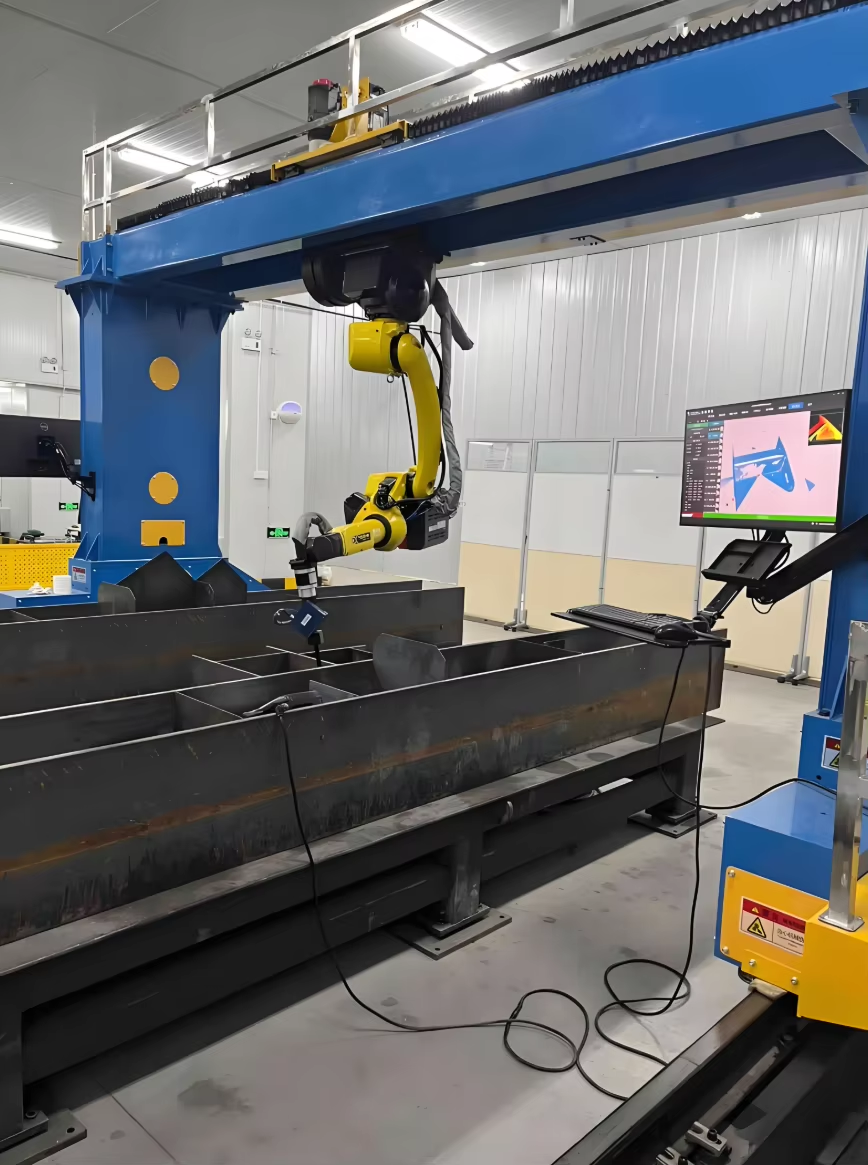
The crawler utilizes a four-wheel or continuous track drive system integrated with rare-earth neodymium magnets. This design generates sufficient pull-off force to support not only the weight of the crawler but also the umbilical cables (gas lines, wire conduits, and power leads). In wind tower fabrication, the curvature of the sections presents a challenge for flat-base crawlers; therefore, intelligent units employ an articulated chassis to maintain a constant air gap between the magnets and the surface, ensuring consistent traction.
On-Board Torch Oscillation and Sensing
To accommodate the tolerances in fit-up and bevel preparation, the crawler is equipped with a motorized cross-slide. Through through-arc sensing (TASE) or laser-based seam tracking, the system adjusts the torch position in real-time. This is critical for MAG welding where the stick-out distance directly influences current density and penetration. The crawler’s controller regulates travel speed in sync with the wire feed speed to maintain the programmed heat input (kJ/mm), which is a vital parameter for the metallurgical integrity of the S355 or S420 structural steels used in wind energy.
MAG Welding Process Optimization
Metal Active Gas (MAG) welding is preferred for crawler applications due to its high deposition rates and the ability to operate in all positions (1G, 2G, 3G). In wind tower applications, we typically utilize a shielding gas mixture of 80% Argon and 20% CO2 to balance penetration depth with spatter control.
Pulse and Double-Pulse Configurations
Intelligent power sources coupled with the crawler allow for pulsed MAG welding. This reduces the average heat input while maintaining peak current for deep penetration. For the industrial engineer, this means less thermal distortion of the tower sections, reducing the need for post-weld straightening. Double-pulse modes are frequently utilized for the cap pass to achieve a TIG-like aesthetic finish, which is often required by quality inspectors to minimize stress concentrators at the weld toe.
Wire Chemistry and Feed Consistency
The use of 1.2mm or 1.6mm solid wire or metal-cored wire is standard. Metal-cored wires are particularly effective in MAG welding automation because they offer higher deposition rates than solid wires at the same current levels and are more tolerant of mill scale or minor surface impurities. The crawler system must be paired with a high-torque wire feeder capable of pushing wire through 15-20 meter umbilical leads without buckling or inconsistent delivery.
Maintenance Protocols for Robotic Crawler Units
To ensure a high Return on Investment (ROI), the Mean Time Between Failures (MTBF) must be maximized. A preventative maintenance schedule is essential for the mobile welding unit.
Weekly Mechanical Inspection
The magnetic wheels must be inspected for the accumulation of metallic dust and spatter. Ferritic particles clinging to the magnets can score the tower surface or degrade traction. Drive chains and gears require lubrication with high-viscosity synthetic oils that do not attract slag.
Consumable Management
The contact tip is the most frequent failure point in automated MAG welding. Industrial engineers should implement a “scheduled replacement” policy—changing the tip every 4-6 hours of arc time rather than waiting for a failure. This prevents “burn-back” and wire wandering, which can cause the crawler to produce off-seam welds. Liners should be blown out with compressed air weekly and replaced monthly to ensure smooth wire feeding.
Economic Analysis and Labor ROI
The shift from manual welding to magnetic crawler welding represents a capital expenditure (CAPEX) that is usually recouped within 12 to 18 months through labor savings and throughput increases.
Reduction in Man-Hours
Manual welding of a 30-meter girth seam requires significant time for welder fatigue management, pauses for repositioning, and safety checks. A single operator can oversee two or three magnetic crawlers simultaneously. This “multi-machine tending” model reduces the direct labor cost per meter of weld by approximately 60%.
Quality and Rework Mitigation
In wind tower fabrication, the cost of repairing a weld defect (found via Ultrasonic Testing) is typically 10 times the cost of the initial weld. Robotic crawlers provide a 98% first-pass yield by eliminating human error related to travel speed fluctuations and hand tremors. By stabilizing the arc length and travel speed, the crawler ensures a uniform fusion zone.
Throughput Calculations
| Metric | Manual MAG | Robotic Crawler (MAG) |
|---|---|---|
| Duty Cycle (Arc-on time) | 30-35% | 75-85% |
| Travel Speed (avg) | 250 mm/min | 450-600 mm/min |
| Daily Output (m/shift) | 18-22m | 45-55m |
Operational Safety and Ergonomics
Beyond the direct financial metrics, the use of magnetic crawlers removes the welder from the immediate vicinity of the welding arc and the associated fumes. In wind tower sections, confined space entry is a major safety concern. By using a remote-controlled crawler, the operator remains at a distance, monitoring the process via a high-definition arc camera. This reduces the company’s liability and improves the long-term health of the workforce, leading to higher retention rates in a market where skilled welders are increasingly scarce.
Conclusion
The implementation of an Intelligent Robotic Welder with a magnetic crawler is a strategic necessity for modern wind tower production facilities. By focusing on the optimization of the MAG process, maintaining rigorous equipment uptime schedules, and leveraging the crawler’s ability to operate at high duty cycles, manufacturers can achieve superior weld quality while significantly lowering the cost per kilowatt-hour of the wind energy infrastructure they produce.
-


LT240S tube laser cutting machine
-
LT120S tube laser cutting machine
-
Sale

Tank Fillet Welding Machine
Original price was: $1,000.00.$900.00Current price is: $900.00. -
Sale

MAK100 tube laser cutting machine
Original price was: $5,500.00.$5,000.00Current price is: $5,000.00. -

portable plasma air cutting machine
$1,200.00 -

2in1 fiber laser cutting machine
-

Air cooling Laser welding machine
-

HF h beam laser cutting machine
-

LT240 laser cutting machine
-

Laser welding machine
-


Cobot Welding Station
-

Gantry welding robot solution
-

Tracked Wheeled AGV Welding robot
-

LFH6020 Fiber laser cutting machine
-
LFP6020
-

robotic welidng machine
Advanced Fiber Laser Tube Processing Technology
Our CNC Fiber Laser Tube Cutting systems revolutionize metal fabrication by integrating high-precision cutting, punching, and profiling into a single automated workflow. Designed for versatility, this technology handles a wide array of profiles including Round, Square, Rectangular, and Oval tubes, as well as complex L-shaped and U-shaped channels.
- Precision Punching: High-speed hole punching with micron-level accuracy, eliminating the need for mechanical drilling or die-stamping.
- Complex Profiling: Advanced 3D pathing allows for intricate interlocking joints and specialized notch cuts, ideal for structural frames.
- High Material Efficiency: Intelligent nesting software minimizes scrap, reducing raw material costs across large production runs.
- Clean Finish: Delivers oxide-free, burr-free edges that require zero secondary grinding before welding.

Seamlessly processing multiple profiles with consistent precision.
Global Delivery & Logistics



From our high-tech manufacturing facility directly to your global site. PCL WeldCut ensures secure packaging, professional handling, and reliable international logistics to safeguard your equipment throughout the entire journey.