Technical Implementation of Robotic MAG Welding in Wind Tower Manufacturing
The global demand for renewable energy infrastructure has placed unprecedented pressure on Wind Tower Fabrication facilities to increase throughput while maintaining stringent structural standards. The fabrication of wind tower sections involves joining massive steel plates, often ranging from 20mm to 60mm in thickness. Traditional manual or semi-automated processes often fail to meet the required consistency and speed. The transition to intelligent robotic units equipped with high-amperage MAG welding (Metal Active Gas) power sources represents a critical shift in industrial engineering strategy for this sector.
Robotic MAG welding offers a significant advantage over traditional submerged arc welding (SAW) in specific tower applications, particularly for circumferential seams and internal attachments where maneuverability and visibility are paramount. By utilizing a robotic arm with a high degree of freedom, manufacturers can achieve precise torch angles and travel speeds that are humanly impossible to maintain over long-duration shifts. The intelligence of the system is derived from the integration of the controller with advanced sensing technology, ensuring that the weld bead profile remains consistent despite the inherent variances in large-scale steel fit-ups.
Advanced Laser Seam Tracking and Real-Time Path Correction
In the context of wind tower sections, geometric deviations are common. Large diameter cans often exhibit slight ovality or edge misalignment after rolling. Laser Seam Tracking is the technological enabler that allows the robot to compensate for these variances in real-time. Unlike “touch-sensing” methods that require a pause in the welding cycle, laser-based triangulation sensors scan the joint several millimeters ahead of the arc. This data is processed by the robot controller to adjust the torch position in the X, Y, and Z axes instantaneously.
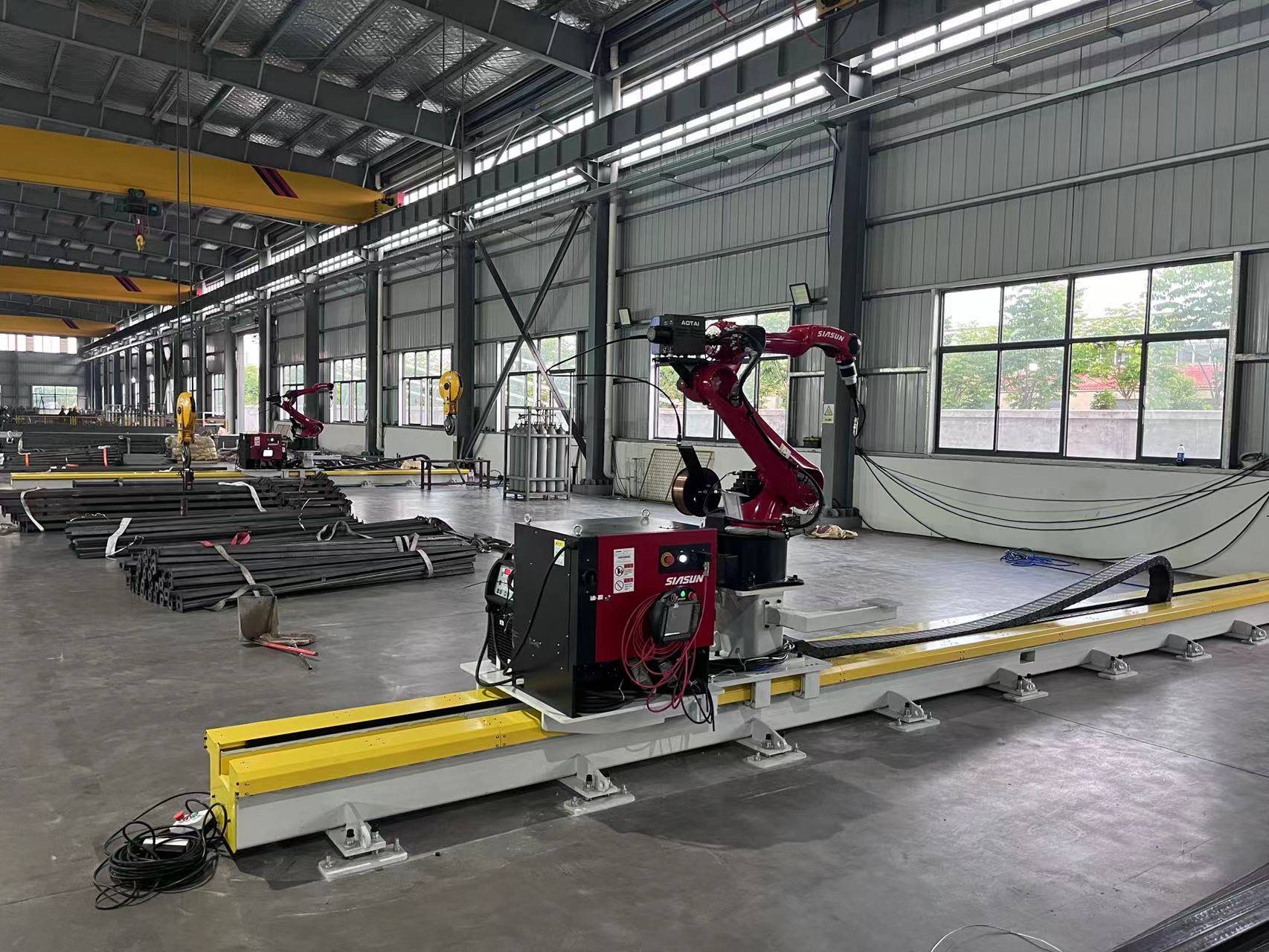
The sensor projects a laser line across the joint, capturing the profile of the groove. This allows the system to calculate the exact center of the seam and the volume of the gap. For wind towers, where multi-pass welding is mandatory, the system can adjust the oscillation width and travel speed to ensure full fusion and adequate reinforcement. This level of adaptive control eliminates the need for manual intervention, effectively bridging the gap between theoretical CAD programming and the reality of workshop floor tolerances.
Optimizing Deposition Rates and Thermal Management
From an industrial engineering perspective, the primary goal of robotic integration is the maximization of the arc-on time. In manual operations, a welder may spend only 30 percent of their shift actually depositing metal. A robotic cell can push this figure above 75 percent. To achieve this, the system must utilize high-performance water-cooled torches capable of handling 500+ amperes at a 100 percent duty cycle. The MAG welding process, using argon-CO2 shielding gas blends, provides the deep penetration necessary for the structural integrity of the tower base sections.
Thermal management is a critical sub-system. Continuous high-heat input can lead to torch deformation or sensor failure. Intelligent robotic cells incorporate closed-loop cooling systems that monitor coolant flow and temperature. Furthermore, the software calculates inter-pass temperatures to ensure the metallurgical properties of the high-tensile steel are not compromised. By controlling the heat input precisely, the robot minimizes the heat-affected zone (HAZ), thereby reducing the risk of hydrogen-induced cracking—a common failure point in large-scale wind energy components.
Maintenance Protocols for High-Availability Robotic Cells
Maintaining a robotic welding system in a heavy industrial environment requires a shift from reactive to preventive and predictive maintenance. The abrasive nature of welding fumes and the intensity of the UV radiation produced during the MAG process necessitate robust protection for the robotic arm and its peripherals. Heavy-duty “suits” or heat-resistant covers are standard for the arm, but the internal components require scheduled technical audits.
Contact tip replacement is the most frequent maintenance task. In high-volume wind tower production, automated torch cleaning stations (reamers) are integrated into the cell. Every few cycles, the robot moves to the station where a mechanical blade removes spatter from the gas nozzle, sprays anti-spatter fluid, and trims the wire to a precise “stick-out” length. This ensures consistent arc ignition. Beyond the torch, the wire delivery system—including the conduits and drive rolls—must be inspected weekly to prevent wire slippage or bird-nesting, which are the leading causes of unscheduled downtime.
Calculating Labor ROI and Economic Impact
The financial justification for robotic welding in wind tower production is rooted in labor ROI. The skilled welder shortage has driven up labor costs while reducing the availability of operators capable of performing high-quality welds over 10-hour shifts. A single robotic welding cell can typically replace three to four manual welding stations in terms of output volume. However, the ROI calculation must also include the reduction in non-conformance costs.
Manual welding on thick plates often results in a 3-5 percent defect rate, requiring expensive carbon-arc gouging and re-welding. A robotic system with laser tracking reduces this rate to less than 0.5 percent. When factoring in the cost of filler metal, shielding gas, and the energy consumption per kilogram of deposited metal, the robotic system demonstrates a lower cost-per-meter of weld. Typically, a wind tower manufacturer can expect a full return on investment within 18 to 24 months, depending on the number of shifts operated and the local labor market conditions. The transition also shifts the labor force from manual “torch-in-hand” tasks to higher-value roles such as robotic technicians and weld programmers, improving overall facility morale and safety.
Conclusion of System Integration
The integration of intelligent robotic MAG welding represents the pinnacle of modern Wind Tower Fabrication. By removing the variability of human performance and replacing it with the precision of laser-guided automation, manufacturers achieve a level of consistency that is required for the 25-year service life of offshore and onshore turbines. Industrial engineers must continue to focus on the synergy between sensing hardware, robust welding power sources, and rigorous maintenance schedules to ensure these systems provide the necessary competitive edge in an increasingly demanding energy market.
-


LT240S tube laser cutting machine
-
LT120S tube laser cutting machine
-
Sale

Tank Fillet Welding Machine
Original price was: $1,000.00.$900.00Current price is: $900.00. -
Sale

MAK100 tube laser cutting machine
Original price was: $5,500.00.$5,000.00Current price is: $5,000.00. -

portable plasma air cutting machine
$1,200.00 -

2in1 fiber laser cutting machine
-

Air cooling Laser welding machine
-

HF h beam laser cutting machine
-

LT240 laser cutting machine
-

Laser welding machine
-


Cobot Welding Station
-

Gantry welding robot solution
-

Tracked Wheeled AGV Welding robot
-

LFH6020 Fiber laser cutting machine
-
LFP6020
-

robotic welidng machine
Advanced Fiber Laser Tube Processing Technology
Our CNC Fiber Laser Tube Cutting systems revolutionize metal fabrication by integrating high-precision cutting, punching, and profiling into a single automated workflow. Designed for versatility, this technology handles a wide array of profiles including Round, Square, Rectangular, and Oval tubes, as well as complex L-shaped and U-shaped channels.
- Precision Punching: High-speed hole punching with micron-level accuracy, eliminating the need for mechanical drilling or die-stamping.
- Complex Profiling: Advanced 3D pathing allows for intricate interlocking joints and specialized notch cuts, ideal for structural frames.
- High Material Efficiency: Intelligent nesting software minimizes scrap, reducing raw material costs across large production runs.
- Clean Finish: Delivers oxide-free, burr-free edges that require zero secondary grinding before welding.

Seamlessly processing multiple profiles with consistent precision.
Global Delivery & Logistics



From our high-tech manufacturing facility directly to your global site. PCL WeldCut ensures secure packaging, professional handling, and reliable international logistics to safeguard your equipment throughout the entire journey.