Optimizing Shipbuilding Throughput with Adaptive MAG Welding Systems
Shipbuilding remains one of the most demanding environments for structural steel fabrication. The scale of blocks and panels, combined with the inherent variations in heavy plate fit-up, necessitates a welding solution that transcends fixed-path automation. The integration of an Intelligent Robotic Welder utilizing Metal Active Gas (MAG) processes provides the necessary deposition rates for massive hull sections while maintaining the precision required for stringent maritime certifications. Unlike traditional manual operations, these systems leverage advanced sensors to manage the complexities of long-seam welding and multi-pass fillets.
The core challenge in maritime welding is the inconsistency of the weld joint. Thermal distortion, plate undulations, and tack-weld interference create a dynamic environment where a static robot program would fail. To counter this, the adoption of Arc Voltage Control (AVC) is critical. AVC allows the robotic system to measure the electrical characteristics of the arc in real-time and adjust the Z-axis (torch height) to maintain a constant arc length. This adaptive capability ensures consistent penetration and bead morphology, even when the base material deviates from the theoretical CAD model.
The Mechanics of Arc Voltage Control in Heavy Plate Fabrication
In the MAG welding process, the distance between the contact tip and the workpiece—often referred to as the contact-to-work distance (CTWD)—directly affects the current and heat input. In shipbuilding, where plates can be 20mm to 50mm thick, maintaining a stable CTWD is paramount for preventing defects such as undercut or lack of fusion. AVC functions as a closed-loop feedback mechanism. As the robot traverses a seam, the system monitors the voltage. If the plate rises, the voltage drops; the controller immediately corrects the torch position upward to restore the setpoint voltage.
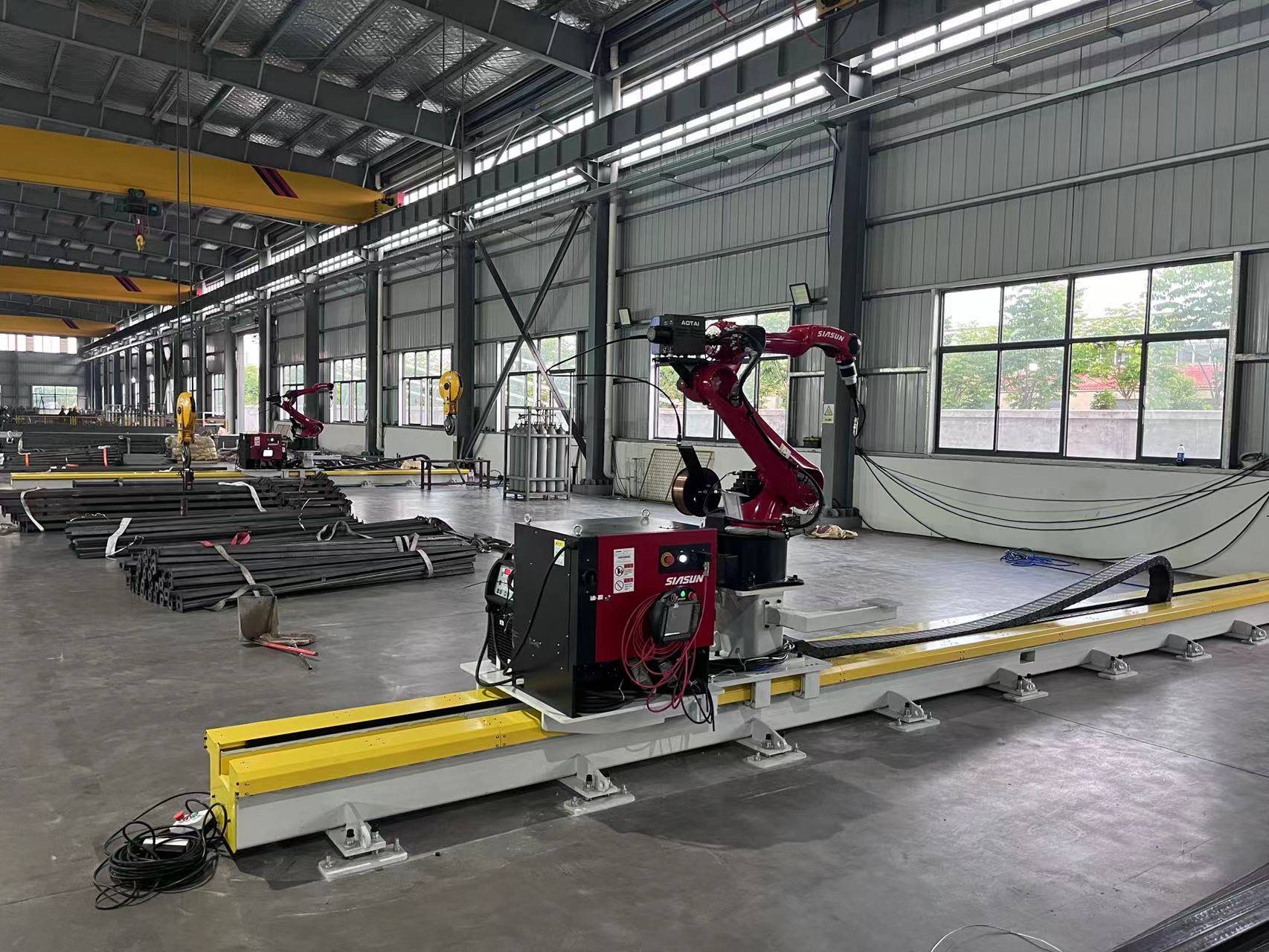
This level of intelligence eliminates the need for manual “touch-sensing” at every interval, which significantly reduces non-value-added time. Furthermore, when combined with “Through-the-Arc” seam tracking, the robot can compensate for both vertical deviations via AVC and lateral deviations by monitoring current fluctuations. For shipyard engineers, this translates to a reduction in rework and a standardized Heat Affected Zone (HAZ) across the entire length of the bulkhead or deck plate.
Quantifying Labor ROI and Production Scalability
The economic justification for robotic MAG systems in shipyards is primarily driven by the Labor ROI. The maritime industry faces a global shortage of certified high-skill welders capable of maintaining consistent quality over 10-meter or 20-meter seams. A robotic system does not suffer from fatigue, which is a critical factor in the 6G or 3G positions often required in block assembly. An industrial engineer must look at the “Duty Cycle” as the primary metric. While a manual welder might achieve a 20-30% arc-on time due to repositioning and breaks, a robotic cell can easily exceed 70-80%.
When calculating ROI, the following factors must be integrated into the model:
- Deposition Rate: Robotic MAG systems can utilize higher wire feed speeds and larger diameter wires (1.2mm to 1.6mm) without compromising bead appearance.
- Rework Mitigation: The cost of grinding out a defective weld in a confined double-bottom tank is ten times the cost of the initial weld. AVC reduces these occurrences to near zero.
- Consumable Efficiency: Precise control over the arc reduces spatter, leading to 5-10% less wire waste and reduced gas consumption through optimized shielding gas delivery.
By automating the repetitive, high-volume welds of the hull and internal stiffeners, shipyards can reallocate their skilled human capital to complex pipe fitting or outfitting tasks that require human dexterity. This strategic labor allocation accelerates the overall vessel delivery schedule.
Maintenance Protocols for High-Availability Robotic Cells
To realize the projected ROI, the MAG welding process must be supported by a rigorous preventive maintenance schedule. Robotic welders in shipyards operate in environments filled with conductive dust, humidity, and temperature swings. The maintenance strategy should be divided into three technical tiers: the delivery system, the torch geometry, and the electrical feedback loops.
Wire Delivery and Liner Integrity
The stability of the arc starts with the wire feeder. Any friction in the liner or the conduit will cause wire “hunting,” which the AVC might incorrectly interpret as a voltage fluctuation. Maintenance teams must replace liners at fixed intervals based on the quantity of wire consumed (e.g., every 500kg of wire). Utilizing high-quality, chrome-plated drive rolls prevents the shaving of the wire, which otherwise clogs the contact tip and causes erratic arc behavior.
Torch Calibration and Consumables
The Tool Center Point (TCP) is the digital reference for the entire welding operation. In shipbuilding, where the robot might navigate tight angles between stiffeners, torch collisions—however minor—can shift the TCP. Automated TCP calibration stations should be utilized at the start of every shift. Furthermore, the use of high-performance contact tips (such as silver-plated or zirconium-copper) is recommended to maintain electrical conductivity over long durations of continuous arc-on time.
AVC Sensor and Controller Maintenance
The “intelligence” of the system relies on the accuracy of the voltage sensing leads. In a shipyard, these leads are often subject to mechanical wear and electromagnetic interference (EMI). Regular inspection of the grounding clamps and the sensing cables is vital. Poor grounding is the most common cause of “arc hunting,” where the AVC reacts to electrical noise rather than actual changes in the arc gap. Ensuring a low-resistance return path to the power source is a fundamental engineering requirement for adaptive welding.
Integration with Digital Shipyard Workflows
Modern Robotic Welding units are no longer isolated machines; they are data nodes within the shipyard’s Industrial Internet of Things (IIoT) framework. Every weld performed with AVC generates data: average voltage, current, wire feed speed, and travel speed. This data is invaluable for Quality Assurance (QA). Instead of performing X-ray or ultrasonic testing on 100% of a seam, engineers can use the digital weld logs to identify specific segments where the AVC parameters deviated from the Welding Procedure Specification (WPS). This “targeted inspection” approach further reduces bottlenecks in the production line.
The transition to intelligent MAG welding is an engineering necessity for shipyards aiming to compete on a global scale. By leveraging Arc Voltage Control, firms can overcome the physical challenges of large-scale fabrication, ensuring that the structural integrity of the vessel is matched by the efficiency of the production process. The combination of high deposition rates, reduced labor dependency, and data-driven maintenance ensures a sustainable path toward automated maritime manufacturing.
-


LT240S tube laser cutting machine
-
LT120S tube laser cutting machine
-
Sale

Tank Fillet Welding Machine
Original price was: $1,000.00.$900.00Current price is: $900.00. -
Sale

MAK100 tube laser cutting machine
Original price was: $5,500.00.$5,000.00Current price is: $5,000.00. -

portable plasma air cutting machine
$1,200.00 -

2in1 fiber laser cutting machine
-

Air cooling Laser welding machine
-

HF h beam laser cutting machine
-

LT240 laser cutting machine
-

Laser welding machine
-


Cobot Welding Station
-

Gantry welding robot solution
-

Tracked Wheeled AGV Welding robot
-

LFH6020 Fiber laser cutting machine
-
LFP6020
-

robotic welidng machine
Advanced Fiber Laser Tube Processing Technology
Our CNC Fiber Laser Tube Cutting systems revolutionize metal fabrication by integrating high-precision cutting, punching, and profiling into a single automated workflow. Designed for versatility, this technology handles a wide array of profiles including Round, Square, Rectangular, and Oval tubes, as well as complex L-shaped and U-shaped channels.
- Precision Punching: High-speed hole punching with micron-level accuracy, eliminating the need for mechanical drilling or die-stamping.
- Complex Profiling: Advanced 3D pathing allows for intricate interlocking joints and specialized notch cuts, ideal for structural frames.
- High Material Efficiency: Intelligent nesting software minimizes scrap, reducing raw material costs across large production runs.
- Clean Finish: Delivers oxide-free, burr-free edges that require zero secondary grinding before welding.

Seamlessly processing multiple profiles with consistent precision.
Global Delivery & Logistics



From our high-tech manufacturing facility directly to your global site. PCL WeldCut ensures secure packaging, professional handling, and reliable international logistics to safeguard your equipment throughout the entire journey.