Intelligent Robotic Welder with 3D Vision positioning for Construction Machinery

In this article
- Advanced MAG Welding in Heavy Equipment Fabrication
- The Role of 3D Vision Positioning and Seam Tracking
- Adaptive Trajectory Planning
- Real-Time Correction
- Operational Maintenance and System Reliability
- Torch Consumable Management
- Wire Delivery and Liner Integrity
- Vision Sensor Calibration
- Quantifying Labor ROI and Economic Impact
- Throughput Comparison
- Reduction in Rework and Scrap
- Safety and Ergonomics
- Conclusion
Advanced MAG Welding in Heavy Equipment Fabrication
The manufacturing of Construction Machinery—including excavator frames, loader buckets, and crane booms—demands high-strength structural integrity and deep penetration. Traditionally, these components have relied on manual Metal Active Gas (MAG) welding. However, the sheer scale of these parts often introduces significant fit-up tolerances and thermal distortion, making consistent manual execution difficult. The transition to an Intelligent Robotic Welder represents a shift from reactive manual labor to proactive, data-driven fabrication.
Robotic MAG welding utilizes a continuous solid wire electrode and an active shielding gas, typically a mixture of Argon and CO2. In the context of heavy machinery, the robot must manage high current densities and prolonged arc-on times. Unlike manual operations where the welder adjusts the torch angle and travel speed based on visual feedback, a robotic system requires high-fidelity environmental data to maintain weld bead geometry and penetration depth. This is where 3D vision becomes the critical differentiator in system performance.
The Role of 3D Vision Positioning and Seam Tracking
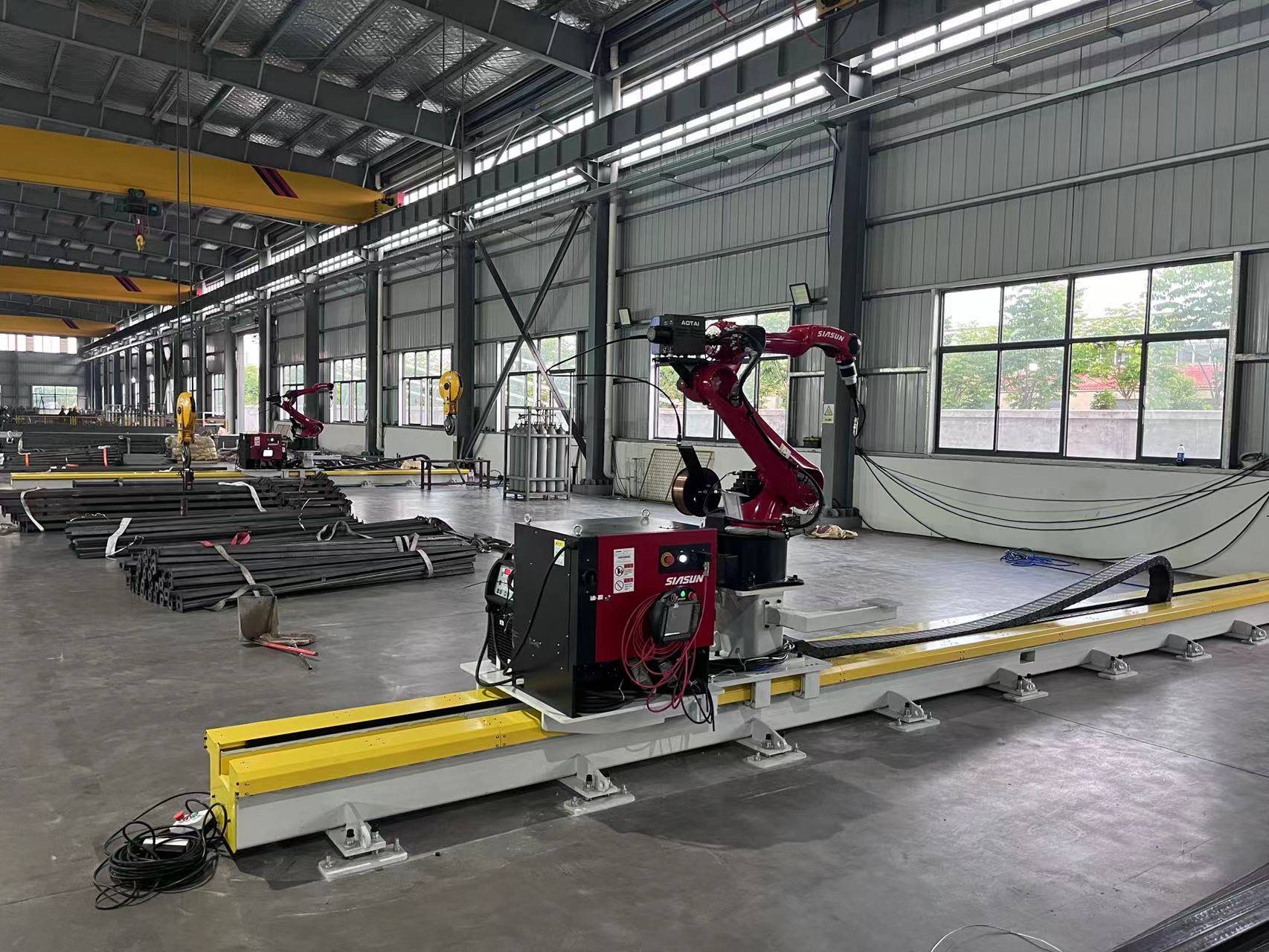
Standard robotic programs are often rigid, operating on the assumption that every workpiece is identical in geometry and placement. In the heavy machinery sector, however, large steel plates are subject to variations from upstream bending and tacking processes. 3D Vision positioning allows the robot to “see” and interpret the physical workspace. By utilizing structured light or stereo-vision sensors mounted on the robot arm, the system generates a high-resolution point cloud of the joint.
Adaptive Trajectory Planning
The vision system identifies the precise coordinates of the weld groove before the arc is struck. It compensates for deviations in the X, Y, and Z axes, ensuring the wire is always centered in the joint. Furthermore, intelligent systems can detect variations in the gap width. If a gap is wider than specified in the baseline program, the robot automatically adjusts its weaving parameters, travel speed, and wire feed rate to ensure the weld throat thickness meets structural engineering requirements.
Real-Time Correction
Thermal expansion is a significant factor when welding thick-walled sections of construction equipment. As the metal heats up, the joint can shift or “yawn.” Advanced 3D sensors provide real-time feedback, allowing the robot to adjust its path mid-weld. This level of precision eliminates the need for expensive, high-precision fixtures, as the robot can adapt to the “as-built” state of the workpiece rather than the “as-designed” CAD model.
Operational Maintenance and System Reliability
For an Intelligent Robotic Welder to provide maximum value, uptime must be prioritized through rigorous maintenance protocols. Robotic Welding is a high-duty cycle environment, often operating at 80% to 90% arc-on time, which places extreme stress on the torch consumables and delivery systems.
Torch Consumable Management
The contact tip and nozzle are the most vulnerable components in a MAG system. Spatter accumulation can disrupt gas flow, leading to porosity, while contact tip wear causes arc instability. Industrial engineers must implement automated torch cleaning stations (reamers). These stations mechanically clear spatter, apply anti-spatter fluid, and can even perform wire cutting to ensure a consistent stick-out length for every weld start.
Wire Delivery and Liner Integrity
In construction machinery plants, the wire is often fed from large bulk drums. Ensuring a smooth, friction-free path from the drum to the robot wrist is essential. Clogged liners or worn drive rolls can lead to “bird-nesting” or inconsistent wire feeding, which directly affects weld quality. Scheduled replacement of liners and the use of high-quality, copper-coated or non-coated wires are standard practices to mitigate these risks.
Vision Sensor Calibration
The 3D vision sensor itself requires periodic maintenance. Dust, smoke, and spatter are inherent to the MAG process. Protective covers and air-knives (compressed air blow-offs) are utilized to keep the sensor lenses clean. Routine calibration checks ensure that the spatial data provided by the sensor remains accurate relative to the robot’s tool center point (TCP).
Quantifying Labor ROI and Economic Impact
The primary driver for adopting robotic welding in construction machinery is the Labor ROI. The global manufacturing sector faces a critical shortage of certified welders capable of working on large-scale structural components.
Throughput Comparison
A manual welder typically maintains an arc-on time of 30% to 40% due to the need for breaks, repositioning, and helmet adjustments. A robot, conversely, can maintain arc-on times exceeding 85%. In a typical shift, a single robotic cell can often replace the output of three to four manual welding stations. This increase in throughput allows manufacturers to meet tight delivery schedules without expanding their footprint or headcount.
Reduction in Rework and Scrap
Human error in welding large structures often results in weld defects like undercut, lack of fusion, or over-welding (which wastes expensive filler metal). By using 3D vision to ensure perfect seam alignment and consistent heat input, the robotic system virtually eliminates rework. Given that the cost of repairing a defect in a heavy frame can be ten times the cost of the original weld, the savings in quality control are substantial.
Safety and Ergonomics
Welding large construction components often involves working in awkward positions, exposing humans to fumes and intense heat. Automating these tasks removes the operator from the hazardous environment, shifting their role to a “Cell Operator” or “Technician” who oversees multiple robots. This transition reduces long-term worker compensation claims and improves employee retention by upgrading the nature of the work.
Conclusion
The integration of an Intelligent Robotic Welder with 3D Vision positioning is no longer a luxury for manufacturers of Construction Machinery; it is a strategic necessity. By addressing the challenges of part variance through advanced sensing and ensuring system longevity through disciplined maintenance, companies can achieve a significant Labor ROI. The move toward automation in MAG welding not only stabilizes production costs but also elevates the structural quality of the machinery that builds our global infrastructure.






