Field Engineering Report: Deployment of High-Speed MAG All-in-one Cobot Station
Location: Krakow, Poland – Industrial District (Nowa Huta Sector)
Date: October 2023
1. Introduction and Site Context
The transition from traditional manual welding to automated systems in the Lesser Poland (Małopolska) region has been accelerated by the demand for higher throughput in the automotive and aerospace supply chains. This report documents the technical commissioning and field performance of the All-in-one Cobot Station at a mid-sized fabrication facility in Krakow. The primary objective was to integrate Collaborative Robotics into a high-speed Metal Active Gas (MAG) workflow, with a secondary specific focus on high-precision Titanium welding for specialized heat exchanger components.
Krakow’s industrial workshops often face a common constraint: floor space. Traditional industrial robots require extensive safety fencing and light curtains. The deployment of collaborative systems allowed us to maintain a footprint of less than 4 square meters while achieving travel speeds that rival fixed automation.
2. Technical Specification of the All-in-one Cobot Station
The All-in-one Cobot Station deployed features a 10kg payload arm integrated with a 400A pulse-capable power source. Unlike modular systems where the integrator must source the table, gas management, and software separately, this station arrived as a pre-calibrated unit. This “all-in-one” philosophy reduced our onsite commissioning time from the typical five days to just under twelve hours.
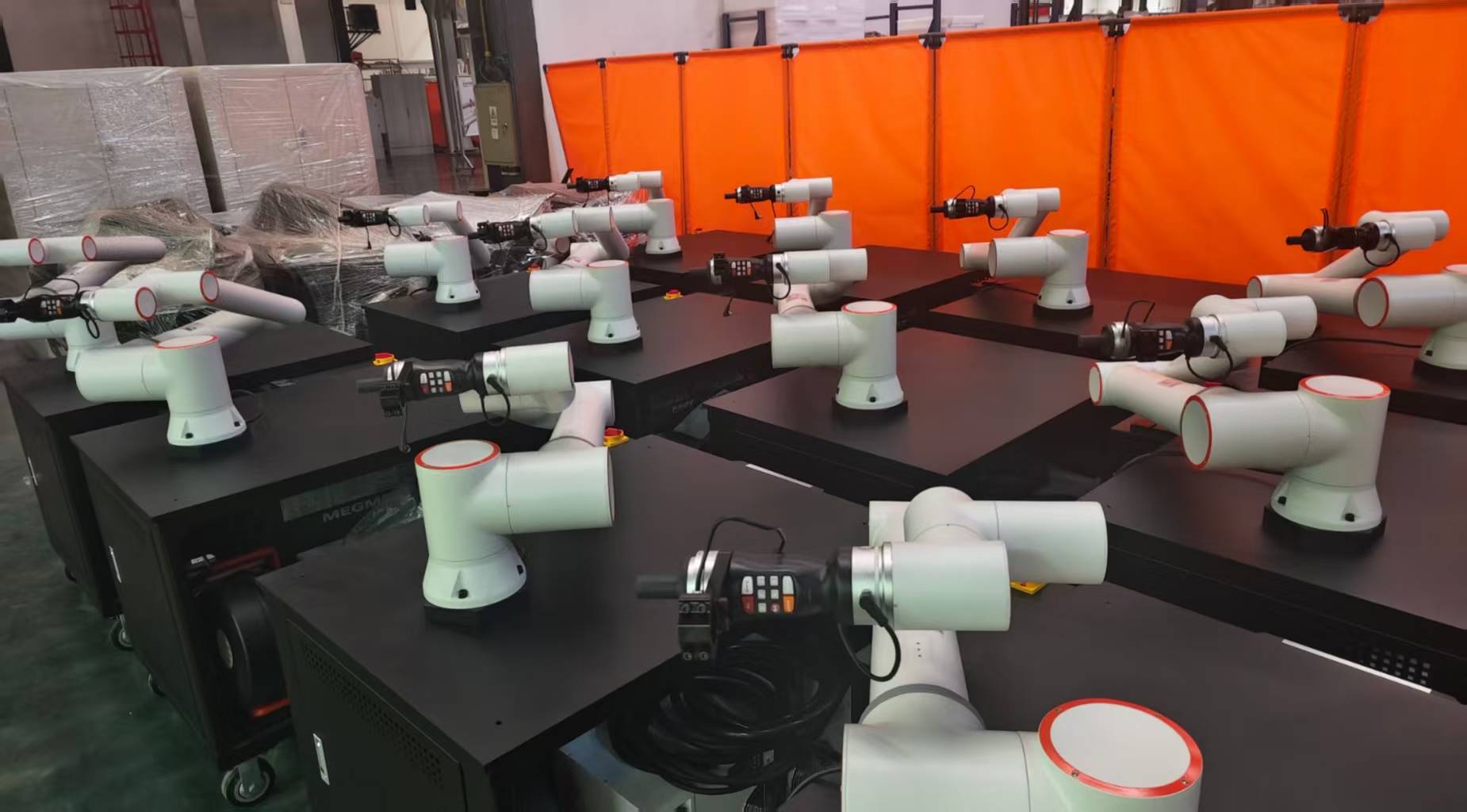
Key System Components:
- Integrated 6-axis collaborative arm with ±0.03mm repeatability.
- High-speed MAG torch with integrated extraction for Krakow’s strict environmental regulations.
- User-interface (HMI) localized in Polish, allowing manual welders to transition to “robot leads” without extensive C++ or Rapid programming knowledge.
3. The Synergy of Collaborative Robotics in a High-Speed MAG Environment
The core advantage of Collaborative Robotics in this Krakow facility is the “Hand-Guiding” teaching mode. In a high-speed MAG environment, the arc-on time is significantly higher than in manual operations. However, the bottleneck is usually the jigging and tacking. By using a collaborative system, the operator can stand adjacent to the robot, set the tacks, and then guide the robot’s TCP (Tool Center Point) to the start position without leaving the cell.
During the field test, we observed that the synergy between the All-in-one Cobot Station and the operator resulted in a 40% increase in duty cycle. The robot handles the long, monotonous seams at high travel speeds (80-120 cm/min), while the human operator manages the complex fit-ups. This “man-and-machine” proximity is only possible due to the torque sensors in the cobot joints that provide ISO 10218-1 compliant safety stops.
4. Titanium Welding: Precision and Gas Management Challenges
While the station was primarily tasked with carbon steel MAG, a critical project phase involved Titanium welding (specifically Grade 2 and Grade 5 alloys). Titanium’s high reactivity with oxygen at temperatures above 400°C makes automation a necessity rather than a luxury. Human fatigue often leads to inconsistent torch angles, which in titanium leads to atmospheric contamination and “straw-to-blue” discoloration, indicating weld embrittlement.
In our Krakow trials, we modified the All-in-one Cobot Station with a specialized trailing shield. The Collaborative Robotics platform allowed us to program precise “weave” patterns that are virtually impossible to maintain manually over a 1-meter seam. We utilized a pulsed-MAG process with high-purity Argon (99.999%). The station’s ability to maintain a constant 3mm stand-off distance was the deciding factor in achieving aerospace-grade results.
Lessons Learned in Titanium Application:
- Gas Post-Flow: We had to override the standard station settings to increase post-flow to 15 seconds to protect the cooling titanium crater.
- Thermal Input: High-speed MAG on titanium requires a delicate balance. The cobot’s ability to travel at exactly 65 cm/min with a 140A pulse setting prevented burn-through on 2mm sheets.
5. Practical Integration in the Krakow Workshop
One of the “unspoken” challenges in the Krakow industrial sector is the integration of new-age tech into legacy workshops. The All-in-one Cobot Station addressed this through its “plug-and-play” power requirements. We did not need to overhaul the shop’s electrical grid, as the station runs on standard 3-phase industrial power with internal voltage stabilization.
The Collaborative Robotics aspect also addressed a labor shortage. We trained two manual welders, who had no prior coding experience, to operate the station within one afternoon. Their “lessons learned” during the first week were focused on wire-feed consistency. They discovered that when running high-speed MAG, the conduit slack must be minimal to prevent the “hunting” effect in the arc—a technical nuance we corrected by repositioning the integrated wire feeder on top of the cobot’s fourth axis.
6. Engineering Analysis of High-Speed MAG Parameters
For the carbon steel production run, we pushed the station to its limits. We utilized a 1.2mm ER70S-6 wire with an 82% Ar / 18% CO2 mix.
Observed Data Points:
- Manual Travel Speed: 35-45 cm/min.
- Cobot Travel Speed: 95 cm/min (Average).
- Defect Rate: Reduced from 4.5% (manual) to 0.8% (automated).
- Titanium Pass Rate: 100% X-ray compliance on the first 50 units.
The All-in-one Cobot Station software allowed for “on-the-fly” parameter adjustment. If the operator noticed a slight undercut due to plate fit-up variation, they could use the tablet interface to adjust the voltage by 0.5V without stopping the cycle. This level of granular control is where Collaborative Robotics outshines traditional CNC welding lathes.
7. Safety and Compliance (European Standards)
Operating in Poland requires strict adherence to CE marking and ISO standards. The All-in-one Cobot Station was subjected to a rigorous risk assessment. Because we were using high-speed MAG, the “optical” hazard of the arc and the “respiratory” hazard of the fumes remained. Even though the robot is “collaborative” and won’t crush an operator, the welding process itself is hazardous. We installed mobile welding screens and integrated the station’s E-stop with the shop’s central extraction system. This holistic approach is essential for any senior engineer overseeing a transition to Collaborative Robotics.
8. Lessons Learned and Recommendations
After four weeks of operation in Krakow, the following conclusions were drawn:
A. Surface Preparation is Non-Negotiable
In manual welding, a welder can “compensate” for a bit of mill scale or oil. The All-in-one Cobot Station is less forgiving. For Titanium welding, we implemented a strict acetone-wipe and stainless-steel brushing protocol. If the material isn’t pristine, the high-speed arc will destabilize, leading to porosity that the cobot cannot “see” or fix in real-time.
B. Wire Tensioning
We found that at high speeds, the inertia of the wire spool could cause over-run during the cobot’s rapid air-moves. Adjusting the brake tension on the integrated feeder within the All-in-one Cobot Station was critical to preventing bird-nesting at the drive rolls.
C. Tooling Rigidity
Collaborative robots are more sensitive to vibration than their heavy-duty counterparts. We had to reinforce the aluminum jigs used for the titanium components. Any slight oscillation at the end-of-arm tool was magnified during high-speed MAG passes, resulting in a “zipper” pattern in the weld bead.
9. Conclusion
The deployment in Krakow proves that an All-in-one Cobot Station is the most viable path for modernizing European fabrication shops. The synergy between the precision required for Titanium welding and the flexibility of Collaborative Robotics creates a competitive advantage that manual labor alone cannot match. For senior engineers, the “all-in-one” aspect is the key to minimizing downtime during the transition to Industry 4.0. The Krakow site is now functioning as a regional benchmark for high-speed automated MAG applications.
-


Cantilever Welding Robot solution
-


GF laser cutting machine
-

P3015 plasma cutting machine
-

LFP3015 Fiber Laser Cutter
-

pipe plasma cutting machine
-
LFH 4020 Fiber Laser Cutting Machine
-
LFP4020
-

gantry plasma air cutting machine
-

3D robot cutting machine
-

8 axis plasma cutting machine
-

5 axis plasma cutting machine
-

LT360 tube laser cutting machine
-

robot welding workstation
-

SF6060 fiber laser cutting machine
Advanced Fiber Laser Tube Processing Technology
Our CNC Fiber Laser Tube Cutting systems revolutionize metal fabrication by integrating high-precision cutting, punching, and profiling into a single automated workflow. Designed for versatility, this technology handles a wide array of profiles including Round, Square, Rectangular, and Oval tubes, as well as complex L-shaped and U-shaped channels.
- Precision Punching: High-speed hole punching with micron-level accuracy, eliminating the need for mechanical drilling or die-stamping.
- Complex Profiling: Advanced 3D pathing allows for intricate interlocking joints and specialized notch cuts, ideal for structural frames.
- High Material Efficiency: Intelligent nesting software minimizes scrap, reducing raw material costs across large production runs.
- Clean Finish: Delivers oxide-free, burr-free edges that require zero secondary grinding before welding.

Seamlessly processing multiple profiles with consistent precision.
Global Delivery & Logistics



From our high-tech manufacturing facility directly to your global site. PCL WeldCut ensures secure packaging, professional handling, and reliable international logistics to safeguard your equipment throughout the entire journey.