Optimizing H-Beam Fabrication Through Robotic Plasma Integration
The structural steel industry is undergoing a fundamental shift toward automated processing to counteract rising labor costs and the demand for tighter tolerances. In the context of H-beam production, the transition from manual layout and mechanical drilling to automated Plasma Cutting systems represents a significant leap in throughput. Industrial engineers focus on the synergy between hardware capability and software intelligence to minimize the cost per ton of fabricated steel. By utilizing multi-axis robotic arms equipped with high-definition plasma torches, facilities can process complex geometries—including bolt holes, copes, and notches—in a single pass.
The efficiency of a modern production line is measured by its “arc-on” time. Traditional methods often see machinery sitting idle while operators manually input coordinates or adjust settings. To solve this, the industry has adopted sophisticated workflows that prioritize continuous motion and high-speed thermal cutting. This approach is particularly effective for H-beams, where the depth of the section and the thickness of the flanges require a robust energy source capable of maintaining a consistent kerf width across varying material densities.
The Role of Offline Programming in Throughput Maximization
Offline Programming (OLP) is the cornerstone of modern structural automation. It allows engineers to generate cutting paths and robotic trajectories in a simulated environment using 3D CAD/CAM data. In an industrial H-beam line, the machine should never stop for programming. OLP software takes the Tekla or SDS/2 files directly, identifies every cut required on the beam, and performs collision detection before the code ever reaches the shop floor.
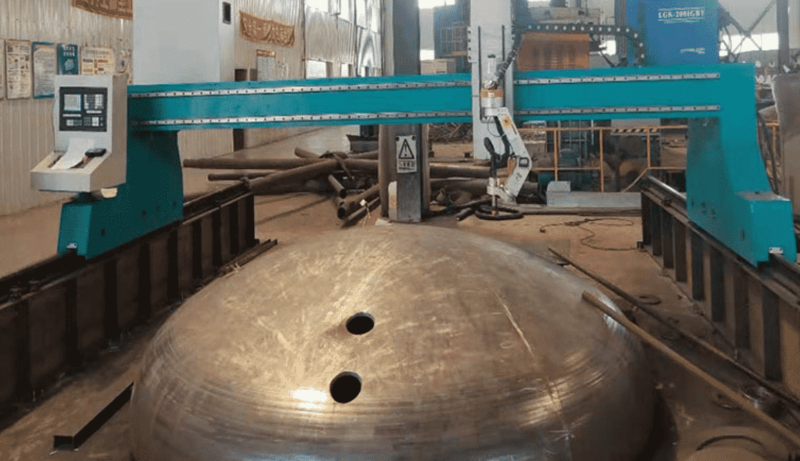
From an engineering standpoint, OLP eliminates the “teach pendant” bottleneck. Instead of moving the robot manually to points in space, the software calculates the optimal toolpath, accounting for the beam’s dimensions and any detected deviations. This predictive modeling ensures that the plasma torch maintains the correct standoff distance and angle, which is critical for preserving the integrity of the cut. Furthermore, OLP enables the nesting of multiple parts and the sequencing of cuts to manage heat distribution, preventing the thermal warping that often plagues heavy section processing.
Achieving Precise Intersection Accuracy
One of the most challenging aspects of structural steel fabrication is the intersection of members. Whether it is a beam-to-column connection or a complex bracing node, the Intersection Accuracy must be nearly perfect to ensure structural integrity and ease of assembly on-site. Plasma systems, when driven by high-precision servo motors and synchronized with 3D scanning sensors, can achieve tolerances that were previously impossible in heavy industry.
Before the cutting sequence begins, automated lines often utilize probing or laser measurement systems to “locate” the actual beam in 3D space. Since hot-rolled H-beams frequently have mill tolerances involving slight twists or flange variations, the software compensates for these discrepancies in real-time. The result is a cut that aligns perfectly with the mating part, even if the raw material isn’t perfectly straight. This level of precision significantly reduces the need for “re-work” or manual grinding during the assembly phase, directly impacting the bottom line of the project.
Advanced Beveling for Structural Connections
In heavy steel construction, beveling is essential for achieving Complete Joint Penetration (CJP) welds. Traditional beveling is a labor-intensive process involving hand-held grinders or track torches. A multi-axis robotic plasma station integrates this step directly into the cutting cycle. The robotic arm can tilt the plasma torch to create V, Y, X, and K-shaped bevels on both the flanges and the web of the H-beam.
The technical advantage here is the consistency of the bevel angle and the land thickness. Because the plasma power source adjusts its parameters—such as gas pressure and voltage—based on the angle of the cut, the quality of the beveled edge remains uniform. This preparation is vital for automated welding processes that may follow later in the production chain, as consistent fit-up geometry is a prerequisite for high-quality weld deposition.
Maintenance Efficiency and Industrial Reliability
Industrial engineers prioritize equipment with high uptime and Low Maintenance requirements. Plasma cutting systems are inherently rugged and designed for the harsh environments of steel mills and fabrication shops. Unlike more sensitive optical cutting technologies, plasma is resilient against the dust, smoke, and vibrations common in heavy fabrication. The primary maintenance tasks are localized to the torch consumables—nozzles, electrodes, and swirl rings—which can be replaced in minutes without specialized tools.
Modern plasma power supplies also feature self-diagnostic capabilities. They monitor coolant flow, gas pressures, and electrical arc stability, alerting operators to potential issues before they cause a failure. In an H-Beam Production Line, the mechanical components—such as the rack-and-pinion drives and the heavy-duty conveyor systems—are designed for high duty cycles. By choosing plasma, fabricators benefit from a system that can run multiple shifts per day with minimal intervention, ensuring that the facility meets its production quotas without unexpected downtime.
Reducing the Environmental and Operational Footprint
Automation in H-beam processing also extends to fume extraction and dross management. High-capacity dust collection systems are integrated into the cutting zones, capturing particulates at the source. This creates a cleaner work environment and reduces the wear and tear on surrounding machinery. Additionally, because the plasma process is highly concentrated, the heat-affected zone (HAZ) is minimized compared to oxy-fuel cutting. This preservation of material properties is essential for high-strength structural applications where metallurgical integrity is non-negotiable.
Engineering the Future of Steel Fabrication
The integration of Structural Steel Fabrication software with robotic hardware defines the next generation of industrial productivity. By focusing on the mechanical advantages of plasma—its speed in thick sections, its ability to bevel on the fly, and its low cost of operation—engineers can design production lines that are both flexible and incredibly fast. The removal of manual layout tasks through offline programming not only increases safety by keeping workers away from heavy material handling but also ensures a digital thread of quality from the design office to the final erected structure.
Ultimately, the goal of any H-beam production line is to deliver components that are ready for immediate assembly. By leveraging intersection accuracy and automated beveling, the plasma-based line achieves this with higher repeatability than any manual crew. As projects become more complex and timelines shorten, the reliance on these automated systems will only increase, making the choice of cutting technology and programming strategy a critical decision for any forward-thinking industrial facility.
-


LT240S tube laser cutting machine
-
LT120S tube laser cutting machine
-
Sale

Tank Fillet Welding Machine
Original price was: $1,000.00.$900.00Current price is: $900.00. -
Sale

MAK100 tube laser cutting machine
Original price was: $5,500.00.$5,000.00Current price is: $5,000.00. -

portable plasma air cutting machine
$1,200.00 -

2in1 fiber laser cutting machine
-

Air cooling Laser welding machine
-

HF h beam laser cutting machine
-

LT240 laser cutting machine
-

Laser welding machine
-


Cobot Welding Station
-

Gantry welding robot solution
-

Tracked Wheeled AGV Welding robot
-

LFH6020 Fiber laser cutting machine
-
LFP6020
-

robotic welidng machine
Advanced Fiber Laser Tube Processing Technology
Our CNC Fiber Laser Tube Cutting systems revolutionize metal fabrication by integrating high-precision cutting, punching, and profiling into a single automated workflow. Designed for versatility, this technology handles a wide array of profiles including Round, Square, Rectangular, and Oval tubes, as well as complex L-shaped and U-shaped channels.
- Precision Punching: High-speed hole punching with micron-level accuracy, eliminating the need for mechanical drilling or die-stamping.
- Complex Profiling: Advanced 3D pathing allows for intricate interlocking joints and specialized notch cuts, ideal for structural frames.
- High Material Efficiency: Intelligent nesting software minimizes scrap, reducing raw material costs across large production runs.
- Clean Finish: Delivers oxide-free, burr-free edges that require zero secondary grinding before welding.

Seamlessly processing multiple profiles with consistent precision.
Global Delivery & Logistics



From our high-tech manufacturing facility directly to your global site. PCL WeldCut ensures secure packaging, professional handling, and reliable international logistics to safeguard your equipment throughout the entire journey.