Optimizing H-Beam Fabrication for LNG Infrastructure
The construction of Liquefied Natural Gas (LNG) processing facilities and storage terminals demands structural steel components of unparalleled precision. As these projects often involve complex modular assemblies, the H-Beam Production Line must evolve beyond traditional manual layout and mechanical sawing. In the current industrial landscape, the synergy between Plasma Cutting technology and sophisticated offline programming (OLP) represents the standard for achieving the required throughput without compromising structural integrity.
The Role of Offline Programming in Complex Structural Geometry
Offline programming serves as the digital backbone of a modern H-beam production line. Unlike traditional teaching methods where the machine is idle during the programming phase, OLP allows engineers to generate cutting paths directly from Building Information Modeling (BIM) data, such as Tekla or SDS/2 files. This process ensures that the plasma torch trajectory is calculated in a virtual environment, accounting for the specific dimensions of the H-beam, including flange thickness variations and web offsets.
for LNG Projects, where hundreds of unique beam configurations are common, OLP eliminates the margin for human error in layout. The software automatically identifies intersections, bolt holes, and coping requirements. By simulating the cutting process before the first arc is struck, industrial engineers can identify potential collisions or unreachable geometries, ensuring that the physical machine operates at peak intersection accuracy.
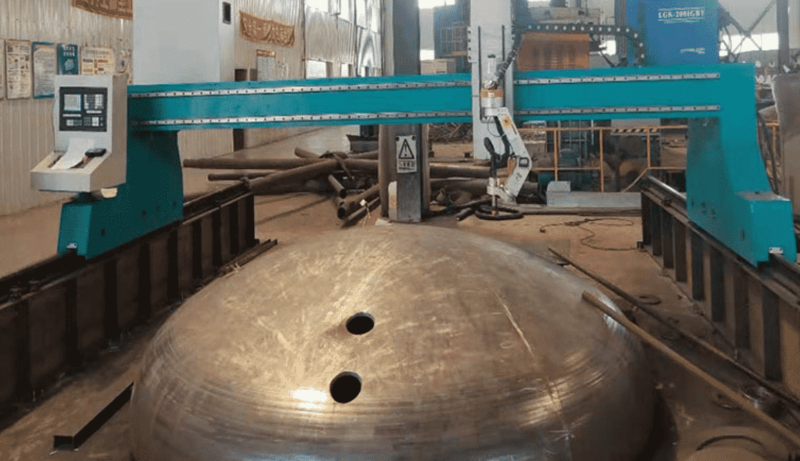
Achieving Precision in Intersection Accuracy
In LNG modular construction, beams must fit together with minimal gap tolerances to ensure structural stability under cryogenic loads and seismic stresses. Intersection accuracy refers to the precision of copes, blocks, and miter cuts where one structural member meets another. Plasma cutting systems equipped with multi-axis robotic arms or rotating torch heads provide the degrees of freedom necessary to execute these complex cuts.
Modern plasma systems utilize advanced sensing technology to detect the actual position of the H-beam on the conveyor. Since raw structural steel often possesses slight deviations in straightness or flange parallelism, the system adjusts the cutting path in real-time based on the OLP data. This compensates for material inconsistencies, ensuring that every notch and hole is positioned relative to the beam’s actual center line rather than a theoretical model. This level of precision is critical for the rapid assembly of pipe racks and support structures common in LNG plants.
Thermal Management and Kerf Compensation
Industrial engineers must account for the thermal dynamics of plasma cutting. High-definition plasma systems use precise gas flow control to constrict the arc, resulting in a narrower kerf and a smaller heat-affected zone (HAZ). Through OLP, engineers apply kerf compensation values that are specific to the material thickness and gas mixture being used. This ensures that the final dimensions of the cutouts remain within the tight tolerances mandated by international structural codes.
Advanced Beveling for High-Strength Joints
Beveling is a non-negotiable requirement for heavy-wall H-beams used in LNG projects. These projects involve thick-gauge steel that requires full penetration or partial penetration joints to handle massive static and dynamic loads. Utilizing a multi-axis plasma head allows for the integration of beveling for structural welds directly into the primary cutting cycle.
Instead of secondary processes involving manual grinding or dedicated beveling machines, the plasma torch can tilt to create V, Y, X, or K-shaped bevels on both the flanges and the web. The OLP software calculates the necessary tilt angles and torch offsets to maintain the correct land thickness and bevel angle. This integrated approach not only speeds up the production line but also ensures uniformity across thousands of joints, which is essential for passing rigorous ultrasonic or X-ray inspections of the final structural assembly.
Consistency in Bevel Geometry
The consistency provided by automated plasma beveling reduces the volume of filler metal required in subsequent stages. When the bevel angle is precise and the land is uniform, the fit-up between H-beams is significantly tighter. This reduces the risk of burn-through or lack of fusion, directly impacting the long-term reliability of the LNG infrastructure.
H-Beam Low Maintenance and System Reliability
From an operational standpoint, the selection of plasma technology is often driven by its robustness in harsh industrial environments. Production lines for LNG projects are frequently located in coastal areas or regions with extreme temperatures, where equipment reliability is paramount. Plasma systems are inherently less sensitive to environmental dust and vibration compared to other high-precision thermal cutting methods.
The concept of H-beam low maintenance is realized through the simplified consumable nature of the plasma torch. Modern systems feature “quick-change” torch designs and long-life electrodes that maximize the duty cycle. Furthermore, the mechanical components of a plasma H-beam line—such as the heavy-duty gantry and the rack-and-pinion drive systems—are designed for high-uptime environments. Predictive maintenance modules within the OLP and control software monitor gas pressures, coolant temperatures, and arc voltage, alerting operators to potential issues before they lead to unplanned downtime.
Optimizing Consumable Life
Industrial engineers focus on the cost-per-foot of cut. By using OLP to optimize the nesting of parts and minimize the number of pierces, the life of the plasma nozzle and electrode is extended. In H-beam processing, “edge-starting” techniques can often be employed via clever programming, which reduces the thermal shock to the consumables and maintains cut quality over a longer production run.
Throughput and Efficiency in Modular Construction
The ultimate goal of integrating plasma cutting and OLP in an H-beam line is the maximization of throughput. For LNG projects, the “just-in-time” delivery of fabricated steel to the modular assembly yard is vital. An automated plasma line can process a raw 12-meter H-beam—performing all necessary bolt hole drilling (via plasma piercing), coping, and beveling—in a fraction of the time required by manual methods.
Because the OLP software communicates directly with the factory’s Material Resource Planning (MRP) system, the production sequence can be optimized based on the assembly schedule of the LNG modules. This reduces inventory carry costs and ensures that the fabrication shop remains a high-velocity link in the project supply chain.
Conclusion of Process Integration
In summary, the transition to an automated H-beam production line centered on plasma cutting and offline programming is a strategic necessity for LNG-related fabrication. By focusing on the technical execution of intersection accuracy and automated beveling, and leveraging the low-maintenance characteristics of plasma hardware, industrial engineers can deliver structural components that meet the highest standards of safety and precision. The result is a streamlined fabrication process that supports the aggressive timelines and rigorous quality demands of the global energy sector.
-


LT240S tube laser cutting machine
-
LT120S tube laser cutting machine
-
Sale

Tank Fillet Welding Machine
Original price was: $1,000.00.$900.00Current price is: $900.00. -
Sale

MAK100 tube laser cutting machine
Original price was: $5,500.00.$5,000.00Current price is: $5,000.00. -

portable plasma air cutting machine
$1,200.00 -

2in1 fiber laser cutting machine
-

Air cooling Laser welding machine
-

HF h beam laser cutting machine
-

LT240 laser cutting machine
-

Laser welding machine
-


Cobot Welding Station
-

Gantry welding robot solution
-

Tracked Wheeled AGV Welding robot
-

LFH6020 Fiber laser cutting machine
-
LFP6020
-

robotic welidng machine
Advanced Fiber Laser Tube Processing Technology
Our CNC Fiber Laser Tube Cutting systems revolutionize metal fabrication by integrating high-precision cutting, punching, and profiling into a single automated workflow. Designed for versatility, this technology handles a wide array of profiles including Round, Square, Rectangular, and Oval tubes, as well as complex L-shaped and U-shaped channels.
- Precision Punching: High-speed hole punching with micron-level accuracy, eliminating the need for mechanical drilling or die-stamping.
- Complex Profiling: Advanced 3D pathing allows for intricate interlocking joints and specialized notch cuts, ideal for structural frames.
- High Material Efficiency: Intelligent nesting software minimizes scrap, reducing raw material costs across large production runs.
- Clean Finish: Delivers oxide-free, burr-free edges that require zero secondary grinding before welding.

Seamlessly processing multiple profiles with consistent precision.
Global Delivery & Logistics



From our high-tech manufacturing facility directly to your global site. PCL WeldCut ensures secure packaging, professional handling, and reliable international logistics to safeguard your equipment throughout the entire journey.
One thought on “H-Beam Production Line with Offline Programming for for LNG Projects”
The customer support for the Fiber Laser was very helpful during installation.