Precision Plasma Cutting in LNG Structural Fabrication
Liquefied Natural Gas (LNG) projects represent some of the most demanding environments for structural steel fabrication. The reliance on modular construction requires H-beams to be processed with extreme dimensional fidelity to ensure seamless site assembly. An automated H-Beam Production Line leveraging high-definition plasma technology has become the industrial standard for meeting these requirements. Unlike traditional manual methods, these lines integrate multi-axis robotic or CNC-controlled plasma torches that execute complex cuts with repeatable precision. The focus is not merely on severing steel, but on the mechanical integrity of the structural intersections that form the backbone of pipe racks and processing modules.
The Role of Offline Programming (OLP) in Throughput
In high-capacity LNG steel production, the bottleneck is often the programming phase. Offline programming (OLP) shifts the technical burden from the machine operator to the engineering office. By utilizing 3D CAD data, OLP software generates the necessary cutting paths without interrupting the physical production line. This is critical for structural steel fabrication where beam geometries often involve complex coping and hole patterns.
OLP systems allow for full kinematic simulation of the plasma torch movement. This ensures that the torch head avoids collisions with the beam flanges or web, particularly during tight-radius maneuvers. For the industrial engineer, this means a significant reduction in “dry run” time. The ability to simulate the cutting process in a digital twin environment ensures that the first cut on a massive, expensive H-beam is accurate, minimizing scrap rates and optimizing material nesting strategies.
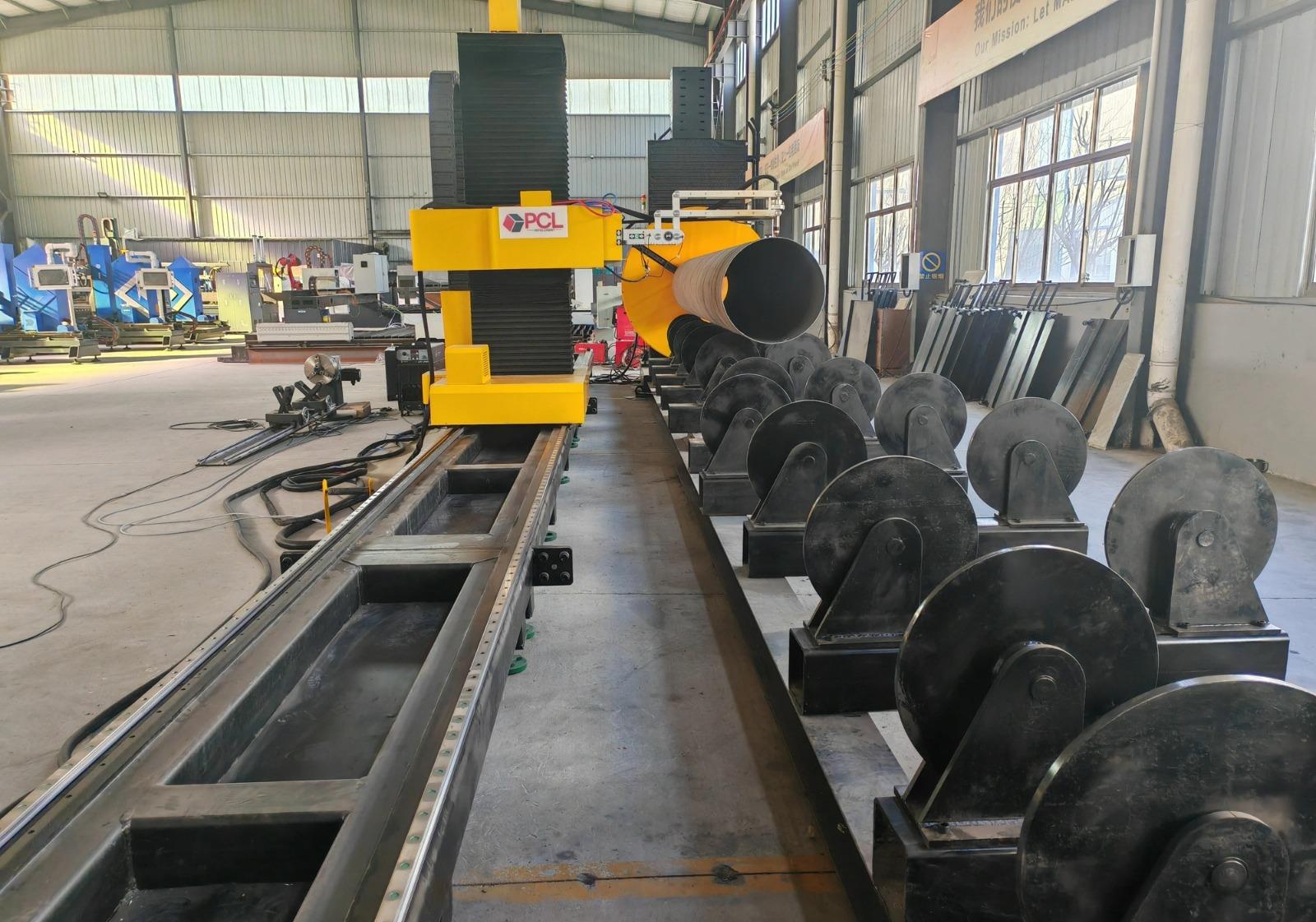
Achieving Superior Intersection Accuracy
Intersection accuracy is the primary metric of quality in LNG structural modules. When H-beams meet at oblique angles or involve complex interlocking notches, the fit-up tolerance must be minimal to ensure structural stability under thermal stress. High-definition plasma systems utilize sophisticated Torch Height Control (THC) and kerf compensation algorithms to maintain the arc’s focus exactly where the geometry demands.
The precision of the intersection is governed by the synchronization between the beam feed conveyor and the transverse movement of the plasma head. Modern production lines employ laser measurement systems to “touch off” and map the actual dimensions of the H-beam, accounting for mill tolerances such as flange tilt or web eccentricity. By feeding this real-world data back into the control system, the plasma torch adjusts its path in real-time to maintain intersection accuracy, ensuring that when the beam reaches the assembly floor, no manual grinding or gap-filling is required.
Advanced Beveling for High-Integrity Joints
Weld preparation is a non-negotiable step in LNG projects due to the stringent non-destructive testing (NDT) standards applied to structural joints. Plasma cutting systems equipped with 360-degree rotating bevel heads allow for the simultaneous cutting and beveling of H-beam profiles. This eliminates the need for secondary processing stations where beams would traditionally be moved to a separate area for manual beveling with handheld grinders.
The plasma system can execute V, X, Y, and K-bevels with precise degree control. For heavy-wall H-beams used in liquefaction plant supports, the ability to maintain a consistent root face and bevel angle across the entire profile is vital. This consistency directly impacts the quality of subsequent welding processes, reducing the risk of slag inclusions or lack of fusion. Automated beveling ensures that the heat-affected zone (HAZ) is minimized through high-speed travel, preserving the metallurgical properties of the specialized steel grades often used in low-temperature environments.
Engineering for Low Maintenance and High Duty Cycles
From an operational standpoint, the reliability of the cutting medium is as important as its precision. Plasma systems are engineered for the high duty cycles required by 24/7 LNG project schedules. The mechanical design of modern H-beam plasma cutting machines focuses on protecting sensitive components from the harsh environment of a steel mill. Smoke extraction systems are integrated directly into the cutting zone to remove abrasive dust and metallic particles that could cause wear on linear guides and rack-and-pinion drives.
Maintenance requirements for plasma systems are significantly lower than alternative thermal cutting technologies when processing heavy structural sections. The primary wear items are limited to consumables like nozzles, electrodes, and swirl rings, which can be replaced in minutes. Furthermore, the absence of complex optical paths or delicate lens assemblies makes plasma systems more resilient to the vibrations and ambient temperature fluctuations common in large-scale fabrication shops. This mechanical robustness ensures that the production line maintains its uptime, a critical factor when meeting the tight delivery windows of global energy projects.
Integration with Material Handling and Workflow
The efficiency of the plasma cutting station is maximized when integrated into a holistic material handling workflow. Automated infeed and outfeed systems use cross-transfers and conveyor beds to move H-beams into the cutting envelope. Sensors detect the leading edge of the beam, triggering the OLP-driven cutting sequence. Once the plasma head completes the complex intersections and bolt holes, the beam is automatically marked with layout lines or part numbers using the plasma torch at a lower amperage or a dedicated marking tool.
This level of automation reduces the labor-intensive nature of structural steelwork. By focusing on the plasma cutting process as a data-driven operation, industrial engineers can track production metrics in real-time. Every pierce and every linear meter of cut is recorded, providing precise data for cost estimation and project management. In the context of LNG projects, where documentation and traceability are paramount, this digital integration provides a clear record of fabrication accuracy and material usage.
Conclusion on Process Optimization
The deployment of an H-beam production line featuring offline programming and high-definition plasma cutting represents a strategic investment in precision and scalability. By focusing on intersection accuracy and automated beveling, fabricators can meet the rigorous technical specifications of the LNG sector while maintaining a low-maintenance operational profile. As the industry moves toward greater modularity, the ability to produce perfectly fitted structural components at high speeds will remain the defining characteristic of leading steel fabricators.
-


Cantilever Welding Robot solution
-


GF laser cutting machine
-

P3015 plasma cutting machine
-

LFP3015 Fiber Laser Cutter
-

pipe plasma cutting machine
-
LFH 4020 Fiber Laser Cutting Machine
-
LFP4020
-

gantry plasma air cutting machine
-

3D robot cutting machine
-

8 axis plasma cutting machine
-

5 axis plasma cutting machine
-

LT360 tube laser cutting machine
-

robot welding workstation
-

SF6060 fiber laser cutting machine
Advanced Fiber Laser Tube Processing Technology
Our CNC Fiber Laser Tube Cutting systems revolutionize metal fabrication by integrating high-precision cutting, punching, and profiling into a single automated workflow. Designed for versatility, this technology handles a wide array of profiles including Round, Square, Rectangular, and Oval tubes, as well as complex L-shaped and U-shaped channels.
- Precision Punching: High-speed hole punching with micron-level accuracy, eliminating the need for mechanical drilling or die-stamping.
- Complex Profiling: Advanced 3D pathing allows for intricate interlocking joints and specialized notch cuts, ideal for structural frames.
- High Material Efficiency: Intelligent nesting software minimizes scrap, reducing raw material costs across large production runs.
- Clean Finish: Delivers oxide-free, burr-free edges that require zero secondary grinding before welding.

Seamlessly processing multiple profiles with consistent precision.
Global Delivery & Logistics



From our high-tech manufacturing facility directly to your global site. PCL WeldCut ensures secure packaging, professional handling, and reliable international logistics to safeguard your equipment throughout the entire journey.