Optimizing LNG Structural Integrity via Plasma H-Beam Production Lines
Liquefied Natural Gas (LNG) infrastructure projects represent some of the most demanding environments for structural engineering. The structural steel frameworks, particularly H-beams used in modular pipe racks and cryogenic tank supports, must adhere to stringent geometric tolerances to ensure safety under extreme thermal cycling. The adoption of an automated H-beam production line centered on high-definition Plasma Cutting and Offline Programming Software has transitioned from a competitive advantage to an industrial necessity. This approach prioritizes throughput and precision while minimizing the mechanical downtime associated with traditional layout and cutting methods.
The Role of Offline Programming in Modular LNG Construction
In traditional fabrication, the machine remains idle while an operator manually inputs coordinates or adjusts paths at the controller. For LNG modules, where a single rack may require hundreds of unique H-beam configurations, this “teach-mode” or manual data entry creates a significant bottleneck. Offline programming (OLP) solves this by allowing engineers to generate and simulate cutting paths in a virtual environment using 3D CAD/CAM data.
OLP environments allow for the simulation of the plasma torch’s kinematics, ensuring that complex rotations required for flange thinning or web penetrations do not result in collisions with the workpiece or the machine structure. By the time the G-code reaches the production floor, the logic is verified. This decoupling of the programming phase from the hardware phase ensures that the plasma station maintains a high duty cycle, focused exclusively on material transformation rather than data processing.
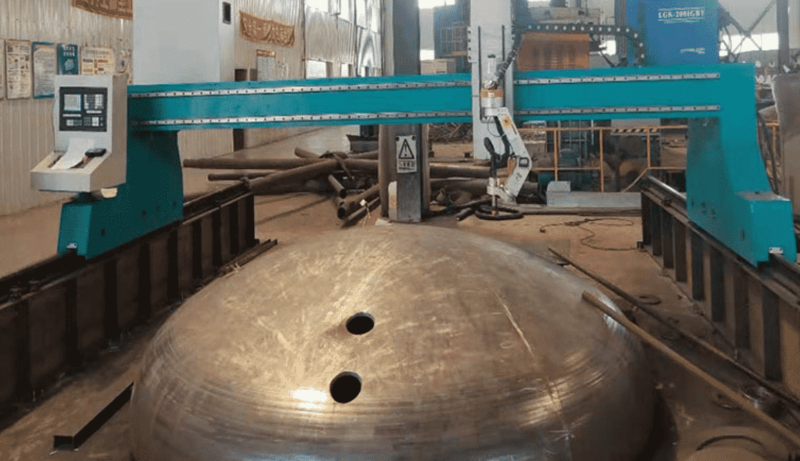
Achieving Intersection Precision for Cryogenic Loading
One of the primary challenges in H-beam processing for LNG Projects is the execution of complex Intersection Precision. Unlike standard commercial construction, LNG modules often involve intricate pipe-to-beam or beam-to-beam intersections where the fit-up must be nearly seamless to allow for standardized robotic joining later in the process. Plasma cutting systems, mounted on multi-axis robotic arms or high-degree-of-freedom gantries, can articulate around the beam’s profile to execute cope cuts, ratholes, and bolt hole clusters in a single pass.
The accuracy of these intersections is governed by the system’s ability to compensate for the beam’s inherent deviations. Raw H-beams often arrive with slight flange tilt or web eccentricity. Advanced plasma lines utilize laser or mechanical probing to “map” the actual profile of the beam before the cut begins. The OLP-generated path is then dynamically shifted to align with the real-world geometry of the steel. This ensures that when two beams meet at an angle, the contact surfaces are optimized for structural load distribution, reducing the need for onsite modifications or excessive gap-filling.
Advanced Plasma Beveling for High-Strength Connections
In LNG structural design, full-penetration welds are frequently specified to handle dynamic loads and seismic requirements. This necessitates precise edge preparation. Traditional manual grinding of bevels is labor-intensive and prone to inconsistency. An automated Plasma Beveling system integrated into the production line allows for the creation of V, Y, X, and K-shaped bevels directly during the primary cutting process.
Modern plasma torches can tilt up to 45 or 50 degrees, allowing for the creation of complex weld prep geometries on both the web and the flanges of the H-beam. The thermal control provided by high-definition plasma power sources ensures that the Heat Affected Zone (HAZ) remains within acceptable limits for the high-strength carbon steels and low-alloy steels common in energy projects. Because the beveling is performed by the same machine that executes the length cutting and hole drilling, the spatial relationship between the bevel and the beam’s center line is maintained with sub-millimeter accuracy.
Low Maintenance Requirements and Industrial Robustness
Industrial engineers favor plasma technology for H-beam lines due to its resilience in harsh fabrication environments. Unlike other thermal cutting processes that are highly sensitive to dust, vibration, and ambient light, plasma systems are inherently robust. The primary wear components—nozzles, electrodes, and swirl rings—are designed for rapid replacement, often featuring “quick-change” torch designs that minimize Mean Time to Repair (MTTR).
For a production line running double shifts on an LNG contract, the Structural Steel Fabrication schedule cannot afford extended downtime. Plasma systems are less susceptible to the optical contamination issues that plague high-tech light-based systems. As long as the power supply is stable and the gas delivery (typically oxygen or nitrogen) is filtered for moisture and oil, a plasma H-beam line can maintain consistent output for years. Furthermore, the mechanical simplicity of the torch assembly makes it resistant to the physical shocks often encountered when handling 12-meter structural sections.
Kerf Compensation and Hole Quality
A critical engineering consideration in plasma cutting is the management of the kerf—the width of the material removed during the cut. Offline programming incorporates sophisticated kerf compensation algorithms that adjust the torch path based on the material thickness and the amperage used. This is particularly vital when cutting bolt holes in H-beam flanges. Through the use of long-life oxygen plasma technology, modern systems can produce “true hole” quality, where the taper of the hole is virtually eliminated, allowing bolts to be seated without the need for secondary reaming.
Optimizing Material Utilization and Nesting
While the focus is often on the cutting speed, the efficiency of an LNG production line is also measured by scrap reduction. OLP allows for advanced nesting of parts across standard stock lengths of H-beams. By analyzing the entire project’s bill of materials, the software can nest cope cuts and shorter segments within the “dead zone” of larger beams. This level of optimization is impossible with manual layout. When combined with the high-speed capability of plasma, this results in a lower total cost per ton for the fabricated steel.
Final Engineering Considerations
The transition to an offline-programmed plasma cutting line requires an initial investment in digital workflow integration. Engineers must ensure that the 3D models provided by the EPC (Engineering, Procurement, and Construction) firm are compatible with the OLP environment. However, once the pipeline is established, the reduction in manual labor, the elimination of layout errors, and the superior fit-up of the H-beams result in a significantly accelerated project timeline. For LNG projects, where time-to-market and structural reliability are paramount, the plasma-based H-beam production line stands as the most efficient solution for heavy structural fabrication.
-


LT240S tube laser cutting machine
-
LT120S tube laser cutting machine
-
Sale

Tank Fillet Welding Machine
Original price was: $1,000.00.$900.00Current price is: $900.00. -
Sale

MAK100 tube laser cutting machine
Original price was: $5,500.00.$5,000.00Current price is: $5,000.00. -

portable plasma air cutting machine
$1,200.00 -

2in1 fiber laser cutting machine
-

Air cooling Laser welding machine
-

HF h beam laser cutting machine
-

LT240 laser cutting machine
-

Laser welding machine
-


Cobot Welding Station
-

Gantry welding robot solution
-

Tracked Wheeled AGV Welding robot
-

LFH6020 Fiber laser cutting machine
-
LFP6020
-

robotic welidng machine
Advanced Fiber Laser Tube Processing Technology
Our CNC Fiber Laser Tube Cutting systems revolutionize metal fabrication by integrating high-precision cutting, punching, and profiling into a single automated workflow. Designed for versatility, this technology handles a wide array of profiles including Round, Square, Rectangular, and Oval tubes, as well as complex L-shaped and U-shaped channels.
- Precision Punching: High-speed hole punching with micron-level accuracy, eliminating the need for mechanical drilling or die-stamping.
- Complex Profiling: Advanced 3D pathing allows for intricate interlocking joints and specialized notch cuts, ideal for structural frames.
- High Material Efficiency: Intelligent nesting software minimizes scrap, reducing raw material costs across large production runs.
- Clean Finish: Delivers oxide-free, burr-free edges that require zero secondary grinding before welding.

Seamlessly processing multiple profiles with consistent precision.
Global Delivery & Logistics



From our high-tech manufacturing facility directly to your global site. PCL WeldCut ensures secure packaging, professional handling, and reliable international logistics to safeguard your equipment throughout the entire journey.