Precision Plasma Integration in Wind Tower H-Beam Fabrication
In the specialized sector of wind tower internal structural fabrication, the H-beam serves as the primary backbone for secondary steelwork, including platforms, cable trays, and ladder supports. To meet the rigorous demands of offshore and onshore environments, the production of these beams must adhere to strict geometric tolerances. The adoption of a specialized H-beam production line utilizing Plasma Cutting technology is no longer optional but a baseline requirement for maintaining metallurgical integrity and assembly speed. This analysis focuses on the technical superiority of plasma systems in achieving the intersection accuracy and edge preparation necessary for subsequent narrow gap welding operations.
Optimizing Intersection Accuracy for Structural Integrity
Intersection accuracy in H-beam processing refers to the precision with which the plasma torch executes cuts where beam webs and flanges meet, or where the beam intersects the curved radius of a wind tower section. In high-output production lines, CNC-controlled plasma heads must account for the mechanical deviations inherent in rolled steel. Advanced plasma systems utilize touch-probing and laser-sensing to map the actual profile of the H-beam before the arc is struck. This ensures that the kerf remains consistent across the entire cross-section.
For wind tower internals, plasma cutting intersection accuracy is measured in sub-millimeter increments. This level of precision is critical because any deviation in the cut profile creates irregular gaps that a narrow gap welding system cannot effectively bridge. By utilizing multi-axis plasma heads—often 5-axis or 6-axis configurations—the system can compensate for flange tilt and web off-center conditions in real-time. This eliminates the need for manual grinding or secondary fit-up adjustments, directly increasing the linear meters of beam processed per shift.
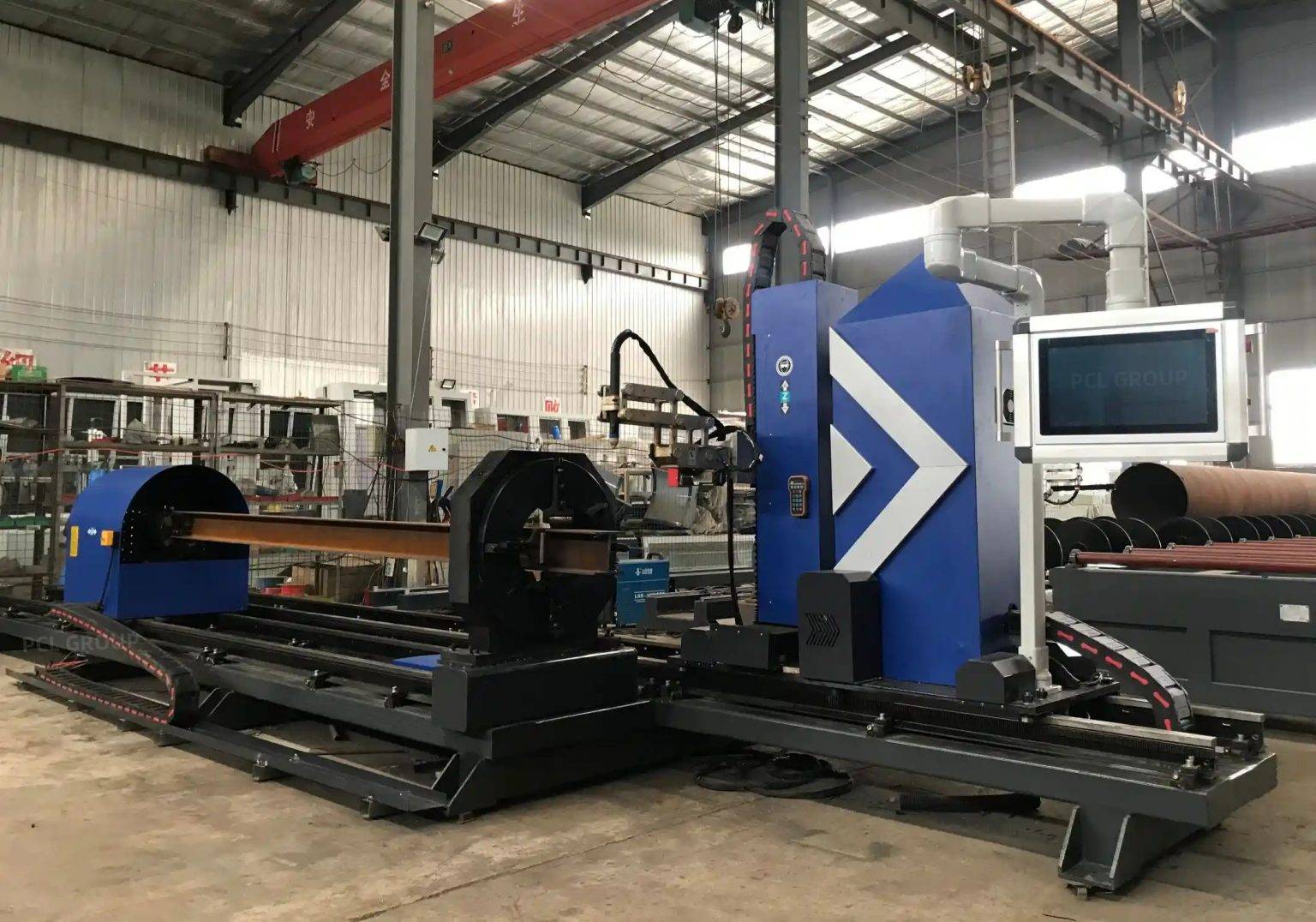
H-Beam Low Maintenance Architecture
From an industrial engineering perspective, the lifecycle cost of a production line is heavily weighted by maintenance downtime. Plasma cutting units integrated into H-beam lines are engineered for high duty cycles in dusty, thermally volatile environments. Unlike other thermal cutting methods that require delicate optical alignments or frequent gas pressure recalibrations, modern high-definition plasma systems are robust. The primary wear components—nozzles, electrodes, and swirl rings—are designed for rapid replacement, often featuring “quick-change” cartridges that minimize MTTR (Mean Time To Repair).
The mechanical structure of the H-beam handling system contributes to this low-maintenance profile. By using heavy-duty conveyor beds and longitudinal drive systems with hardened racks and pinions, the line resists the abrasive effects of dross and metal dust. Furthermore, the absence of complex beam-delivery optics means the system is less sensitive to the vibrations common in heavy steel fabrication shops. This mechanical resilience ensures that the H-beam production line remains operational through three-shift rotations, which is standard in the peak cycles of wind tower project execution.
Advanced Beveling for Narrow Gap Preparation
The transition to narrow gap welding for thick-walled structural members requires a specific edge geometry that differs from standard V-groove preparations. Plasma cutting is the superior choice for creating these precise geometries on H-beam ends and flange edges. Automated plasma beveling allows for the creation of J-grooves and compound angles that facilitate deep penetration with minimal filler metal volume. This is a critical factor in wind tower fabrication, where reducing the total weld metal volume leads to lower thermal distortion and faster cycle times.
During the beveling process, the plasma torch maintains a constant standoff distance via voltage-sensing height controls. This ensures that even if the H-beam has slight longitudinal bowing, the bevel angle remains constant throughout the cut. For narrow gap applications, the consistency of the “land” (the un-beveled portion of the edge) is paramount. Plasma systems provide the thermal density required to achieve a clean, square land without excessive slag accumulation, providing an ideal substrate for high-quality narrow gap weld beads.
Thermal Management and Metallurgical Stability
A common concern in thermal cutting is the Heat Affected Zone (HAZ). However, high-definition plasma systems utilized in H-beam lines employ narrow-bore nozzles and secondary shielding gases (such as Oxygen or Nitrogen/Hydrogen mixes) to constrict the arc. This constriction increases the energy density, allowing for higher travel speeds. The faster the torch moves, the less heat is conducted into the base material. In the context of S355 or higher-grade structural steels used in wind towers, maintaining a small HAZ is vital for preserving the fatigue resistance of the H-beam intersections.
By optimizing the cutting parameters—specifically the gas flow rates and arc current—industrial engineers can ensure that the edge hardness remains within the limits required for narrow gap welding fusion. Modern automated beveling routines include lead-in and lead-out strategies that prevent gouging at the corners of the H-beam, ensuring that the structural integrity is uniform across the entire cut face.
Throughput and Economic Efficiency
The economic justification for a dedicated plasma-equipped H-beam line lies in the consolidation of processes. By performing cutting, hole-punching (via plasma marking or drilling units), and beveling in a single pass, the material handling overhead is reduced by up to 40%. In a wind tower facility, floor space is at a premium. A streamlined H-beam line with integrated plasma processing replaces multiple standalone machines, reducing the logistical complexity of moving 12-meter beams through the shop.
Furthermore, the digitalization of the cutting process allows for seamless integration with BIM (Building Information Modeling) and CAD/CAM software. Nesting algorithms can be applied to H-beam lengths to minimize scrap, while the CNC system logs every cut for quality assurance and traceability—a mandatory requirement for wind energy certification. The data-driven nature of these systems allows for predictive maintenance, where consumable wear is tracked by the number of pierces and arc-on time, allowing for scheduled interventions that do not disrupt the production flow.
Conclusion: Engineering the Future of Wind Infrastructure
The reliance on plasma cutting technology within H-Beam Production Lines represents a strategic alignment with the needs of the wind energy sector. By focusing on intersection accuracy and the sophisticated requirements of narrow gap welding preparation, manufacturers can produce structural components that meet the highest standards of safety and durability. The low maintenance requirements and high-speed beveling capabilities of plasma systems ensure that the production of wind tower internals remains both cost-competitive and technically superior. As tower heights and load requirements continue to increase, the precision of the initial cut will remain the foundation of structural excellence.
-


Cantilever Welding Robot solution
-


GF laser cutting machine
-

P3015 plasma cutting machine
-

LFP3015 Fiber Laser Cutter
-

pipe plasma cutting machine
-
LFH 4020 Fiber Laser Cutting Machine
-
LFP4020
-

gantry plasma air cutting machine
-

3D robot cutting machine
-

8 axis plasma cutting machine
-

5 axis plasma cutting machine
-

LT360 tube laser cutting machine
-

robot welding workstation
-

SF6060 fiber laser cutting machine
Advanced Fiber Laser Tube Processing Technology
Our CNC Fiber Laser Tube Cutting systems revolutionize metal fabrication by integrating high-precision cutting, punching, and profiling into a single automated workflow. Designed for versatility, this technology handles a wide array of profiles including Round, Square, Rectangular, and Oval tubes, as well as complex L-shaped and U-shaped channels.
- Precision Punching: High-speed hole punching with micron-level accuracy, eliminating the need for mechanical drilling or die-stamping.
- Complex Profiling: Advanced 3D pathing allows for intricate interlocking joints and specialized notch cuts, ideal for structural frames.
- High Material Efficiency: Intelligent nesting software minimizes scrap, reducing raw material costs across large production runs.
- Clean Finish: Delivers oxide-free, burr-free edges that require zero secondary grinding before welding.

Seamlessly processing multiple profiles with consistent precision.
Global Delivery & Logistics



From our high-tech manufacturing facility directly to your global site. PCL WeldCut ensures secure packaging, professional handling, and reliable international logistics to safeguard your equipment throughout the entire journey.