Optimizing H-Beam Production for Narrow Gap Welding
In the realm of structural steel fabrication, the efficiency of an H-Beam Production Line is dictated by the precision of its initial stages. For heavy-duty applications requiring high load-bearing capacities, narrow gap welding has emerged as the preferred method for joining thick-walled flanges and webs. Unlike traditional methods, narrow gap techniques require an incredibly tight fit-up and specific joint geometries to ensure full penetration with minimal filler metal. The foundation of this process lies in the primary cutting stage, where plasma technology provides the necessary speed and geometrical accuracy to meet stringent engineering standards.
The transition toward narrow gap configurations is driven by the need to reduce thermal distortion and consumption of welding consumables. However, this transition is only successful if the Plasma Cutting system can deliver edges that are virtually ready for the welding arc. Industrial engineers must focus on the synergy between the cutting gantry’s CNC precision and the subsequent welding station’s requirements.
Critical Intersection Accuracy in Heavy Fabrication
One of the most complex aspects of H-beam assembly is the intersection between the web and the flange. In a high-throughput production line, any deviation in the squareness or the longitudinal straightness of the web plate leads to gaps that narrow gap welding cannot easily bridge. Intersection accuracy is the metric by which we measure the success of the fit-up.
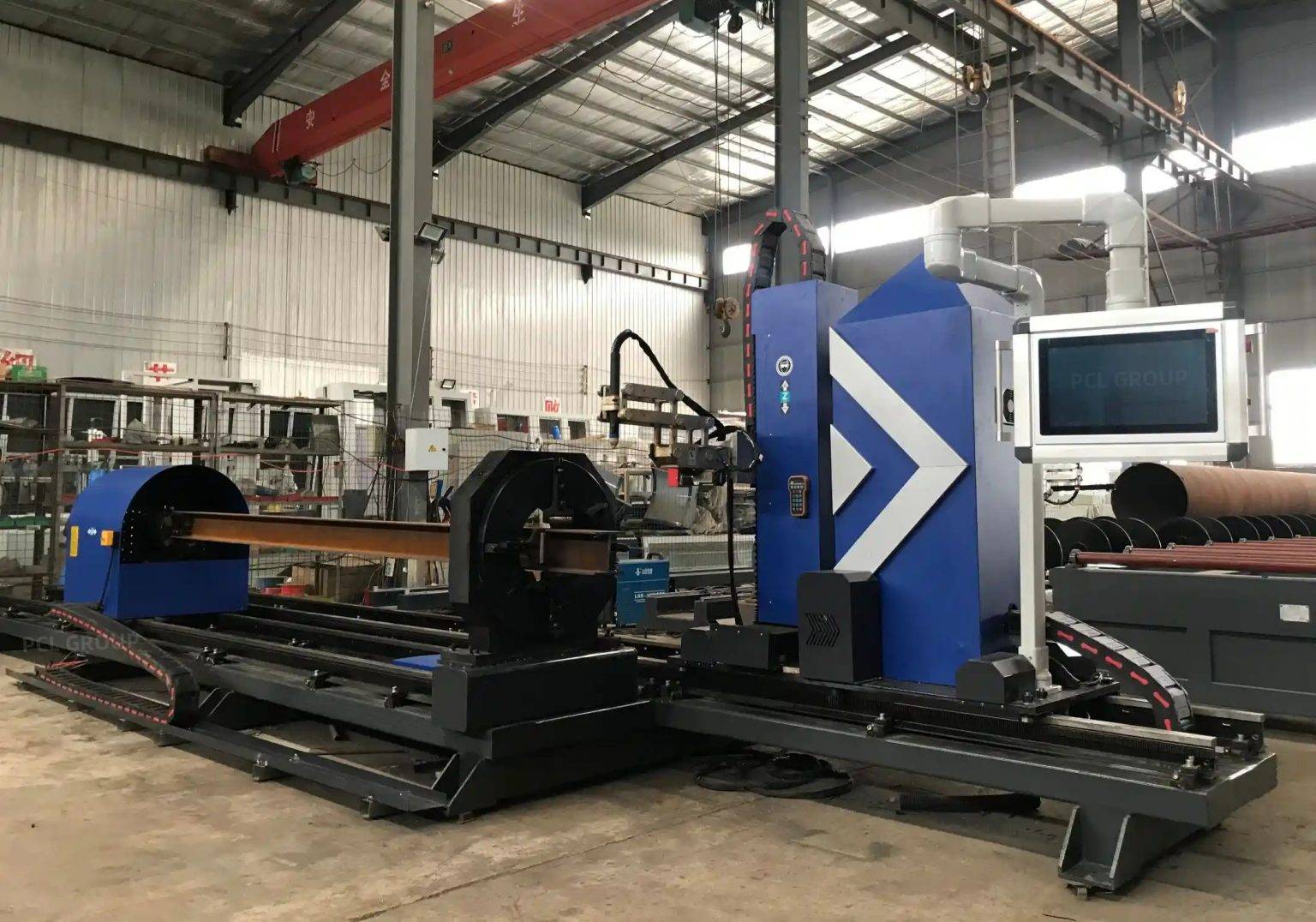
Modern plasma systems utilize sophisticated Torch Height Control (THC) and high-definition power sources to maintain a constant arc voltage. This ensures that even if the raw plate has slight undulations, the plasma torch maintains an optimal distance, resulting in a consistent kerf width. For H-beams, this means the web plate sits perfectly flush against the flange. When the gap is held to tolerances of +/- 0.5mm, the narrow gap welding torch can operate at peak efficiency, utilizing a high-duty cycle without the risk of burn-through or lack of fusion at the root.
The Role of Multi-Axis Plasma Beveling
Narrow gap welding necessitates a specific bevel profile—often a very tight V-groove or a U-groove with an opening angle as low as 1 to 5 degrees. Traditional straight-edge cutting is insufficient. This is where 3D plasma beveling heads become indispensable in the production line.
By utilizing a five-axis or six-axis robotic arm or a specialized gantry head, the plasma cutting process can execute complex bevels in a single pass. This eliminates the need for secondary grinding or milling, which are labor-intensive and introduce variability. From an industrial engineering perspective, the ability to produce a weld-ready bevel directly from the cutting bed reduces material handling costs and accelerates the “floor-to-floor” time for each H-beam section.
Maintaining Geometrical Integrity
The heat-affected zone (HAZ) generated by plasma is significantly smaller than that of oxy-fuel cutting. For narrow gap welding, maintaining the metallurgical integrity of the bevel face is paramount. Excessive oxidation or hardening of the cut edge can lead to porosity or cracking during the welding phase. High-definition plasma systems use oxygen or nitrogen as plasma gases to produce a clean, dross-free edge that requires minimal post-cut cleaning, ensuring the weld pool bonds effectively with the base material.
Maximizing Uptime: H-Beam Low Maintenance Considerations
In a 24/7 manufacturing environment, equipment reliability is the cornerstone of profitability. Plasma systems are engineered for the rugged conditions of steel mills and fabrication shops. A key advantage for engineers is the H-beam low maintenance profile associated with modern plasma power supplies. Unlike other thermal cutting technologies that may involve complex optical paths or delicate alignment procedures, plasma systems are robust and relatively simple to service.
The primary maintenance concerns in a plasma line involve the replacement of consumables—nozzles, electrodes, and swirls rings. These are designed for quick-change operations, often taking less than two minutes to replace, thus minimizing machine downtime. Furthermore, the integration of self-diagnostic software in CNC plasma units allows for predictive maintenance, alerting operators to cooling system issues or gas pressure fluctuations before they result in part defects or system failure.
Reliability in Harsh Environments
Steel structure production lines are often dusty and prone to temperature fluctuations. Plasma torches are designed to withstand these conditions. The use of liquid-cooled torches ensures that the components remain within operational temperature limits even during extended cutting cycles on thick flange plates. By reducing the frequency of unplanned interventions, the overall equipment effectiveness (OEE) of the H-beam line remains high.
Technical Integration: From Cutting to Narrow Gap Welding
The workflow integration starts with the CAD/CAM software. The software must account for the specific kerf characteristics of the plasma arc to ensure the final dimensions of the H-beam components are exact. Once the web and flanges are cut with high intersection accuracy, they are moved to the assembly and tacking station.
Because the narrow gap welding process uses a specialized torch that reaches deep into a narrow groove, any misalignment in the components will cause the torch to collide with the sidewalls or result in an inconsistent weld bead. The precision of the plasma cut ensures that the “land” or “root face” of the joint is uniform across the entire length of the beam, which can often exceed 12 or 18 meters.
Furthermore, the speed of plasma cutting allows the fabrication line to maintain a steady flow. Since narrow gap welding is generally faster than traditional multi-pass submerged arc welding (due to less volume of filler material), the cutting station must be able to keep pace. Plasma’s high linear cutting speeds on 16mm to 50mm plate thicknesses ensure that the welding robots are never starved for material.
Conclusion: The Engineering Rationale
The selection of plasma cutting as the primary preparation tool for H-beam production lines using narrow gap welding is a strategic decision based on precision, throughput, and cost-of-ownership. The ability to achieve high intersection accuracy ensures that the subsequent welding processes are repeatable and defect-free. When combined with the H-beam low maintenance requirements of the hardware, plasma technology provides a scalable solution for modern infrastructure demands.
For industrial engineers, the focus remains on minimizing the cost per ton of fabricated steel. By optimizing the plasma cutting parameters and leveraging multi-axis beveling, facilities can achieve a streamlined production flow that meets the highest standards of structural integrity in the steel construction industry.
-


LT240S tube laser cutting machine
-
LT120S tube laser cutting machine
-
Sale

Tank Fillet Welding Machine
Original price was: $1,000.00.$900.00Current price is: $900.00. -
Sale

MAK100 tube laser cutting machine
Original price was: $5,500.00.$5,000.00Current price is: $5,000.00. -

portable plasma air cutting machine
$1,200.00 -

2in1 fiber laser cutting machine
-

Air cooling Laser welding machine
-

HF h beam laser cutting machine
-

LT240 laser cutting machine
-

Laser welding machine
-


Cobot Welding Station
-

Gantry welding robot solution
-

Tracked Wheeled AGV Welding robot
-

LFH6020 Fiber laser cutting machine
-
LFP6020
-

robotic welidng machine
Advanced Fiber Laser Tube Processing Technology
Our CNC Fiber Laser Tube Cutting systems revolutionize metal fabrication by integrating high-precision cutting, punching, and profiling into a single automated workflow. Designed for versatility, this technology handles a wide array of profiles including Round, Square, Rectangular, and Oval tubes, as well as complex L-shaped and U-shaped channels.
- Precision Punching: High-speed hole punching with micron-level accuracy, eliminating the need for mechanical drilling or die-stamping.
- Complex Profiling: Advanced 3D pathing allows for intricate interlocking joints and specialized notch cuts, ideal for structural frames.
- High Material Efficiency: Intelligent nesting software minimizes scrap, reducing raw material costs across large production runs.
- Clean Finish: Delivers oxide-free, burr-free edges that require zero secondary grinding before welding.

Seamlessly processing multiple profiles with consistent precision.
Global Delivery & Logistics



From our high-tech manufacturing facility directly to your global site. PCL WeldCut ensures secure packaging, professional handling, and reliable international logistics to safeguard your equipment throughout the entire journey.
One thought on “H-Beam Production Line with Narrow Gap welding for for Steel Structure”
Highly recommend for any professional aerospace workshop. Precision is top-notch.