Optimizing H-Beam Fabrication for Pressure Vessel Integrity
In the heavy industrial landscape of pressure vessel manufacturing, the structural framework and support systems—often comprised of heavy-duty H-beams—must meet stringent geometric tolerances. The integration of Plasma Cutting technology into the production line serves as the primary gateway for ensuring these tolerances are met. Unlike general construction-grade steelwork, H-beams utilized in pressure vessel environments act as critical load-bearing members or headers that must interface seamlessly with cylindrical shells. The focus remains on the thermal preparation of these profiles, specifically addressing how plasma systems prepare the material for specialized narrow gap welding applications.
Precision Plasma Cutting and Intersection Accuracy
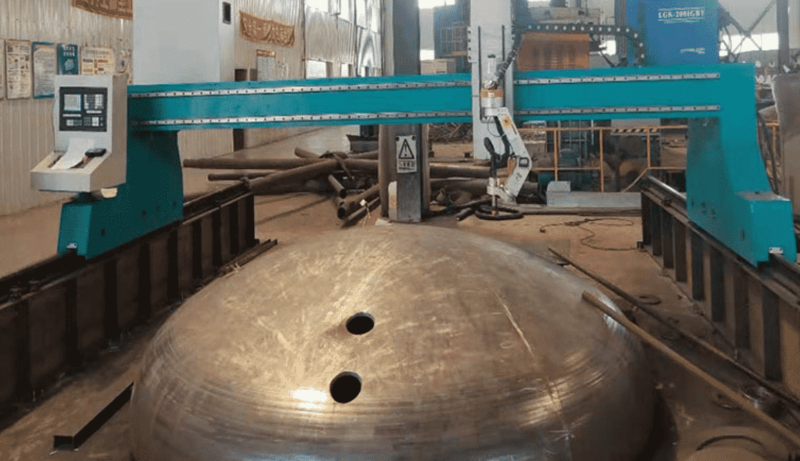
The engineering requirement for intersection accuracy in H-beam production cannot be overstated. When an H-beam is designed to support or intersect a pressure vessel, the cut profile must account for the curvature of the vessel shell. This necessitates a 5-axis or 6-axis plasma robotic movement that can execute complex paths across both the flanges and the web of the beam.
Geometric Volumetric Consistency
Plasma cutting systems utilize high-definition arc technology to maintain a consistent kerf width across varying material thicknesses. For H-beams, where the web and flange thicknesses often differ, the plasma power supply must dynamically adjust amperage and gas flow. This dynamic adjustment ensures that the intersection point where the beam meets the vessel is airtight and dimensionally accurate to within fractions of a millimeter. This level of precision eliminates the need for manual grinding or secondary fit-up adjustments, which are common bottlenecks in traditional fabrication shops.
Software Integration and Kerf Compensation
Modern plasma units are driven by advanced nesting and path-planning software. By utilizing real-time kerf compensation, the system adjusts the torch path to account for the width of the plasma arc. In the context of H-beams, this means the internal and external corners of the beam are cut with sharp definition, ensuring that when the beam is positioned for the subsequent welding phase, the root gap remains uniform. Uniformity is the foundational requirement for any narrow gap process, as fluctuations in the gap lead to inconsistent penetration and potential weld defects.
Beveling Capabilities for Narrow Gap Welding Preparation
The transition from cutting to welding is bridged by the quality of the edge preparation. Narrow gap welding preparation requires specific groove geometries—typically narrow V-grooves or U-grooves—designed to minimize the volume of weld metal deposited while ensuring deep fusion. Plasma cutting excels in this area due to its ability to perform multi-pass beveling or single-pass contoured cuts on heavy sections.
Controlling the Heat Affected Zone (HAZ)
Industrial engineers favor plasma for H-beam beveling because of the controlled Heat Affected Zone. While all thermal cutting processes introduce heat, high-definition plasma systems use secondary shielding gases (such as Oxygen or Nitrogen/Hydrogen mixes) to constrict the arc. This constriction results in a narrower HAZ compared to oxy-fuel cutting. For pressure vessel components, minimizing the HAZ is vital for maintaining the metallurgical properties of the base metal, preventing embrittlement, and ensuring the beam can withstand high-pressure cycles over its operational lifespan.
Bevel Angle Precision
Narrow gap welding thrives on steep bevel angles, often between 3 to 7 degrees. Achieving these angles consistently on the thick flanges of an H-beam requires a plasma torch with a robust tilt-and-rotate mechanism. The stability of the plasma arc at these acute angles is critical. Advanced torch height control (THC) systems monitor the arc voltage hundreds of times per second, maintaining the exact torch-to-workpiece distance required to prevent bevel deviation. This precision ensures that the narrow gap torch can later track the joint without risk of sidewall lack-of-fusion.
Operational Efficiency and Low Maintenance Design
From a lifecycle cost perspective, the H-beam low maintenance profile of plasma systems is a significant advantage in a high-output production line. Pressure vessel fabrication is a continuous process where downtime in the cutting station can halt the entire assembly flow. Plasma systems are engineered for the rigors of heavy industrial environments, offering several mechanical advantages.
Consumable Longevity and Torch Robustness
Modern plasma torches are designed with liquid-cooling systems that extend the life of electrodes and nozzles. In an H-beam line, where long, continuous cuts are common, the ability of the torch to operate at a 100 percent duty cycle is essential. The maintenance requirements are primarily centered on the scheduled replacement of consumables, which can be performed in minutes. This contrasts with other thermal methods that may require complex alignment or frequent cleaning of sensitive optical components.
System Durability in Harsh Environments
The environment of a heavy steel fabrication shop is characterized by dust, vibration, and temperature fluctuations. Plasma cutting hardware is inherently robust, utilizing ruggedized rack-and-pinion drives and protected linear guides. The absence of delicate internal components sensitive to ambient particulates makes plasma the most reliable choice for H-beam processing. Furthermore, the integration of fume extraction systems directly into the cutting bed or the robotic cell ensures that the mechanical components are shielded from the accumulation of metallic dust, further reducing the maintenance interval.
Conclusion of Thermal Processing in H-Beam Lines
The integration of high-definition plasma cutting into an H-Beam Production Line provides the geometric precision and metallurgical integrity required for pressure vessel applications. By focusing on the accuracy of intersections and the technical requirements of beveling for narrow gap welding, manufacturers can achieve a higher throughput with significantly lower defect rates. The robustness of plasma technology ensures that the production line remains operational with minimal maintenance, ultimately supporting the stringent safety and quality standards demanded by the pressure vessel industry. The synergy between precise thermal cutting and advanced welding preparation remains the hallmark of a modern, efficient industrial fabrication facility.
-


LT240S tube laser cutting machine
-
LT120S tube laser cutting machine
-
Sale

Tank Fillet Welding Machine
Original price was: $1,000.00.$900.00Current price is: $900.00. -
Sale

MAK100 tube laser cutting machine
Original price was: $5,500.00.$5,000.00Current price is: $5,000.00. -

portable plasma air cutting machine
$1,200.00 -

2in1 fiber laser cutting machine
-

Air cooling Laser welding machine
-

HF h beam laser cutting machine
-

LT240 laser cutting machine
-

Laser welding machine
-


Cobot Welding Station
-

Gantry welding robot solution
-

Tracked Wheeled AGV Welding robot
-

LFH6020 Fiber laser cutting machine
-
LFP6020
-

robotic welidng machine
Advanced Fiber Laser Tube Processing Technology
Our CNC Fiber Laser Tube Cutting systems revolutionize metal fabrication by integrating high-precision cutting, punching, and profiling into a single automated workflow. Designed for versatility, this technology handles a wide array of profiles including Round, Square, Rectangular, and Oval tubes, as well as complex L-shaped and U-shaped channels.
- Precision Punching: High-speed hole punching with micron-level accuracy, eliminating the need for mechanical drilling or die-stamping.
- Complex Profiling: Advanced 3D pathing allows for intricate interlocking joints and specialized notch cuts, ideal for structural frames.
- High Material Efficiency: Intelligent nesting software minimizes scrap, reducing raw material costs across large production runs.
- Clean Finish: Delivers oxide-free, burr-free edges that require zero secondary grinding before welding.

Seamlessly processing multiple profiles with consistent precision.
Global Delivery & Logistics



From our high-tech manufacturing facility directly to your global site. PCL WeldCut ensures secure packaging, professional handling, and reliable international logistics to safeguard your equipment throughout the entire journey.