Optimizing H-Beam Production for Construction Machinery
In the manufacturing of heavy-duty construction machinery, the structural integrity of H-beams is paramount. Components such as telescopic crane booms, excavator chassis, and mining truck frames demand high load-bearing capacities and resistance to cyclic fatigue. The shift toward Narrow Gap Welding (NGW) has necessitated a revolution in upstream processes, specifically in the preparation of heavy plate sections. To facilitate a successful narrow gap process, the initial cutting and beveling phase must deliver exceptional edge quality and geometric consistency.
High-definition Plasma Cutting serves as the foundational technology in this production line. Unlike traditional methods, modern plasma systems are engineered to handle the massive scales of H-beam profiles while maintaining the precision of small-scale machining. By focusing on the intersection between the web and the flange, engineers can ensure that the subsequent welding stages are executed with minimal rework and maximum filler metal efficiency.
The Critical Role of Intersection Accuracy
The geometry of an H-beam used in construction machinery is rarely a simple straight line. Complex load distributions require precise cutouts, interlocking notches, and specific web-to-flange fit-ups. Dimensional accuracy at these intersections determines the success of the narrow gap welding pass. If the gap between the web and flange varies by even a fraction of a millimeter, the narrow gap torch may experience arc instability or insufficient penetration.
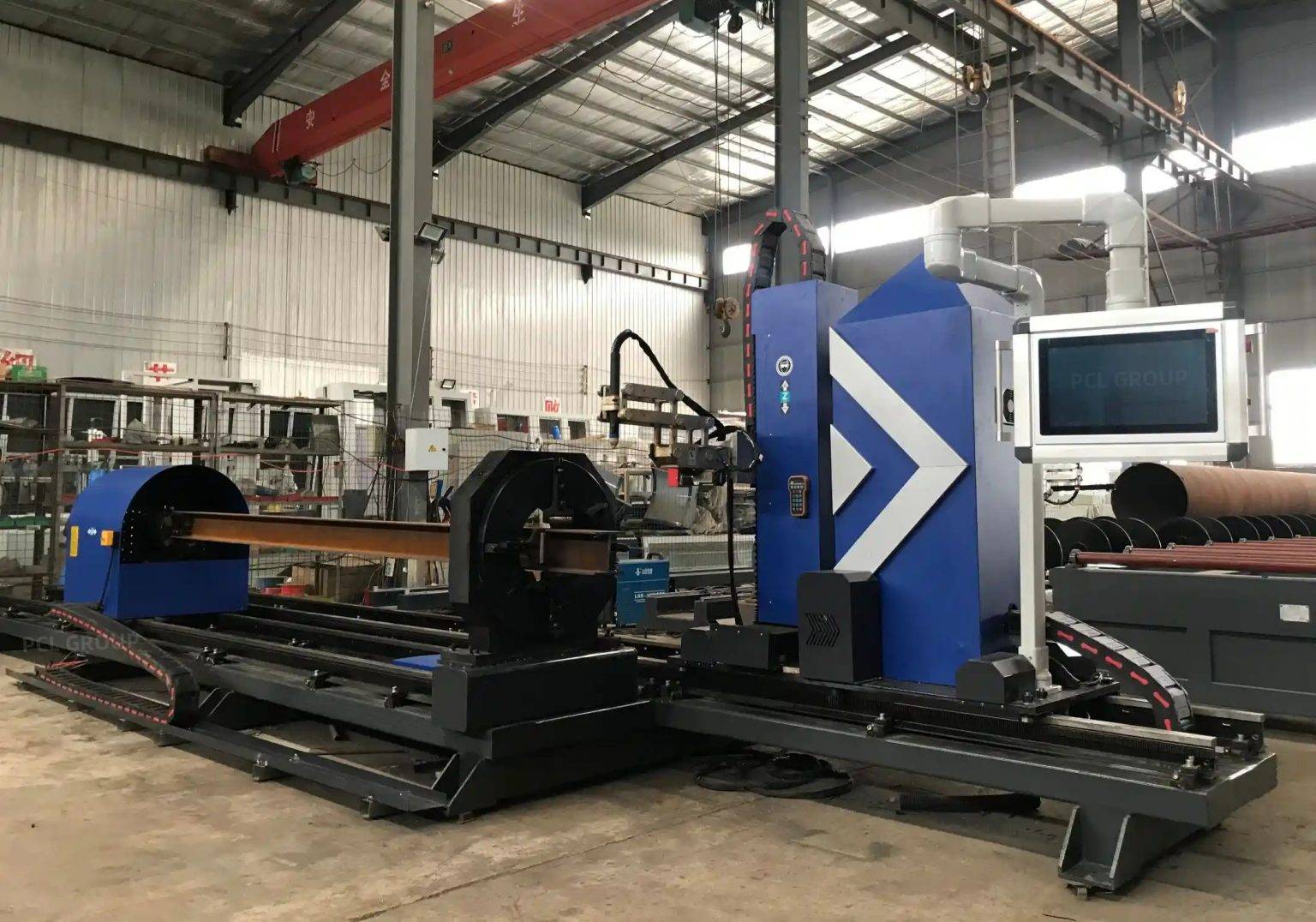
Industrial plasma systems utilize advanced CNC motion controllers to synchronize the X, Y, and Z axes with rotational tilt. This synchronization is vital when cutting the web to match the inner radius of a rolled flange. Achieving a “zero-gap” fit-up or a precisely defined 1mm landing requires the plasma arc to remain perfectly perpendicular to the material surface, even during high-speed directional changes. This level of intersection accuracy reduces the need for manual grinding and ensures that the structural bond between the beam elements is uniform across the entire length of the assembly.
Advanced Plasma Beveling for Narrow Gap Preparation
Narrow gap welding relies on a tight groove angle, often between 1 to 5 degrees, to significantly reduce the volume of weld metal required. Traditional beveling methods often struggle with these acute angles on thick-walled H-beams. A 3D plasma beveling head solves this by providing multi-axis rotation, allowing for V, Y, X, and K-cuts in a single pass.
For construction machinery, where plate thicknesses can exceed 40mm, the plasma torch must maintain a stable arc over a long standoff distance while tilted. Modern high-definition systems use secondary gas shielding to constrict the arc, resulting in a narrower kerf and a cleaner edge. This precision is critical because any dross or roughness on the beveled face can introduce inclusions during the narrow gap welding process. By utilizing oxygen-based plasma for carbon steel, the system produces a metallurgical surface that is ready for welding without extensive chemical cleaning.
Impact of Thermal Management on Beam Straightness
A common challenge in an H-Beam Production Line is thermal distortion. When cutting heavy flanges, the localized heat input from the plasma arc can induce longitudinal bowing. Industrial engineers mitigate this by employing synchronous cutting torches that operate on both sides of the web simultaneously. This balances the heat input across the neutral axis of the beam.
Furthermore, the speed of the plasma process is a distinct advantage. Because the plasma arc moves at higher velocities compared to oxy-fuel systems, the total heat-affected zone (HAZ) is significantly smaller. A narrower HAZ means the base material retains its quenched-and-tempered properties—a vital requirement for the high-strength steels (such as S690QL or S960) frequently used in mobile crane manufacturing.
H-Beam Low Maintenance and Operational Reliability
In a 24/7 production environment, equipment uptime is the most significant driver of profitability. Plasma cutting systems are favored in H-beam lines due to their robust mechanical design and predictable maintenance schedules. Unlike complex optical systems, plasma components are built to withstand the vibration, dust, and temperature fluctuations common in heavy fabrication shops.
Consumable Life and Cost Control
Modern plasma torches feature “Quick-Disconnect” designs that allow operators to replace electrodes and nozzles in under a minute. Innovations in electrode cooling, such as liquid-cooled silver inserts, have extended the life of consumables by up to 300% compared to legacy systems. For an H-beam line, this means fewer stoppages during the cutting of long flange sections. The CNC system also tracks consumable wear in real-time, providing predictive alerts before the cut quality degrades enough to impact the narrow gap welding tolerances.
System Durability in Heavy Industry
The absence of sensitive mirrors or alignment-sensitive components makes plasma the “workhorse” of the industry. The power supplies are typically housed in over-pressurized, filtered cabinets to prevent metallic dust from causing short circuits. This ruggedization ensures that the H-beam production line remains operational even when processing scaled or rusted raw material, which is often the case with heavy structural steel stored in outdoor yards.
Technical Specifications for Plasma Integration
To achieve the necessary standards for construction machinery, the plasma system must adhere to specific technical parameters. The table below outlines the target metrics for a high-output H-beam line.
| Parameter | Target Specification | Impact on Narrow Gap Welding |
|---|---|---|
| Angular Deviation | ± 0.5 Degrees | Ensures consistent sidewall fusion. |
| Positioning Accuracy | ± 0.15 mm | Guarantees precise root gap spacing. |
| Surface Roughness (Rz) | 40 – 80 μm | Eliminates the need for post-cut grinding. |
| Bevel Range | +45° to -45° | Allows for complex NGW groove geometries. |
Integration with Downstream Narrow Gap Welding
The synergy between the plasma cutting unit and the narrow gap welding station is managed through a unified software ecosystem. CAD/CAM files are nested to optimize material yield, but they also contain the specific bevel profiles required for the NGW torch. As the plasma head completes the cut, it can also perform automated marking—etching part numbers, bend lines, and welding alignment marks.
By automating the beveling process within the cutting cell, manufacturers eliminate the logistical bottleneck of moving heavy beams to a separate bevelling station. This “one-hit” manufacturing approach ensures that the geometric relationship between the web and the flange is preserved from the moment the plate is cut until the final weld bead is deposited. This flow is essential for producing the rigid, high-performance H-beams that define modern construction equipment.
Conclusion
For industrial engineers designing H-beam production lines, the choice of plasma cutting is a strategic decision that prioritizes throughput, accuracy, and reliability. By mastering intersection accuracy and leveraging advanced beveling capabilities, manufacturers can meet the rigorous demands of narrow gap welding. The result is a more efficient production cycle, lower maintenance overhead, and structural components capable of withstanding the most demanding environments in the construction and mining sectors.
-


LT240S tube laser cutting machine
-
LT120S tube laser cutting machine
-
Sale

Tank Fillet Welding Machine
Original price was: $1,000.00.$900.00Current price is: $900.00. -
Sale

MAK100 tube laser cutting machine
Original price was: $5,500.00.$5,000.00Current price is: $5,000.00. -

portable plasma air cutting machine
$1,200.00 -

2in1 fiber laser cutting machine
-

Air cooling Laser welding machine
-

HF h beam laser cutting machine
-

LT240 laser cutting machine
-

Laser welding machine
-


Cobot Welding Station
-

Gantry welding robot solution
-

Tracked Wheeled AGV Welding robot
-

LFH6020 Fiber laser cutting machine
-
LFP6020
-

robotic welidng machine
Advanced Fiber Laser Tube Processing Technology
Our CNC Fiber Laser Tube Cutting systems revolutionize metal fabrication by integrating high-precision cutting, punching, and profiling into a single automated workflow. Designed for versatility, this technology handles a wide array of profiles including Round, Square, Rectangular, and Oval tubes, as well as complex L-shaped and U-shaped channels.
- Precision Punching: High-speed hole punching with micron-level accuracy, eliminating the need for mechanical drilling or die-stamping.
- Complex Profiling: Advanced 3D pathing allows for intricate interlocking joints and specialized notch cuts, ideal for structural frames.
- High Material Efficiency: Intelligent nesting software minimizes scrap, reducing raw material costs across large production runs.
- Clean Finish: Delivers oxide-free, burr-free edges that require zero secondary grinding before welding.

Seamlessly processing multiple profiles with consistent precision.
Global Delivery & Logistics



From our high-tech manufacturing facility directly to your global site. PCL WeldCut ensures secure packaging, professional handling, and reliable international logistics to safeguard your equipment throughout the entire journey.