Strategic Implementation of Plasma Cutting in Heavy Structural H-Beam Lines
In the sector of bridge truss fabrication, the transition toward automated H-Beam Production Lines is driven by the necessity for extreme structural reliability and cost-effective throughput. The core of this efficiency lies in the thermal cutting stage. Unlike general structural steelwork, bridge trusses require narrow gap welding preparation, a process that demands surgical precision in plate edge geometry. High-definition plasma cutting has emerged as the industrial standard for this application, providing the necessary balance between cutting speed, edge quality, and metallurgical integrity in heavy-gauge carbon steel.
The industrial engineer’s objective is to eliminate “bottlenecking” during the assembly phase. When fabricating large-scale H-beams, any deviation in the web-to-flange intersection or the bevel angle results in increased weld volume and potential joint failure. Plasma systems, equipped with sophisticated CNC controls and multi-axis torch heads, allow for the simultaneous processing of complex geometries that traditional mechanical methods cannot replicate at scale.
Achieving Superior Intersection Accuracy for Complex Truss Geometries
Bridge trusses often involve intricate intersections where vertical and diagonal members meet the main H-beam chord. The intersection accuracy of these cuts determines the fit-up quality. High-definition plasma systems utilize advanced “True Hole” or “Precision Hole” technologies along with rapid-response torch height control (THC) to ensure that every penetration and cope is executed with a tolerance typically within +/- 0.5mm. This precision is vital for narrow gap welding, where the groove must be uniform to maintain a stable arc and consistent bead penetration.
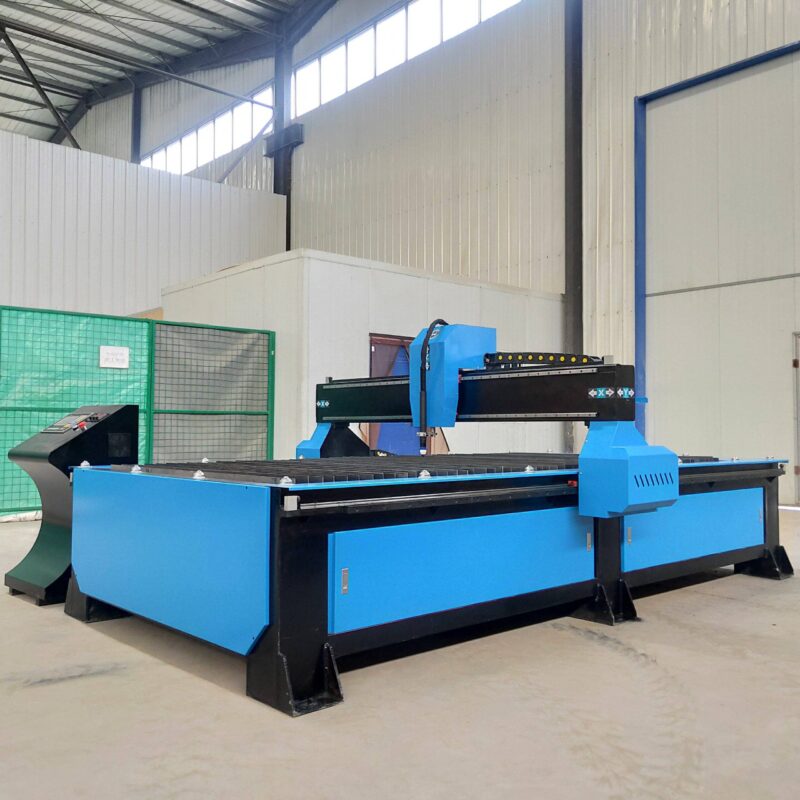
From an engineering perspective, intersection accuracy reduces the “gap bypass” phenomenon. If the plasma arc deviates or the kerf width is inconsistent, the resulting fit-up requires manual shim or excessive filler material, which compromises the fatigue resistance of the bridge. Modern plasma oscillators provide a stable plasma column that minimizes the angularity of the cut, ensuring that the web of the H-beam sits perfectly flush against the flange, or that the bracing members interface seamlessly with the chord surfaces.
Advanced 3D Beveling for Narrow Gap Welding Preparation
The primary advantage of plasma in a bridge truss line is its ability to perform 3D beveling. Narrow gap welding requires a specific groove geometry—often a deep V or J-groove with a very tight included angle (typically between 1 degree and 5 degrees). Achieving this on thick H-beam flanges requires a plasma cutting head with a full five-axis range of motion.
The plasma beveling process eliminates the need for a separate edge-milling stage. The CNC system calculates the kerf compensation for various angles in real-time, allowing the torch to create complex weld preparations, including Y-grooves and K-grooves, in a single pass. This is particularly critical for H-beams where the flange thickness can exceed 50mm. By maintaining a constant tip-to-workpiece distance, the system ensures that the root face of the bevel remains consistent along the entire length of the beam, which is a prerequisite for automated narrow gap welding robots to function without constant human intervention.
H-Beam Line Maintenance: Maximizing Operational Uptime
Industrial engineers prioritize H-beam low maintenance profiles to ensure high OEE (Overall Equipment Effectiveness). Compared to mechanical shearing or older thermal technologies, modern high-definition plasma systems are designed for high duty cycles in harsh environments. The maintenance cycle for a plasma system is centered on consumable management—specifically the nozzle, electrode, and swirl ring.
To optimize the line, engineers implement “Long-Life” oxygen plasma technologies which extend the number of pierces and the total cut-inches per set of consumables. Furthermore, the absence of high-velocity moving parts (as seen in mechanical saws) reduces the vibration-induced wear on the gantry and rail systems. The slag management in plasma systems is also highly refined; automated dross-stripping systems and integrated water tables or downdraft systems ensure that the work environment remains clean, reducing the wear on linear guides and rack-and-pinion drives.
Metallurgical Impact and Heat Affected Zone (HAZ) Control
A common concern in bridge engineering is the Heat Affected Zone (HAZ) created during thermal cutting. Excessive heat can alter the grain structure of the steel, leading to localized hardening or embrittlement. Modern high-speed plasma cutting minimizes the heat input by maintaining high travel speeds and using specific gas mixtures (such as H35 or F5 for stainless, or O2 for carbon steel) that concentrate the energy density.
By controlling the plasma gas flow and the arc current, the system produces a narrow HAZ that is typically removed or consumed during the subsequent narrow gap welding process. This ensures that the base metal properties of the H-beam remain within the design specifications for tensile strength and ductility, which is non-negotiable for infrastructure projects subjected to dynamic loading and environmental stressors.
Integration with Automated Material Handling
The efficiency of the plasma cutting stage is amplified when integrated with automated conveyors and cross-transfers. In a dedicated H-beam production line, the beam is moved via motorized rollers to the cutting station where sensors detect the leading edge. The plasma system then executes the copes, bolt holes, and bevels according to the imported BIM (Building Information Modeling) data. This digital workflow ensures that there is no data loss between the design office and the shop floor, further enhancing the intersection accuracy across the entire truss assembly.
Economic Considerations and Return on Investment
While the initial capital expenditure for a multi-axis high-definition plasma system is significant, the ROI is realized through the elimination of secondary processes. By delivering “weld-ready” H-beams directly from the cutting station, the production line reduces labor costs associated with manual grinding and beveling. Furthermore, the high speed of plasma (often 3 to 5 times faster than oxy-fuel on thicknesses up to 40mm) allows the production line to meet the aggressive timelines often associated with large-scale bridge projects. The low maintenance requirements ensure that the system remains operational for three-shift rotations, maximizing the output per square foot of the fabrication facility.
In conclusion, for the fabrication of bridge trusses using narrow gap welding, the selection of plasma cutting technology is a strategic imperative. The ability to provide high-precision bevels, maintain tight tolerances on intersections, and operate with minimal downtime makes plasma the most viable thermal process for high-volume, high-spec H-beam production. The focus remains on process stability and geometric repeatability, ensuring that every truss component contributes to the overall safety and longevity of the infrastructure.
-


Cantilever Welding Robot solution
-


GF laser cutting machine
-

P3015 plasma cutting machine
-

LFP3015 Fiber Laser Cutter
-

pipe plasma cutting machine
-
LFH 4020 Fiber Laser Cutting Machine
-
LFP4020
-

gantry plasma air cutting machine
-

3D robot cutting machine
-

8 axis plasma cutting machine
-

5 axis plasma cutting machine
-

LT360 tube laser cutting machine
-

robot welding workstation
-

SF6060 fiber laser cutting machine
Advanced Fiber Laser Tube Processing Technology
Our CNC Fiber Laser Tube Cutting systems revolutionize metal fabrication by integrating high-precision cutting, punching, and profiling into a single automated workflow. Designed for versatility, this technology handles a wide array of profiles including Round, Square, Rectangular, and Oval tubes, as well as complex L-shaped and U-shaped channels.
- Precision Punching: High-speed hole punching with micron-level accuracy, eliminating the need for mechanical drilling or die-stamping.
- Complex Profiling: Advanced 3D pathing allows for intricate interlocking joints and specialized notch cuts, ideal for structural frames.
- High Material Efficiency: Intelligent nesting software minimizes scrap, reducing raw material costs across large production runs.
- Clean Finish: Delivers oxide-free, burr-free edges that require zero secondary grinding before welding.

Seamlessly processing multiple profiles with consistent precision.
Global Delivery & Logistics



From our high-tech manufacturing facility directly to your global site. PCL WeldCut ensures secure packaging, professional handling, and reliable international logistics to safeguard your equipment throughout the entire journey.