Precision Plasma Cutting in H-Beam Fabrication
In the heavy industrial sector, specifically regarding the construction of pressure vessels and their supporting frameworks, the requirement for dimensional exactness is absolute. H-beams serve as the primary structural backbone for these high-pressure environments. The implementation of an automated production line utilizing Arc Voltage Control (AVC) transforms the efficiency of the plasma cutting phase. Unlike manual operations, an integrated plasma line ensures that every flange and web cut meets the rigorous tolerances dictated by engineering standards such as ASME or PED.
The core advantage of plasma technology in this context is its ability to maintain high speeds while processing thick-walled structural steel. When fabricating supports for Pressure Vessels, the material thickness often exceeds standard commercial grades. Plasma systems provide the thermal energy density required to penetrate these sections without the mechanical stress associated with traditional sawing or punching. This results in a cleaner edge profile and a significantly reduced heat-affected zone (HAZ), which is critical for maintaining the metallurgical properties of the H-beam.
The Engineering Logic of Arc Voltage Control
Arc Voltage Height Control is the technical linchpin of modern H-beam production. In any large-scale industrial beam, slight physical deviations, such as bowing or twisting, are common. Without a responsive height control system, the distance between the plasma torch nozzle and the workpiece would fluctuate, leading to inconsistent kerf widths, dross accumulation, or catastrophic torch collisions.
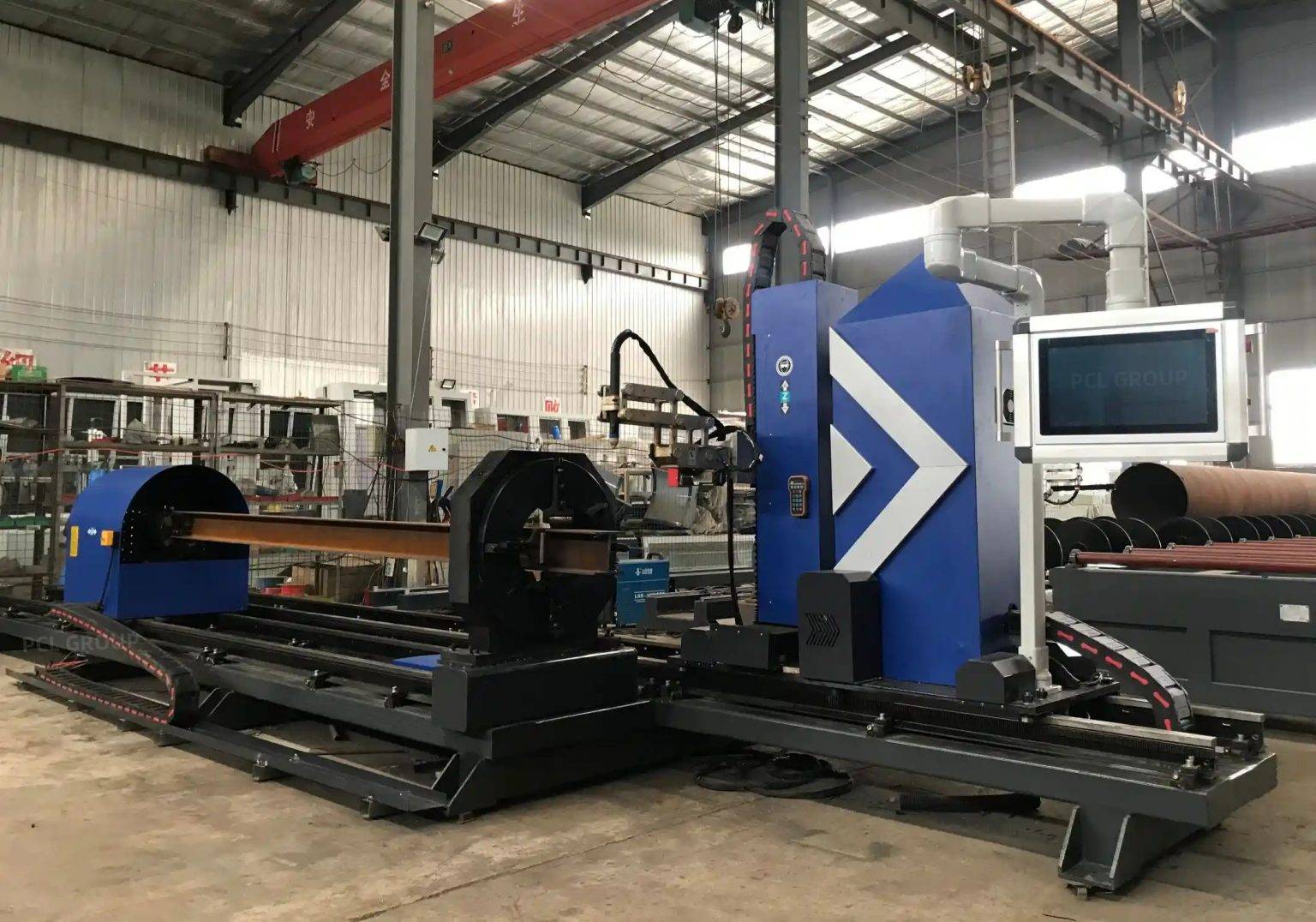
AVC works by monitoring the electrical potential of the plasma arc itself. As the distance between the torch and the steel beam changes, the voltage of the arc varies proportionally. The control system samples this voltage at millisecond intervals, feeding data back to a high-speed Z-axis motor. This creates a real-time feedback loop that maintains a constant standoff distance. For pressure vessel components, this consistency ensures that the cut geometry remains uniform across the entire length of the beam, regardless of surface irregularities. This precision is vital for subsequent assembly phases where gaps must be minimized to ensure structural safety under load.
Maximizing Intersection Accuracy for Complex Geometries
Pressure vessel supports often require complex intersections where beams must interface with cylindrical shells or other structural members. Achieving Plasma Cutting Accuracy during these intersection cuts requires multi-axis synchronization. The production line utilizes CNC programming to calculate the exact path of the plasma torch as it moves across the flanges and web of the H-beam.
High intersection accuracy eliminates the need for manual grinding and secondary fitting. When a beam is cut to wrap around a vessel’s circumference or to join another structural member at an oblique angle, the plasma torch must adjust its orientation dynamically. The AVC system ensures that even during these complex movements, the torch height remains optimized for the specific material thickness encountered at different points of the cut. This results in a “snap-fit” assembly, which significantly reduces the time required for tacking and final assembly while enhancing the overall load-bearing capacity of the structure.
Advanced Beveling for High-Pressure Integrity
Weld preparation is perhaps the most critical stage in the H-Beam Production Line for pressure vessel applications. Deep penetration or full-penetration welds are often required to handle the cyclic loading and thermal expansion associated with vessel operation. Consequently, Bevel Preparation is integrated directly into the plasma cutting process.
Modern plasma units feature 3D tilting heads capable of producing V, Y, K, and X-type bevels. By automating the beveling process, the production line ensures that the angle of the cut is consistent to within fractions of a degree. The Arc Voltage Control system plays a dual role here; it must maintain the correct height even when the torch is inclined at a 45-degree angle. This requires sophisticated algorithms that compensate for the increased arc length inherent in angled cutting. The result is a consistent root face and bevel angle that facilitates superior weld penetration, reducing the risk of internal defects that could lead to structural failure.
Low Maintenance and Operational Reliability
From an industrial engineering perspective, the choice of plasma over other cutting technologies is often driven by the need for Industrial H-Beam Fabrication durability. Plasma systems are inherently robust and designed for the harsh environments of heavy fabrication shops. The lack of sensitive optical components means the system is less susceptible to the vibrations, dust, and temperature fluctuations common in steel mills and vessel shops.
The maintenance profile of a plasma-based H-beam line is predictable and manageable. Consumables such as electrodes and nozzles are the primary wear items, and their replacement is a localized, rapid process that does not require extensive downtime. The mechanical components of the AVC system are shielded from slag and sparks, ensuring a long service life. By focusing on a low-maintenance plasma solution, facilities can achieve higher duty cycles and a lower total cost of ownership. This reliability is essential when meeting tight project deadlines for large-scale energy or chemical processing installations.
Integration into the Production Workflow
The transition from raw H-beam stock to a finished, beveled, and precision-cut component occurs within a single automated workflow. The sequence begins with material sensing, where the dimensions of the incoming beam are verified. Once the beam is positioned, the CNC system takes over, coordinating the movement of the gantry with the AVC-equipped plasma torch.
This integrated approach removes the variability of human error. Each cut, whether it is a simple bolt hole or a complex saddle cut for a vessel interface, is executed with mathematical precision. The data collected by the AVC system can also be logged for quality assurance purposes, providing a digital footprint of the fabrication process. For pressure vessel manufacturers, this level of traceability is often a contractual requirement, ensuring that every structural support meets the specified safety margins. Through the synergy of plasma cutting speed and Arc Voltage Control precision, the H-beam production line stands as a model of modern industrial efficiency.
-


LT240S tube laser cutting machine
-
LT120S tube laser cutting machine
-
Sale

Tank Fillet Welding Machine
Original price was: $1,000.00.$900.00Current price is: $900.00. -
Sale

MAK100 tube laser cutting machine
Original price was: $5,500.00.$5,000.00Current price is: $5,000.00. -

portable plasma air cutting machine
$1,200.00 -

2in1 fiber laser cutting machine
-

Air cooling Laser welding machine
-

HF h beam laser cutting machine
-

LT240 laser cutting machine
-

Laser welding machine
-


Cobot Welding Station
-

Gantry welding robot solution
-

Tracked Wheeled AGV Welding robot
-

LFH6020 Fiber laser cutting machine
-
LFP6020
-

robotic welidng machine
Advanced Fiber Laser Tube Processing Technology
Our CNC Fiber Laser Tube Cutting systems revolutionize metal fabrication by integrating high-precision cutting, punching, and profiling into a single automated workflow. Designed for versatility, this technology handles a wide array of profiles including Round, Square, Rectangular, and Oval tubes, as well as complex L-shaped and U-shaped channels.
- Precision Punching: High-speed hole punching with micron-level accuracy, eliminating the need for mechanical drilling or die-stamping.
- Complex Profiling: Advanced 3D pathing allows for intricate interlocking joints and specialized notch cuts, ideal for structural frames.
- High Material Efficiency: Intelligent nesting software minimizes scrap, reducing raw material costs across large production runs.
- Clean Finish: Delivers oxide-free, burr-free edges that require zero secondary grinding before welding.

Seamlessly processing multiple profiles with consistent precision.
Global Delivery & Logistics



From our high-tech manufacturing facility directly to your global site. PCL WeldCut ensures secure packaging, professional handling, and reliable international logistics to safeguard your equipment throughout the entire journey.