Optimizing H-Beam Fabrication for Pressure Vessel Integrity
In the construction of heavy-duty pressure vessels, the structural integrity of the supporting H-beam framework is as critical as the vessel shell itself. Industrial engineering standards demand rigorous precision in the fabrication of these beams to ensure load distribution and seismic resilience. The transition from manual layout to automated Arc Voltage Control (AVC) in Plasma Cutting lines has redefined the tolerances achievable in structural steel processing. By focusing on the mechanical synergy between the plasma power source and the CNC motion controller, manufacturers can achieve superior fit-up quality required for high-pressure applications.
The Mechanics of Arc Voltage Control in Plasma Systems
Arc Voltage Control is the primary mechanism for maintaining the torch-to-workpiece distance during the cutting cycle. In H-beam production, material irregularities such as flange warping, web bowing, or structural crowning are common. Without a responsive AVC system, the plasma torch remains at a fixed height, leading to variations in the arc length. As the arc length changes, so does the voltage and the resulting kerf angle.
The AVC system functions as a real-time feedback loop. It measures the voltage between the electrode and the H-beam; if the voltage deviates from the set point, the Z-axis motor compensates instantly to move the torch up or down. This constant distance ensures a stable plasma arc column, which is essential for maintaining consistent dross levels and edge perpendicularity. For pressure vessel supports, where beams must often conform to the curvature of a tank, this height stability is the foundation of Intersection Accuracy.
Achieving High-Precision Intersection Accuracy
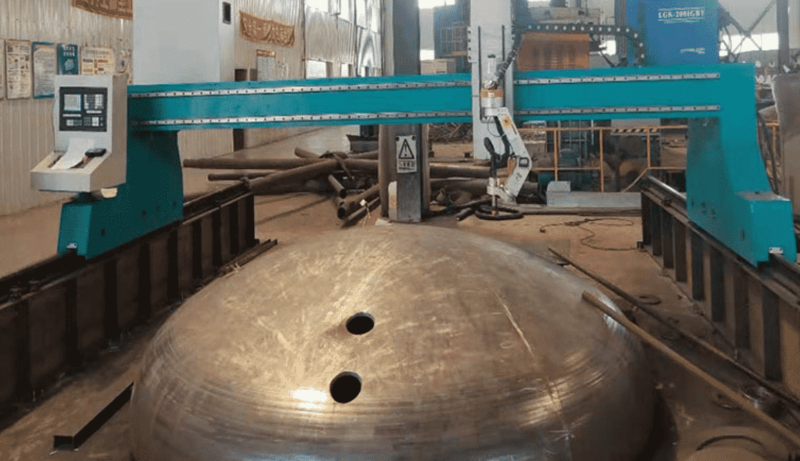
Pressure vessel saddle supports and reinforcement frames require complex intersections where H-beams meet cylindrical or spherical surfaces. Traditional 2D cutting methods fail to account for the three-dimensional “cope” or “fish-mouth” cuts needed for a flush fit-up. Modern H-Beam Production Lines utilize multi-axis robotic arms or specialized gantry systems equipped with plasma torches to execute these trajectories.
Precision at the intersection point reduces the gap variance during assembly. In engineering terms, minimizing the root gap fluctuation allows for more controlled weld deposition in subsequent stages. The use of Plasma Beveling during the intersection cut further enhances this by allowing the beam to wrap around the vessel’s circumference with a continuous bevel angle. This ensures that the structural load is transferred uniformly across the connection point, mitigating stress concentrations that could lead to fatigue failure in the vessel housing.
Advanced Beveling for Groove Preparation
In the context of pressure vessel fabrication, the preparation of the welding groove is a non-negotiable quality gate. Plasma cutting systems integrated into H-beam lines are now capable of executing V, Y, X, and K-style bevels in a single pass. This is achieved through a tilting torch head (often a 5-axis or 6-axis configuration) that adjusts the torch angle relative to the beam surface while maintaining the AVC-regulated height.
The primary advantage here is the reduction of secondary operations. Traditionally, H-beams were cut to length and then moved to a separate station for manual grinding or edge preparation. Automated plasma beveling eliminates this bottleneck. By programming the CNC to include the bevel logic directly into the cutting path, the H-beam emerges from the production line ready for immediate fit-up. This precision is particularly vital for thick-walled H-beams used in heavy industrial skids, where deep penetration is required for structural stability.
Durability and Low Maintenance Requirements
From an operational expenditure (OPEX) perspective, plasma-based H-beam lines offer a significant advantage in terms of Low Maintenance and industrial robustness. Unlike other thermal cutting technologies that may be sensitive to dust, vibration, or ambient temperature fluctuations common in heavy fabrication shops, plasma systems are designed for high duty cycles in harsh environments.
The maintenance profile of a modern plasma system focuses on consumable management rather than complex optical alignments. The torch leads, electrode, and nozzle are designed for rapid replacement, ensuring that downtime is measured in minutes rather than hours. Furthermore, the lack of sensitive internal components in the cutting head makes plasma systems less prone to damage from material collisions or spatter. For a production line focused on pressure vessels, where project timelines are often tight and material costs are high, the reliability of the cutting tool is paramount to maintaining a steady throughput.
Thermal Cutting Optimization and Heat Affected Zone (HAZ)
Industrial engineers often scrutinize the Heat Affected Zone (HAZ) produced by plasma cutting, especially when working with high-strength steels. Modern high-definition plasma systems utilize oxygen-based or nitrogen-shielded gases to constrict the arc, resulting in a narrower HAZ compared to older air-plasma technology. This constriction increases the energy density of the arc, allowing for faster travel speeds.
Faster travel speeds equate to less heat soak into the H-beam. This is critical for maintaining the metallurgical properties of the steel, ensuring that the flanges do not become brittle or lose their yield strength near the cut edge. By optimizing the cutting parameters—specifically the gas flow and current amperage in coordination with the AVC—manufacturers can produce edges that require minimal edge dressing before they are integrated into the vessel’s support structure.
Integration with Structural BIM and CAD/CAM
The final component of the high-accuracy H-beam line is the software integration. Advanced CAD/CAM packages allow for the direct import of BIM (Building Information Modeling) files. The software automatically calculates the necessary compensations for the plasma kerf and the bevel angles required for the pressure vessel’s specific geometry.
This digital workflow ensures that the “as-built” beam matches the “as-designed” model with sub-millimeter precision. When the AVC-controlled torch follows these mathematically derived paths, the resulting component fits perfectly into the assembly, reducing the need for “forced fits” or excessive filler material. This level of synchronization between software and hardware is what allows modern production lines to meet the stringent safety codes of the pressure vessel industry.
Summary of Technical Advantages
By prioritizing Arc Voltage Control and multi-axis plasma capabilities, H-beam production lines achieve a level of precision that was previously unattainable in heavy structural fabrication. The focus on intersection accuracy ensures that vessel supports are both safe and efficient to assemble. The inherent low maintenance of plasma hardware, combined with advanced beveling logic, provides a high-ROI solution for engineers tasked with delivering complex industrial infrastructure under rigorous quality standards.
-


LT240S tube laser cutting machine
-
LT120S tube laser cutting machine
-
Sale

Tank Fillet Welding Machine
Original price was: $1,000.00.$900.00Current price is: $900.00. -
Sale

MAK100 tube laser cutting machine
Original price was: $5,500.00.$5,000.00Current price is: $5,000.00. -

portable plasma air cutting machine
$1,200.00 -

2in1 fiber laser cutting machine
-

Air cooling Laser welding machine
-

HF h beam laser cutting machine
-

LT240 laser cutting machine
-

Laser welding machine
-


Cobot Welding Station
-

Gantry welding robot solution
-

Tracked Wheeled AGV Welding robot
-

LFH6020 Fiber laser cutting machine
-
LFP6020
-

robotic welidng machine
Advanced Fiber Laser Tube Processing Technology
Our CNC Fiber Laser Tube Cutting systems revolutionize metal fabrication by integrating high-precision cutting, punching, and profiling into a single automated workflow. Designed for versatility, this technology handles a wide array of profiles including Round, Square, Rectangular, and Oval tubes, as well as complex L-shaped and U-shaped channels.
- Precision Punching: High-speed hole punching with micron-level accuracy, eliminating the need for mechanical drilling or die-stamping.
- Complex Profiling: Advanced 3D pathing allows for intricate interlocking joints and specialized notch cuts, ideal for structural frames.
- High Material Efficiency: Intelligent nesting software minimizes scrap, reducing raw material costs across large production runs.
- Clean Finish: Delivers oxide-free, burr-free edges that require zero secondary grinding before welding.

Seamlessly processing multiple profiles with consistent precision.
Global Delivery & Logistics



From our high-tech manufacturing facility directly to your global site. PCL WeldCut ensures secure packaging, professional handling, and reliable international logistics to safeguard your equipment throughout the entire journey.