Optimizing H-Beam Fabrication for Oil and Gas Storage Infrastructure
In the structural fabrication sector of the oil and gas industry, the demand for precision in heavy-duty H-beam components is non-negotiable. These beams serve as the skeletal framework for massive storage tanks and pressure vessels, where every millimeter of deviation can lead to structural compromise or costly onsite adjustments. The implementation of an H-Beam Production Line utilizing high-definition Plasma Cutting technology has revolutionized this workflow. Unlike traditional mechanical methods, plasma processing offers a versatile approach to handling complex geometries while maintaining high throughput.
The primary challenge in processing large-scale H-beams for tank supports lies in the consistency of the cut across long spans and varying material thicknesses. As an industrial engineer, the focus remains on reducing the Total Cost of Ownership (TCO) while ensuring that the output meets American Petroleum Institute (API) standards. This is achieved through the marriage of robust mechanical design and sophisticated electronic feedback loops.
The Critical Function of Arc Voltage Control (AVC)
At the heart of a high-performance plasma system is the Arc Voltage Control system. In plasma cutting, the distance between the torch nozzle and the workpiece—often referred to as the torch-to-work distance—is directly proportional to the voltage of the plasma arc. Even the highest quality H-beams are rarely perfectly flat or straight; they often possess slight bows, twists, or surface irregularities.
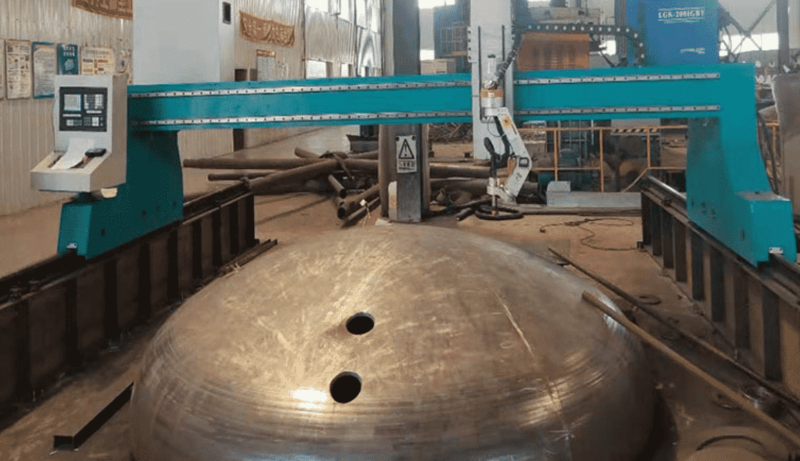
The AVC system functions as a real-time closed-loop feedback mechanism. By continuously monitoring the arc voltage, the system can detect minute changes in the distance to the plate. If the voltage fluctuates, indicating a change in distance, the Z-axis motor receives an immediate command to adjust the torch height. This ensures a constant arc length, which is vital for maintaining a uniform kerf width and preventing dross accumulation. For oil and gas tanks, where structural integrity depends on tight fit-ups, the stability provided by AVC is the difference between a clean cut and a rejected component.
Achieving Superior Intersection Accuracy
Oil and gas tanks require complex intersections where H-beams must interface with curved shell plates or other structural members at varying angles. Achieving high Intersection Accuracy is a primary objective for any automated production line. When cutting copes, notches, or bolt holes, the plasma torch must navigate the web and flanges of the H-beam with extreme precision.
Modern plasma cutting lines utilize 5-axis or 6-axis robotic heads that can rotate around the beam’s profile. The integration of CNC algorithms allows the machine to compensate for the beam’s dimensional tolerances in real-time. By accurately calculating the intersection points where a beam meets a cylindrical tank wall, the plasma system produces a contoured cut that requires no manual trimming. This precision reduces the gap during assembly, ensuring that the subsequent structural connections are sound and that the stress distribution across the tank support remains within engineering specifications.
Plasma Beveling for Enhanced Weld Preparation
Weld preparation is perhaps the most labor-intensive aspect of H-beam fabrication. For heavy-wall tanks, the edges of the H-beam flanges must be beveled to allow for full-penetration welds. Plasma Beveling integrated directly into the production line eliminates the need for secondary grinding or edge milling.
The system can execute V, K, Y, and X-type bevels with high repeatability. Because the AVC maintains the torch height even at an angle, the bevel depth remains consistent throughout the entire length of the cut. This is particularly important for the thick-gauge steel commonly used in the oil and gas sector. By providing a clean, beveled edge straight from the cutting bed, the production line significantly reduces the “man-hours per ton” metric, which is a key performance indicator (KPI) in industrial engineering.
Mechanical Reliability and Low Maintenance Design
In an industrial environment, downtime is the enemy of profitability. A key advantage of modern plasma-based H-beam lines is their low maintenance profile. Unlike mechanical saws or drills that suffer from tool wear, breakage, and the need for constant lubrication, plasma is a non-contact thermal process. This inherently reduces the mechanical stress on the machine components.
To ensure high uptime, these lines are designed with heavy-duty rack-and-pinion drives and pressurized cabinets to protect electronics from metallic dust. The consumables in the plasma torch—the electrode, nozzle, and swirl ring—are designed for extended life cycles. Modern power supplies provide “soft-start” technology, which reduces the thermal shock to these components, further extending their operational life. For an oil and gas fabrication facility, this means fewer interruptions and a more predictable maintenance schedule, allowing for continuous multi-shift operations.
Thermal Distortion Management and Kerf Compensation
Cutting thick H-beams introduces significant thermal energy into the material. Without proper management, this can lead to heat-affected zones (HAZ) or structural warping. Industrial-grade plasma systems manage this through optimized cutting speeds and gas chemistry. By using oxygen or nitrogen-water injection, the system can narrow the HAZ, preserving the metallurgical properties of the steel.
Furthermore, the CNC control system applies dynamic kerf compensation. As the torch moves through different thicknesses—transitioning from the flange to the web—the system adjusts the feed rate and gas pressure. This ensures that the internal and external dimensions of the cut remain within a tolerance of +/- 0.5mm, which is essential for the high-tolerance requirements of modular tank construction.
Standardizing Quality through CNC Integration
The final layer of the H-beam production line is the software integration. By importing CAD/BIM models directly into the cutting controller, the possibility of human error in measurement is virtually eliminated. The software automatically nests the parts to maximize material utilization and programs the AVC setpoints for each specific cut. In the context of oil and gas tanks, this digital thread ensures that every beam produced is a perfect replica of the engineering design, facilitating faster field assembly and higher safety margins.
Conclusion: The Industrial Engineering Perspective on Throughput
From a process engineering standpoint, the transition to an AVC-enabled plasma cutting line for H-beams represents a significant leap in operational efficiency. By prioritizing intersection accuracy and automating the beveling process, fabricators can achieve a level of consistency that manual methods cannot replicate. The combination of high-speed thermal cutting and low maintenance requirements creates a robust production environment capable of meeting the rigorous demands of the energy sector. As we continue to scale oil and gas infrastructure, the role of precision plasma processing remains a cornerstone of structural integrity and economic viability.
-


LT240S tube laser cutting machine
-
LT120S tube laser cutting machine
-
Sale

Tank Fillet Welding Machine
Original price was: $1,000.00.$900.00Current price is: $900.00. -
Sale

MAK100 tube laser cutting machine
Original price was: $5,500.00.$5,000.00Current price is: $5,000.00. -

portable plasma air cutting machine
$1,200.00 -

2in1 fiber laser cutting machine
-

Air cooling Laser welding machine
-

HF h beam laser cutting machine
-

LT240 laser cutting machine
-

Laser welding machine
-


Cobot Welding Station
-

Gantry welding robot solution
-

Tracked Wheeled AGV Welding robot
-

LFH6020 Fiber laser cutting machine
-
LFP6020
-

robotic welidng machine
Advanced Fiber Laser Tube Processing Technology
Our CNC Fiber Laser Tube Cutting systems revolutionize metal fabrication by integrating high-precision cutting, punching, and profiling into a single automated workflow. Designed for versatility, this technology handles a wide array of profiles including Round, Square, Rectangular, and Oval tubes, as well as complex L-shaped and U-shaped channels.
- Precision Punching: High-speed hole punching with micron-level accuracy, eliminating the need for mechanical drilling or die-stamping.
- Complex Profiling: Advanced 3D pathing allows for intricate interlocking joints and specialized notch cuts, ideal for structural frames.
- High Material Efficiency: Intelligent nesting software minimizes scrap, reducing raw material costs across large production runs.
- Clean Finish: Delivers oxide-free, burr-free edges that require zero secondary grinding before welding.

Seamlessly processing multiple profiles with consistent precision.
Global Delivery & Logistics



From our high-tech manufacturing facility directly to your global site. PCL WeldCut ensures secure packaging, professional handling, and reliable international logistics to safeguard your equipment throughout the entire journey.