Optimizing Structural Integrity via 5-Axis Plasma Beveling
In the fabrication of heavy-duty construction machinery—such as excavator chassis, crane booms, and large-scale loader frames—the H-beam serves as a primary structural element. The transition toward automated H-Beam Production Line environments has necessitated a shift in how these beams are processed. Traditional manual layout and oxy-fuel cutting often fall short of the rigorous tolerances required for modern assembly. High-definition plasma technology, specifically when coupled with a 5-axis kinematic head, provides the necessary precision and throughput to meet these industrial demands.
Kinematics of the 5-Axis Plasma Head
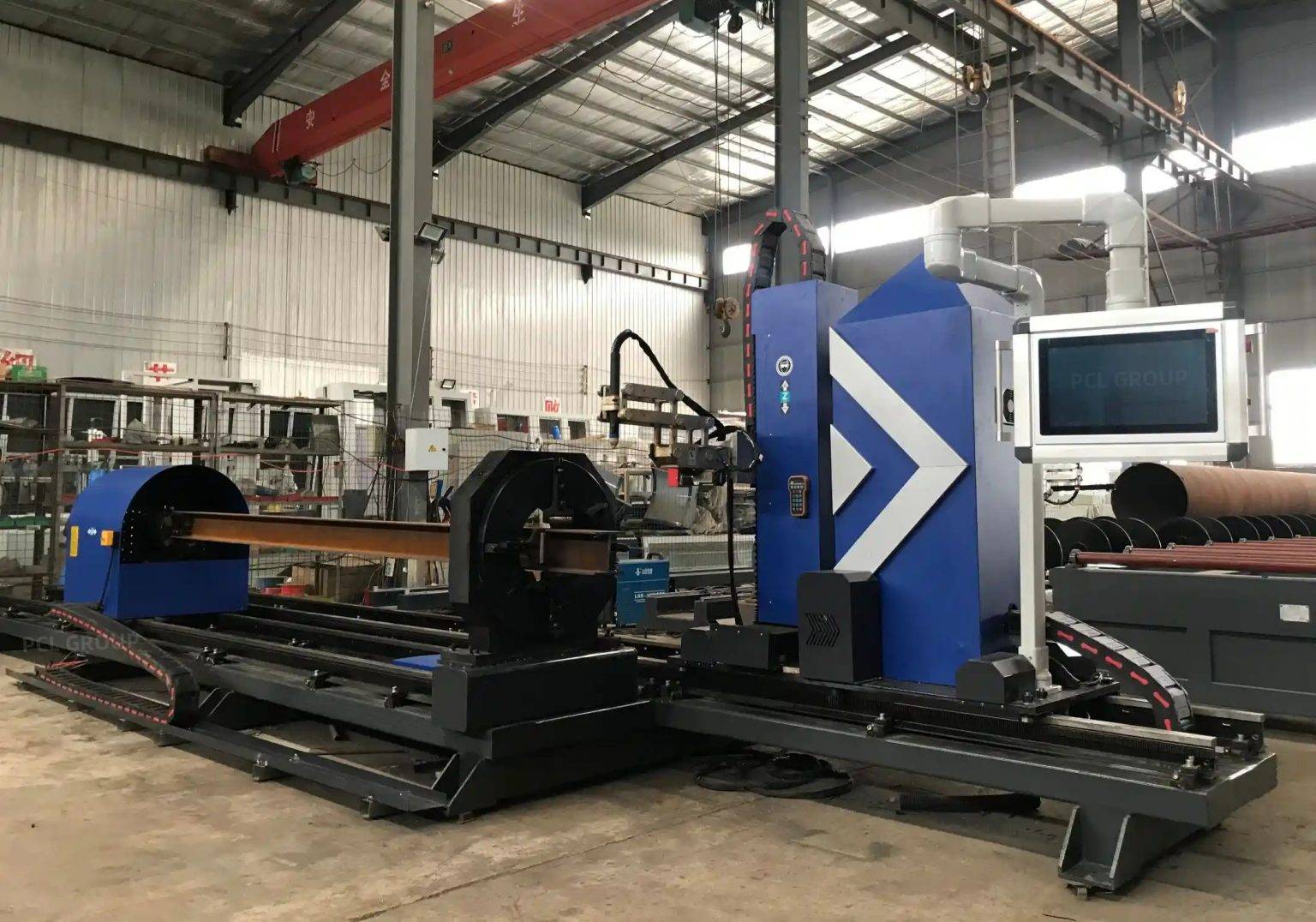
The core of the beveling capability lies in the torch head’s ability to move beyond the standard X, Y, and Z Cartesian coordinates. A 5-axis system introduces two rotational axes, often referred to as the A and B axes. This allows the plasma torch to tilt and rotate simultaneously, maintaining a consistent focal distance from the beam surface regardless of the angle. For H-beams, which feature both web and flange surfaces, this multi-axis capability is essential for creating complex bevel profiles such as V, Y, X, and K-cuts.
Industrial engineers prioritize these systems because they can execute a bevel while the beam is stationary or in a controlled longitudinal crawl. The 5-axis plasma beveling head compensates for the material’s natural variations—such as flange out-of-squareness or web centering issues—by using integrated tactile or laser-based sensing. This real-time adjustment ensures that the bevel angle remains consistent throughout the entire length of the cut, which is critical for the subsequent structural integrity of the machinery.
Achieving Superior Intersection Accuracy
One of the most significant challenges in construction machinery fabrication is the intersection of structural members. Whether it is a miter joint or a saddle cut where a secondary beam meets the main H-beam, intersection accuracy determines the quality of the final assembly. Plasma Cutting systems equipped with advanced CNC controllers utilize sophisticated nesting and pathing algorithms to calculate the exact kerf compensation needed for angled cuts.
When an H-beam undergoes a 5-axis bevel, the software must account for the changing thickness of the material as the torch tilts. A 20mm web becomes effectively thicker when cut at a 45-degree angle. High-definition plasma systems manage this by modulating the arc voltage and gas flow in real-time. The result is a clean, sharp edge with minimal dross and a narrow heat-affected zone (HAZ). Accurate intersections eliminate the need for secondary grinding or manual “fitting” on the assembly floor, directly reducing labor costs and shortening production cycles.
Plasma Arc Physics and Material Interaction
Unlike mechanical shearing or conventional cutting, plasma utilizes an ionized gas to transfer energy to the workpiece. In a high-definition setup, the arc is constricted by a specialized nozzle design, focusing the thermal energy into a very small area. This concentration is what allows for the high degree of precision in beveling. for Construction Machinery, where the steel grades are often high-strength low-alloy (HSLA), maintaining the metallurgical properties of the beam is paramount. Modern plasma cutting systems are calibrated to move at speeds that minimize total heat input, preventing the warping or embrittlement of the H-beam flanges.
Low Maintenance Profiles for Heavy Fabrication
Reliability is the cornerstone of industrial engineering. A production line is only as valuable as its uptime. Plasma systems are inherently robust, designed to operate in the dusty, vibration-heavy environments of structural steel shops. One of the primary drivers for selecting plasma over other thermal cutting methods is the H-beam low maintenance requirement of the torch assembly. The primary wear parts—nozzles, electrodes, and swirl rings—are designed for rapid replacement, often featuring “quick-change” architectures that allow an operator to resume production in under two minutes.
Furthermore, the absence of complex optical paths or delicate lens arrays means the system is less susceptible to the environmental contaminants common in heavy industry. The cooling systems for high-current plasma torches have also evolved; closed-loop liquid cooling prevents the overheating of the 5-axis head during extended duty cycles. For a production line running two or three shifts, this thermal stability ensures that the first cut of the day is identical to the last.
System Integration and Workflow Efficiency
Integrating a 5-axis plasma unit into a full H-beam line involves more than just the cutting head. It requires a synchronized material handling system. Typically, the line starts with an infeed conveyor that positions the beam using a hydraulic clamping and measuring carriage. This ensures the CNC “knows” exactly where the beam begins. Once positioned, the plasma head executes the programmed cuts, including bolt holes, cope notches, and bevels, in a single sequence.
This “one-pass” processing is a massive leap in efficiency. In older workflows, a beam might move from a drill line to a separate sawing station and then to a manual beveling area. By consolidating these functions into a 5-axis plasma station, the industrial engineer eliminates the “hidden” costs of material handling—the time spent waiting for a crane or the risk of damage during transport. The digital workflow from CAD to CAM to CNC ensures that the geometric intent of the designer is perfectly captured in the physical part.
Operational Cost Factors
From an OEE (Overall Equipment Effectiveness) perspective, the 5-axis plasma station is evaluated on its cost per cut. While gas consumption (Oxygen, Nitrogen, or Air) and consumable life are the primary variable costs, they are offset by the high cutting speeds—often exceeding 2000mm/min depending on thickness. Additionally, the ability to perform “common line cutting” and optimized nesting within the software reduces scrap rates. In the context of construction machinery, where steel prices fluctuate significantly, a 3-5% increase in material utilization can translate to tens of thousands of dollars in annual savings.
Conclusion: The Future of Beam Processing
The 5-axis plasma beveling station represents the pinnacle of current H-beam processing technology for the construction machinery sector. By focusing on high-definition arc control and mechanical robustness, manufacturers can achieve the tight tolerances required for complex structural intersections. The combination of precision, low maintenance, and high throughput makes it the preferred choice for engineers looking to modernize their production facilities. As the industry moves toward further automation, the role of plasma as a versatile and reliable cutting medium remains unchallenged in the heavy structural domain.
-


Cantilever Welding Robot solution
-


GF laser cutting machine
-

P3015 plasma cutting machine
-

LFP3015 Fiber Laser Cutter
-

pipe plasma cutting machine
-
LFH 4020 Fiber Laser Cutting Machine
-
LFP4020
-

gantry plasma air cutting machine
-

3D robot cutting machine
-

8 axis plasma cutting machine
-

5 axis plasma cutting machine
-

LT360 tube laser cutting machine
-

robot welding workstation
-

SF6060 fiber laser cutting machine
Advanced Fiber Laser Tube Processing Technology
Our CNC Fiber Laser Tube Cutting systems revolutionize metal fabrication by integrating high-precision cutting, punching, and profiling into a single automated workflow. Designed for versatility, this technology handles a wide array of profiles including Round, Square, Rectangular, and Oval tubes, as well as complex L-shaped and U-shaped channels.
- Precision Punching: High-speed hole punching with micron-level accuracy, eliminating the need for mechanical drilling or die-stamping.
- Complex Profiling: Advanced 3D pathing allows for intricate interlocking joints and specialized notch cuts, ideal for structural frames.
- High Material Efficiency: Intelligent nesting software minimizes scrap, reducing raw material costs across large production runs.
- Clean Finish: Delivers oxide-free, burr-free edges that require zero secondary grinding before welding.

Seamlessly processing multiple profiles with consistent precision.
Global Delivery & Logistics



From our high-tech manufacturing facility directly to your global site. PCL WeldCut ensures secure packaging, professional handling, and reliable international logistics to safeguard your equipment throughout the entire journey.