Advanced Fiber Laser Integration in Pressure Vessel Fabrication
In the specialized field of pressure vessel manufacturing, the transition from traditional mechanical processing to high-power fiber laser systems represents a significant shift in industrial efficiency. For engineers managing the fabrication of tanks, boilers, and heat exchangers, the primary objectives are geometric accuracy, structural integrity, and material utilization. The introduction of Zero-tailing technology has revolutionized how cylindrical and spherical components are processed, specifically addressing the historical problem of material waste at the end of raw stock feeds.
Mechanical Superiority of Fiber Laser Systems
Fiber Laser Cutting utilizes a solid-state laser source where the beam is generated in an optical fiber doped with rare-earth elements. This beam is delivered via a flexible fiber optic cable to the cutting head, resulting in a high-intensity energy density that far exceeds the capabilities of CO2 or mechanical cutting tools. From an engineering perspective, the focal spot size—often less than 0.1mm—allows for a narrow kerf width. This precision ensures that the Heat Affected Zone (HAZ) is minimized, preserving the metallurgical properties of high-tensile steels and stainless alloys common in pressure vessel construction.
Zero-Tailing Technology: Engineering the Minimal Waste Cycle
Material costs account for a substantial percentage of the total cost of ownership in pressure vessel production. Traditional tube and sheet cutting often leave a significant “tail” or remnant that cannot be processed by the clamping chucks. Zero-tailing technology employs a multi-chuck synchronized motion system. In a three-chuck or four-chuck configuration, the lead chuck pulls the material through the cutting zone while the trailing chucks maintain rigid support. As the cut nears the end of the stock, the chucks re-position dynamically, allowing the cutting head to process the material right up to the final millimeter.
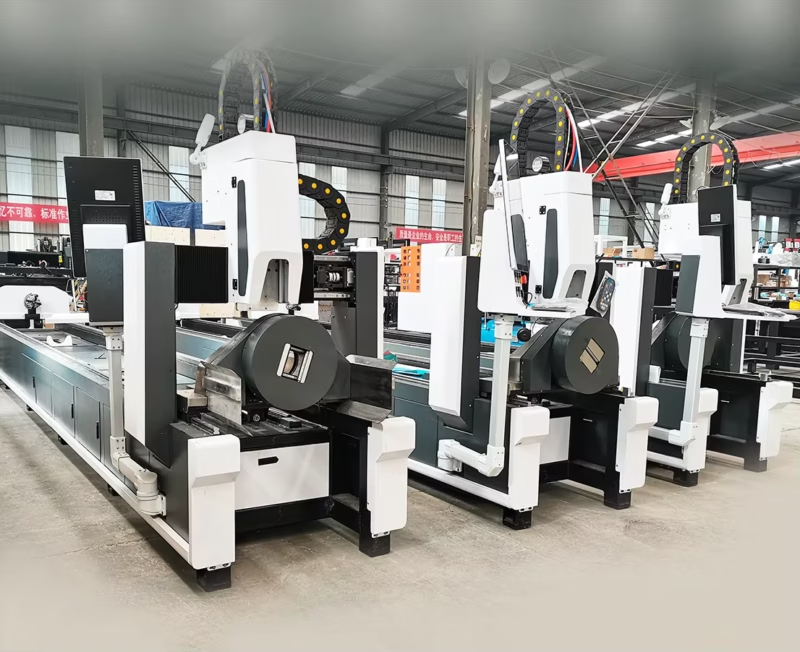
This capability directly impacts nesting efficiency, allowing for more parts to be extracted from a single length of pipe or plate. By reducing the scrap rate from several inches to virtually zero, manufacturers realize an immediate improvement in ROI, especially when working with expensive alloys like Duplex stainless steel or Monel.
Eliminating Secondary Grinding Operations
A critical advantage of the fiber laser in a pressure vessel workflow is the edge quality. Because the fiber laser operates at high frequencies with precise gas assist (typically Oxygen or Nitrogen), the resulting cut edge is exceptionally smooth. In traditional fabrication, edges often require manual grinding to remove dross or to correct geometric deviations before the assembly moves to the welding station.
The fiber laser’s ability to produce a weld-ready edge means that components can move directly from the cutting bed to the assembly jig. The absence of mechanical burrs and slag ensures that fit-up tolerances are maintained within microns. This consistency is vital for the automated longitudinal and circumferential seams required in pressure-retaining equipment, where gap consistency dictates the quality of the root pass.
Integrated Punching, Marking, and Cutting Workflows
Modern industrial fiber lasers are no longer solitary cutting tools; they are integrated machining centers. Within a single NC program, the system can execute three distinct operations:
1. Precision Piercing (Punching): Instead of mechanical punching which can deform thin-walled vessels or create micro-cracks in brittle materials, the fiber laser uses a staged piercing sequence. By modulating the frequency and duty cycle, the laser creates clean entry holes for nozzles and manways without compromising the surrounding material structure.
2. Surface Marking: Traceability is a mandatory requirement under ASME Section VIII. The fiber laser can be de-focused or operated at lower power to etch heat numbers, part ID codes, and alignment marks directly onto the surface. This eliminates the need for manual stamping or secondary ink-jet marking, ensuring that traceability remains permanent throughout the vessel’s lifecycle.
3. Final Profiling (Cutting): The high-velocity cutting phase completes the geometry. For pressure vessel heads and shells, the laser can handle complex saddle cuts and hole profiles with 5-axis motion, allowing for precise beveling that facilitates high-quality butt joints.
Optimizing Beam Collimation and Focal Depth
To maintain precision across varying wall thicknesses, the engineering team must focus on beam collimation. Automatic focusing heads adjust the lens position in real-time based on material feedback sensors. This is particularly important for Pressure Vessels that may have slight variations in wall thickness or surface eccentricity. The fiber laser’s ability to maintain a consistent power density through the thickness of the material ensures that the exit side of the cut is as clean as the entry side, preventing the formation of “re-cast” material that could lead to stress concentrations.
Strategic Impact on Production Throughput
From a production management standpoint, the implementation of a zero-tailing fiber laser system removes several bottlenecks. The consolidation of marking and cutting into one setup reduces work-in-progress (WIP) inventory. There is no longer a need to move large, heavy cylinders between a marking station, a drilling station, and a cutting station. The reduction in material handling not only saves time but also minimizes the risk of surface contamination—a critical factor when fabricating vessels for the pharmaceutical or food grade industries.
Technical Specifications and Energy Efficiency
Industrial engineers must also consider the Heat Affected Zone management as a key performance indicator. Fiber lasers operate at a wavelength of approximately 1.06 microns, which is more readily absorbed by metals than the 10.6 microns of CO2 lasers. This leads to faster cutting speeds and lower total heat input into the part. Lower heat input means less thermal distortion of the vessel shell, ensuring that the final product meets the roundness tolerances required for internal baffles or external jackets.
Conclusion: The Engineering Standard for Future Fabrication
The adoption of fiber laser cutting with Zero-tailing technology represents the pinnacle of current pressure vessel fabrication strategy. By focusing on high-precision beam delivery and intelligent material handling, manufacturers can eliminate wasteful remnants and secondary labor-intensive processes like grinding. The result is a streamlined, highly repeatable manufacturing process that yields superior structural components. As the industry moves toward further automation, the integration of these laser systems will be the defining factor in maintaining competitive edge and ensuring the long-term safety and reliability of pressure-retaining hardware.
-


LT240S tube laser cutting machine
-
LT120S tube laser cutting machine
-
Sale

Tank Fillet Welding Machine
Original price was: $1,000.00.$900.00Current price is: $900.00. -
Sale

MAK100 tube laser cutting machine
Original price was: $5,500.00.$5,000.00Current price is: $5,000.00. -

portable plasma air cutting machine
$1,200.00 -

2in1 fiber laser cutting machine
-

Air cooling Laser welding machine
-

HF h beam laser cutting machine
-

LT240 laser cutting machine
-

Laser welding machine
-


Cobot Welding Station
-

Gantry welding robot solution
-

Tracked Wheeled AGV Welding robot
-

LFH6020 Fiber laser cutting machine
-
LFP6020
-

robotic welidng machine
Advanced Fiber Laser Tube Processing Technology
Our CNC Fiber Laser Tube Cutting systems revolutionize metal fabrication by integrating high-precision cutting, punching, and profiling into a single automated workflow. Designed for versatility, this technology handles a wide array of profiles including Round, Square, Rectangular, and Oval tubes, as well as complex L-shaped and U-shaped channels.
- Precision Punching: High-speed hole punching with micron-level accuracy, eliminating the need for mechanical drilling or die-stamping.
- Complex Profiling: Advanced 3D pathing allows for intricate interlocking joints and specialized notch cuts, ideal for structural frames.
- High Material Efficiency: Intelligent nesting software minimizes scrap, reducing raw material costs across large production runs.
- Clean Finish: Delivers oxide-free, burr-free edges that require zero secondary grinding before welding.

Seamlessly processing multiple profiles with consistent precision.
Global Delivery & Logistics



From our high-tech manufacturing facility directly to your global site. PCL WeldCut ensures secure packaging, professional handling, and reliable international logistics to safeguard your equipment throughout the entire journey.