Optimizing Pressure Vessel Fabrication via Fiber Laser Precision
In the field of pressure vessel manufacturing, the transition from conventional thermal cutting to high-power fiber laser technology represents a significant shift in production efficiency. Pressure vessels, which must withstand extreme internal forces, demand rigorous adherence to dimensional tolerances and material integrity. The implementation of fiber laser systems allows for a streamlined workflow where the traditional bottlenecks of secondary processing are eliminated. By focusing on the precise control of the heat-affected zone (HAZ) and the mechanical stability of the cutting platform, industrial engineers can ensure that the structural properties of the base metal remain uncompromised during the fabrication of shells and heads.
The Mechanics of Zero-Tailing Technology
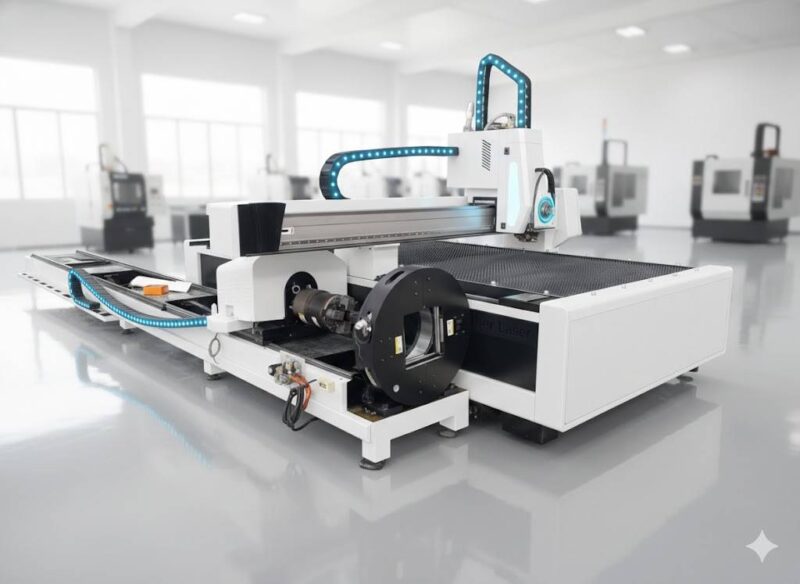
Material cost typically constitutes the largest percentage of the total cost of goods sold (COGS) in pressure vessel production. Standard Laser Cutting machines often leave a significant “tail” or remnant at the end of a pipe or plate, leading to 10% to 15% material waste. Zero-tailing technology utilizes advanced multi-chuck systems—often a three-chuck or four-chuck configuration—that allow the material to be fed through the cutting zone with near-total utilization.
From an engineering perspective, zero-tailing technology functions by synchronized clamping and shifting. As the laser head nears the end of the workpiece, the rear chucks pass the material to the front chucks, maintaining a rigid hold while the final cut is executed. This eliminates the “dead zone” of the machine, ensuring that even the final few centimeters of high-value alloy or carbon steel are utilized. For pressure vessel manufacturers, this translates directly to a lower cost-per-part and a more sustainable production cycle.
Eliminating Secondary Grinding Processes
One of the primary advantages of fiber laser cutting over other thermal methods is the edge quality. High-power fiber lasers (typically 12kW to 30kW for vessel walls) produce a cut edge with minimal roughness. In traditional manufacturing, edges often require mechanical grinding to remove dross or to correct the bevel profile before assembly. Fiber laser systems achieve a “ready-to-fit” edge straight from the machine bed.
The lack of slag and the precision of the beam focus mean that the kerf width is extremely narrow and consistent. This precision is critical when preparing longitudinal or circumferential seams. When the edges are clean and the geometry is exact, the subsequent fit-up process is accelerated. Industrial engineers find that the removal of the grinding stage reduces labor hours by approximately 20% to 30% and significantly lowers the noise and dust pollution within the facility.
Integrated Punching and Marking Capabilities
Modern fiber laser systems for Pressure Vessels are not merely cutting tools; they are multi-functional processing centers. The ability to punch, mark, and cut in a single setup is a major driver of operational efficiency.
High-Speed Hole Punching
For the installation of nozzles, manways, and instrumentation ports, the fiber laser executes high-speed punching and circular cutting. Unlike mechanical punching, which can introduce stress fractures or deformation in thick-walled vessels, the laser uses a non-contact process. The piercing sequences are optimized through software to ensure that the entry point of the laser does not create a defect in the finished circumference of the hole.
Surface Marking and Traceability
Traceability is a legal requirement in the pressure vessel industry. Every component must be linked to its material heat number and batch record. Fiber lasers can be programmed to etch alphanumeric codes, QR codes, or alignment markers directly onto the surface of the metal. This marking occurs at a lower power setting and high speed, ensuring that the structural integrity of the vessel wall is not affected. Marking the centerlines and attachment points during the cutting phase ensures that layout errors during assembly are virtually eliminated.
Dimensional Integrity and Thermal Management
Pressure vessels often utilize thick plates of carbon steel, stainless steel, or specialized alloys. Managing the thermal input during the cutting process is vital to preventing warping. Fiber lasers operate at a wavelength (approximately 1.06 microns) that is highly absorbed by metals, allowing for faster cutting speeds with less total heat input compared to older CO2 technologies.
By maintaining a high material utilization rate through nesting software, the heat is distributed across the workpiece efficiently. Industrial engineers can program the cutting sequence to jump between different areas of the part, allowing local temperatures to dissipate. This thermal management ensures that the circularity of the vessel shells remains within the strict tolerances required by international standards such as ASME Section VIII.
The Industrial Engineering Perspective on Throughput
Total Cost of Ownership (TCO) analysis shows that while fiber laser systems represent a significant capital investment, the return on investment (ROI) is accelerated through increased throughput. A fiber laser can cut through 20mm stainless steel at speeds that triple those of traditional mechanical methods. When combined with zero-tailing features, the machine uptime is maximized because there is less time spent handling scrap and remnants.
Furthermore, the integration of high-precision cutting reduces the “rework” rate. In a standard production environment, parts that do not meet the fit-up tolerance must be trimmed or filled, both of which add time and cost. The fiber laser ensures that the first cut is the final cut. The stability of the fiber source itself—which requires no gas mixing or mirror alignments—results in a machine availability rate often exceeding 95%.
Workflow Integration and CAD/CAM Synergy
The transition to fiber laser technology requires a robust digital thread. Engineering designs from CAD software are fed directly into CAM nesting programs that calculate the optimal path for zero-tailing. These programs account for the thickness of the material, the required bevel angles (V, X, or K types), and the specific gas pressures (Oxygen or Nitrogen) needed for the cleanest possible cut.
The software also manages the “micro-jointing” of parts, ensuring that even as the zero-tailing chucks move the material, the parts remain stable. Once the program is triggered, the intervention of the operator is minimal, allowing one technician to oversee multiple machines. This shift from manual labor to process oversight is a hallmark of modern industrial engineering in the heavy fabrication sector.
Conclusion: The Future of Vessel Fabrication
The adoption of fiber laser cutting with Zero-tailing technology is no longer optional for facilities aiming to compete on a global scale. The combination of material savings, the elimination of secondary grinding, and the multi-process capability of punching and marking creates a streamlined production environment. By focusing on precision and efficiency, manufacturers of pressure vessels can ensure higher safety standards and lower operational costs, securing their position in a demanding industrial landscape.
-


LT240S tube laser cutting machine
-
LT120S tube laser cutting machine
-
Sale

Tank Fillet Welding Machine
Original price was: $1,000.00.$900.00Current price is: $900.00. -
Sale

MAK100 tube laser cutting machine
Original price was: $5,500.00.$5,000.00Current price is: $5,000.00. -

portable plasma air cutting machine
$1,200.00 -

2in1 fiber laser cutting machine
-

Air cooling Laser welding machine
-

HF h beam laser cutting machine
-

LT240 laser cutting machine
-

Laser welding machine
-


Cobot Welding Station
-

Gantry welding robot solution
-

Tracked Wheeled AGV Welding robot
-

LFH6020 Fiber laser cutting machine
-
LFP6020
-

robotic welidng machine
Advanced Fiber Laser Tube Processing Technology
Our CNC Fiber Laser Tube Cutting systems revolutionize metal fabrication by integrating high-precision cutting, punching, and profiling into a single automated workflow. Designed for versatility, this technology handles a wide array of profiles including Round, Square, Rectangular, and Oval tubes, as well as complex L-shaped and U-shaped channels.
- Precision Punching: High-speed hole punching with micron-level accuracy, eliminating the need for mechanical drilling or die-stamping.
- Complex Profiling: Advanced 3D pathing allows for intricate interlocking joints and specialized notch cuts, ideal for structural frames.
- High Material Efficiency: Intelligent nesting software minimizes scrap, reducing raw material costs across large production runs.
- Clean Finish: Delivers oxide-free, burr-free edges that require zero secondary grinding before welding.

Seamlessly processing multiple profiles with consistent precision.
Global Delivery & Logistics



From our high-tech manufacturing facility directly to your global site. PCL WeldCut ensures secure packaging, professional handling, and reliable international logistics to safeguard your equipment throughout the entire journey.