Optimizing Oil and Gas Tank Fabrication via Fiber Laser Precision
In the heavy industrial sector, specifically within the production of pressure vessels and oil and gas tanks, the margin for error is non-existent. Traditional fabrication methods often result in significant material loss and extensive post-processing requirements. The transition to high-power fiber Laser Cutting systems represents a fundamental shift in industrial engineering strategy. Unlike legacy thermal cutting processes, fiber lasers operate at a wavelength of approximately 1.06 microns, allowing for a focused spot size that produces exceptional energy density. This density facilitates a narrow kerf width and a negligible heat-affected zone (HAZ), which are critical for maintaining the metallurgical integrity of high-tensile steels and specialized alloys used in the energy sector.
The Mechanics of Zero-Tailing Technology
Material cost accounts for a substantial percentage of the total project overhead in tank manufacturing. Standard tube and pipe laser systems typically leave a “tail” of unprocessed material—often 200mm to 500mm in length—due to the physical distance between the cutting head and the chuck. Zero-tailing technology utilizes a multi-chuck synchronization system, often employing three or four independent moving chucks. These components work in a “leapfrog” motion, allowing the cutting head to process material directly adjacent to or even within the clamping zone of the final chuck.
Chuck Synchronization and Material Recovery
The engineering logic behind zero-tailing involves real-time feedback loops and high-speed bus communication between the CNC controller and the servo-driven chucks. By enabling the laser to cut the pipe closer to the end-point, the scrap rate is reduced to near zero. For large-diameter pipes used in tank manifolds and structural supports, this recovery can save thousands of dollars per production cycle. This is not merely an incremental improvement; it is a total optimization of the raw material pipeline.
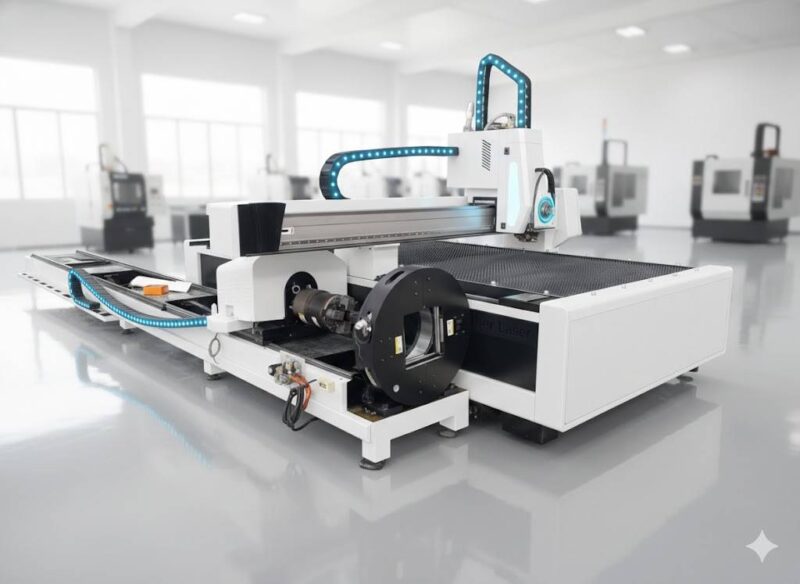
Unified Workflow: Punch, Mark, and Cut
Efficiency in an industrial setting is measured by the reduction of “touches” per part. Fiber laser cutting machines designed for the oil and gas industry integrate three distinct operations into a single CNC program.
High-Speed Precision Punching
In this context, “punching” refers to the laser’s ability to perform high-speed piercing with modulated frequency. This ensures that the entry point for a cut is clean, without the blow-back or slag accumulation common in thicker materials. The precision of the fiber beam allows for hole diameters that are equal to or even smaller than the material thickness, a feat previously difficult to achieve without mechanical drilling.
Automated Parts Marking
Traceability is a legal requirement in the oil and gas sector. Fiber lasers can switch to a low-power, high-speed etching mode to mark heat numbers, serial codes, and assembly directions directly onto the workpiece. This eliminates the need for manual stamping or secondary ink-jet marking, ensuring that every component of the tank is documented before it even leaves the machine bed.
Final Precision Cutting
The final cut is executed with a positional accuracy often within ±0.03mm. This level of precision is vital for the fit-up phase of tank assembly. When the edges are cut to such tight tolerances, the need for manual adjustment during the assembly phase is effectively removed.
Elimination of Post-Processing: The No-Grinding Mandate
One of the most significant bottlenecks in traditional tank fabrication is the cleaning phase. Thermal distortion and dross (slag) usually necessitate hours of manual grinding. Material utilization and labor efficiency are maximized when the laser-cut edge is “weld-ready.”
Surface Quality and Edge Integrity
Fiber lasers, when paired with high-pressure nitrogen or oxygen assist gases, produce a clean, oxide-free edge on stainless steel and a smooth finish on carbon steel. The high-speed oscillation of the laser beam (wobble technology) can also be used to create specific edge profiles or bevels during the initial cut. Because the energy is so focused, the surrounding material does not undergo the same degree of thermal expansion and contraction, preventing the warping that often plagues large-diameter tank sections.
Throughput Velocity
From an industrial engineering perspective, the removal of the grinding station simplifies the factory floor layout. It reduces the footprint required for work-in-progress (WIP) and eliminates the health and safety risks associated with grinding dust and noise. The result is a streamlined flow from the laser machine directly to the assembly jig.
Technical Specifications for Oil and Gas Applications
Machines servicing this sector must be built for 24/7 duty cycles. Industrial engineers must look for specific hardware configurations to ensure the zero-tailing system can handle the weight of heavy-wall pipes.
Load Capacity and Dynamic Response
The bed must be constructed with high-strength manganese steel, stress-relieved to prevent deformation over time. The rack and pinion systems should be helical to ensure smooth movement at high accelerations. In tank production, where pipes can reach 12 meters in length and several tons in weight, the zero-tailing chucks must provide high clamping force without distorting the pipe wall.
Optical Path Protection
Given the dusty environment of heavy fabrication shops, the fiber laser’s optical path is entirely enclosed. This ensures that the beam quality remains consistent over years of operation, preventing the “power drop-off” that affects CO2 systems. For the oil and gas industry, this means consistent penetration depths across every batch of tanks.
Economic Impact and ROI Analysis
The capital expenditure for a fiber laser with zero-tailing capabilities is offset by the drastic reduction in consumable costs and scrap. In a standard operation, saving 300mm of material on every pipe processed can lead to a material recovery rate of 5-8% annually. When combined with the 40-60% reduction in labor time due to the elimination of grinding and secondary marking, the Return on Investment (ROI) is typically realized within 18 to 24 months for high-volume tank manufacturers.
Furthermore, the ability to cut complex geometries—such as saddle cuts for pipe-to-pipe intersections—allows for more advanced tank designs with better fluid dynamics and structural load distribution. The fiber laser does not just cut material; it enables a higher grade of engineering.
Conclusion
The integration of fiber laser cutting with Zero-tailing technology is the logical progression for industrial engineers focused on the oil and gas sector. By prioritizing precision, eliminating redundant secondary processes, and optimizing every millimeter of raw material, manufacturers can achieve a level of operational excellence that meets the rigorous demands of modern energy infrastructure. The shift from “cut and grind” to “laser and assemble” is the hallmark of a sophisticated, data-driven production environment.
-


LT240S tube laser cutting machine
-
LT120S tube laser cutting machine
-
Sale

Tank Fillet Welding Machine
Original price was: $1,000.00.$900.00Current price is: $900.00. -
Sale

MAK100 tube laser cutting machine
Original price was: $5,500.00.$5,000.00Current price is: $5,000.00. -

portable plasma air cutting machine
$1,200.00 -

2in1 fiber laser cutting machine
-

Air cooling Laser welding machine
-

HF h beam laser cutting machine
-

LT240 laser cutting machine
-

Laser welding machine
-


Cobot Welding Station
-

Gantry welding robot solution
-

Tracked Wheeled AGV Welding robot
-

LFH6020 Fiber laser cutting machine
-
LFP6020
-

robotic welidng machine
Advanced Fiber Laser Tube Processing Technology
Our CNC Fiber Laser Tube Cutting systems revolutionize metal fabrication by integrating high-precision cutting, punching, and profiling into a single automated workflow. Designed for versatility, this technology handles a wide array of profiles including Round, Square, Rectangular, and Oval tubes, as well as complex L-shaped and U-shaped channels.
- Precision Punching: High-speed hole punching with micron-level accuracy, eliminating the need for mechanical drilling or die-stamping.
- Complex Profiling: Advanced 3D pathing allows for intricate interlocking joints and specialized notch cuts, ideal for structural frames.
- High Material Efficiency: Intelligent nesting software minimizes scrap, reducing raw material costs across large production runs.
- Clean Finish: Delivers oxide-free, burr-free edges that require zero secondary grinding before welding.

Seamlessly processing multiple profiles with consistent precision.
Global Delivery & Logistics



From our high-tech manufacturing facility directly to your global site. PCL WeldCut ensures secure packaging, professional handling, and reliable international logistics to safeguard your equipment throughout the entire journey.