Optimizing Pressure Vessel Fabrication via High-Power Fiber Lasers
In the industrial landscape of oil and gas infrastructure, the precision of tank components is a critical factor in structural integrity and lifecycle longevity. The transition to high-power Fiber Laser Cutting Machine technology represents a fundamental shift in how heavy-duty steel plates and large-diameter pipes are processed. Unlike legacy thermal cutting methods, the fiber laser utilizes a solid-state gain medium to generate a beam with a wavelength of approximately 1.06 microns. This allows for a much smaller spot size and higher energy density, which translates to a significantly reduced Heat Affected Zone (HAZ).
For industrial engineers, the primary objective is the elimination of non-value-added steps. Traditional fabrication often requires a secondary grinding stage to remove dross or carbonization from the cut edge before assembly. Fiber laser technology, when tuned for high-pressure nitrogen or oxygen assist gases, produces an oxide-free, mirror-like finish. This edge quality allows for immediate fit-up and subsequent processing, effectively removing the labor-intensive grinding station from the factory floor layout.
The Mechanics of Zero-Tailing Technology in Heavy Industry
Material utilization is a key performance indicator (KPI) in the production of Oil & Gas Tanks. Raw material costs for specialized alloys and high-tensile carbon steels fluctuate, making waste reduction a priority. Zero-tailing technology addresses the “remnant problem” inherent in traditional tube and plate processing. In standard configurations, a significant portion of the material—often referred to as the “tail”—is left behind because the machine’s chuck or clamping system cannot safely hold the workpiece close enough to the cutting head.
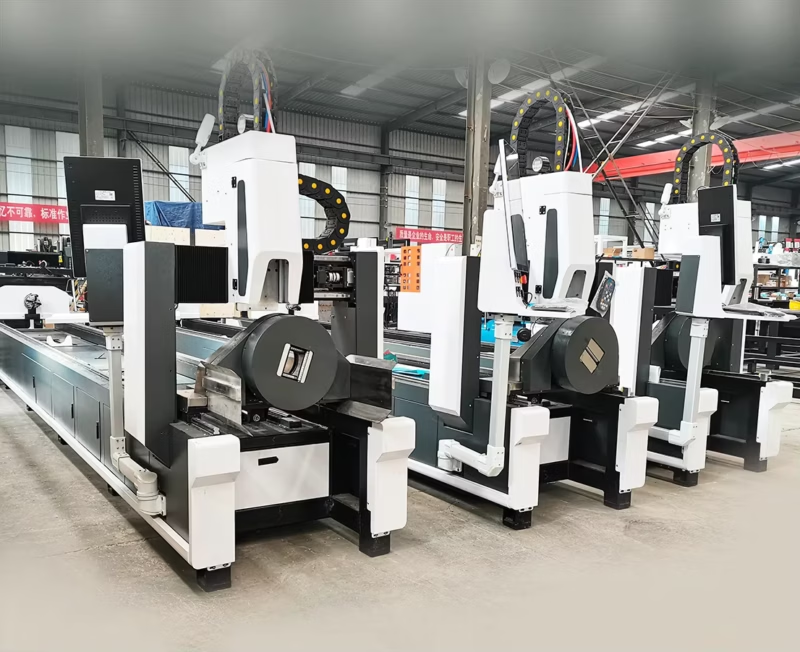
Zero-tailing systems utilize a multi-chuck synchronized movement strategy. By employing three or four independent chucks that can move along the longitudinal axis, the machine can hand off the workpiece mid-process. This enables the cutting head to reach the very end of the material. In the context of large-scale tank piping or structural supports, this technology can improve material yield by 10% to 15% per batch. For an engineer, this equates to a direct reduction in the Cost of Goods Sold (COGS) and a faster return on investment (ROI) for the machinery.
Integrated Punch Mark and Cut Workflow
The modern fiber laser system for oil and gas applications is not merely a cutting tool; it is a multi-functional processing center. The integration of “punch, mark, and cut” into a single CNC program eliminates the need for manual layout and templating.
Precision Marking and Identifiers
Each tank component must be traceable. The fiber laser can be modulated to perform low-power surface marking. This allows for the etching of heat numbers, part IDs, and alignment marks directly onto the steel. Because the marking occurs in the same coordinate system as the cutting, the placement accuracy is sub-millimeter. This is vital for complex assemblies where port locations and nozzle orientations must be exact.
Automated Punching Simulation
While mechanical punching is a separate physical process, the fiber laser “punches” holes through high-speed piercing cycles. Modern controllers use multi-stage piercing where the laser intensity and gas pressure are ramped up to prevent cratering. This ensures that even in thick-walled sections of a tank shell, the entry hole is clean and perfectly vertical, maintaining the geometric tolerance required for high-pressure fittings.
Eliminating Secondary Grinding through Beam Stability
The requirement for “no grinding” is perhaps the most significant efficiency gain for the industrial engineer. In the production of storage tanks, the fit-up of the shell plates requires a perfectly square or precisely beveled edge. If the edge is jagged or contaminated, the structural integrity of the final vessel is compromised.
Fiber lasers achieve this through superior beam stability and high-frequency pulse control. By maintaining a consistent focal point despite fluctuations in material thickness (common in hot-rolled steel), the laser ensures a uniform kerf width. The result is an edge with a roughness profile (Ra) so low that it meets the most stringent requirements for high-frequency induction processing or specialized joining techniques without manual intervention.
Enhancing Throughput in Oil and Gas Applications
In the oil and gas sector, projects are often timeline-sensitive. The speed of precision fabrication provided by fiber lasers—often exceeding 20 meters per minute on thinner gauges and maintaining high velocity on thick plates—dramatically shortens lead times. When combined with zero-tailing, the machine downtime associated with loading and unloading remnants is minimized. The continuous throughput capability allows facilities to move from a batch-processing model to a more fluid, just-in-time (JIT) manufacturing approach.
Technical Specifications and Tolerance Control
From an engineering perspective, the performance of these machines is measured by their volumetric accuracy and repeatability. Most high-end fiber laser systems used for tank production offer a positioning accuracy of +/- 0.03mm and a repeatability of +/- 0.02mm. For large-scale tanks, where cumulative error can lead to significant alignment issues during the final assembly, these tight tolerances are indispensable.
Furthermore, the absence of mechanical force during the cutting process means there is no tool wear and no deformation of the workpiece. This “non-contact” manufacturing preserves the mechanical properties of the steel, ensuring that the tank’s designed pressure ratings are not compromised by localized structural stress often induced by mechanical shearing or punching.
Conclusion: The Engineering Case for Fiber Laser Integration
The implementation of a Fiber Laser Cutting Machine with Zero-tailing technology provides a clear competitive advantage in the oil and gas sector. By consolidating marking, piercing, and final cutting into a single automated sequence, manufacturers can bypass the bottlenecks associated with manual grinding and material waste. The industrial engineer’s focus on lean manufacturing is fully realized through this technology: less waste, higher precision, and zero redundant processing. As global standards for tank safety and efficiency continue to tighten, the transition to high-precision laser processing is no longer an option but a technical necessity for modern fabrication facilities.















