Optimizing Oil and Gas Tank Fabrication through Fiber Laser Precision
The transition toward high-efficiency manufacturing in the oil and gas sector necessitates a departure from traditional thermal cutting methods. The implementation of Fiber Laser Cutting technology represents a significant shift in how pressure vessel components and storage tank shells are processed. From an industrial engineering perspective, the primary objective is the reduction of cycle times and the elimination of non-value-added activities, such as edge cleaning and manual layout marking.
Fiber laser systems utilize a solid-state gain medium, typically ytterbium-doped fibers, which generate a beam with a wavelength of approximately 1.064 microns. This short wavelength allows for high absorption rates in metals common to the energy sector, including carbon steel (A36, A516 Grade 70) and various stainless steel grades. The result is a highly concentrated energy density that enables rapid vaporization of the material, producing a narrow kerf width and a minimal heat-affected zone (HAZ).
Zero-Tailing Technology: Engineering Material Efficiency
In the production of structural supports, internal piping, and reinforcement rings for oil and gas tanks, material waste—specifically tube and pipe ends—represents a significant overhead cost. Zero-tailing technology addresses this by utilizing a multi-chuck synchronization system (typically three or four chucks) that allows the cutting head to operate between the chucks or very close to the final gripping point.
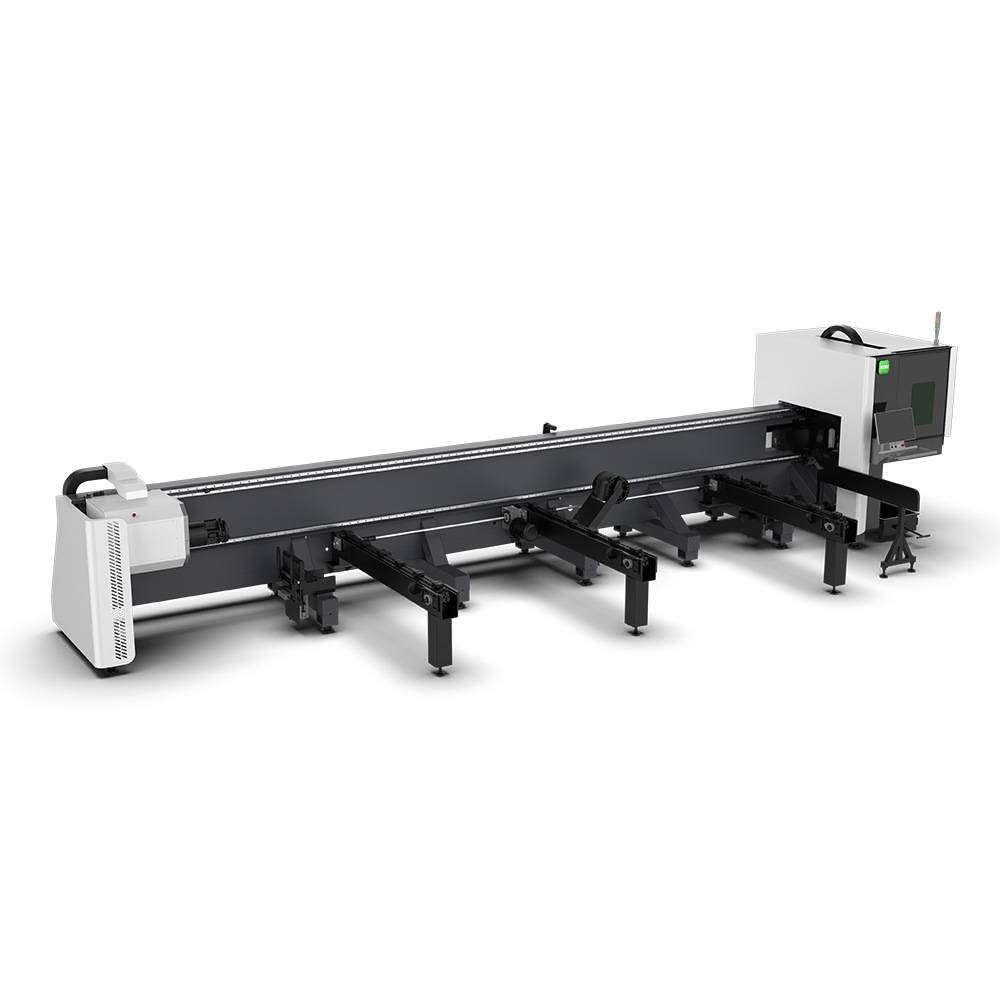
Traditional laser tube cutters often leave a “tailing” or scrap piece of 200mm to 500mm due to the physical limitations of the clamping mechanism. Zero-tailing configurations enable the material to be fed through the final chuck, allowing the laser to process the workpiece until nearly 100% material utilization is achieved. For high-alloy pipes or thick-walled carbon steel tubes used in offshore tank frames, this reduction in scrap translates directly into improved project margins and lower raw material procurement requirements.
The Punch, Mark, and Cut Integrated Workflow
Industrial engineering workflows for tank fabrication often suffer from bottlenecks during the assembly phase due to misaligned holes or missing identification marks. Fiber laser systems resolve this by integrating three distinct functions into a single automated sequence: punching (piercing), marking, and cutting.
Precision Piercing and Punching
Unlike mechanical punching, which can cause deformation in thick plates, the fiber laser uses a high-frequency pulse mode to “punch” holes with extreme accuracy. This is critical for nozzle openings and bolt patterns on tank flanges. The software calculates the ramp-up of laser power and gas pressure to ensure that the entry point does not create a crater, maintaining the geometric tolerance of the orifice within ±0.05mm.
Permanent Traceability through Marking
Regulatory standards in the oil and gas industry, such as ASME Section VIII, require strict traceability for all pressurized components. The fiber laser can be de-focused or operated at a lower wattage to etch heat numbers, part IDs, and assembly guides directly onto the metal surface. Because this occurs in the same setup as the cutting process, there is no risk of human error in transcription or placement, ensuring that every plate and pipe segment is identifiable throughout the lifecycle of the tank.
High-Speed Precision Cutting
The final stage is the high-speed cut. For tank shells, the laser maintains a consistent standoff distance via capacitive height sensing, even if the plate has slight undulations. This ensures a perpendicular cut edge. The high energy density allows for cutting speeds that are significantly faster than CO2 or other traditional methods, particularly on thicknesses up to 25mm, which covers the majority of standard tank wall requirements.
Eliminating Post-Process Grinding
One of the most impactful advantages of Oil & Gas Tanks fabrication via fiber laser is the surface finish of the cut edge. In traditional thermal processes, the edge often develops a heavy oxide layer or dross, necessitating manual grinding before any subsequent joining processes can occur. Grinding is a labor-intensive, high-dust activity that introduces variability into the manufacturing timeline.
Fiber lasers, when configured with the correct assist gas (typically high-pressure Oxygen for carbon steel or Nitrogen for stainless steel), produce a clean, dross-free edge. The narrow kerf ensures that the thermal input is localized, preventing the warping of thin-gauge stainless steel liners used in chemical storage tanks. By moving directly from the laser bed to the assembly jig, the facility eliminates the “grinding station” bottleneck, reducing the total man-hours per tank unit by an estimated 15-20%.
Structural Integrity and Fit-Up Accuracy
The structural integrity of an oil or gas tank depends heavily on the “fit-up” of its components. Large-diameter tanks are composed of multiple rolled plates that must align perfectly. Precision Cutting provided by fiber lasers ensures that the circumference of each plate is accurate to within fractions of a millimeter. This level of precision simplifies the work of assembly technicians, as plates do not need to be “forced” into position, thereby reducing residual stress in the tank structure.
Furthermore, the high repeatability of the CNC laser system ensures that every segment of a multi-part tank is identical. This is particularly beneficial for modular tank designs where components are manufactured in a factory environment and shipped to the field for final installation. The consistency of the laser-cut edge provides a superior substrate for automated welding systems, ensuring deep penetration and consistent bead profiles without the interference of surface contaminants.
Technical Conclusion for Industrial Application
For industrial operations specializing in the energy sector, the adoption of Fiber Laser Cutting Machines with zero-tailing capability is not merely an equipment upgrade; it is a process optimization strategy. By leveraging the specific wavelength advantages of fiber sources, manufacturers can achieve high-speed processing of heavy-gauge materials while maintaining the delicate tolerances required for high-pressure storage applications.
The integration of marking and piercing into the cutting cycle eliminates redundant handling, while the zero-tailing chuck systems ensure that material overhead is minimized. In an industry where safety and material traceability are paramount, the precision and data-integration capabilities of the fiber laser provide a robust foundation for modern fabrication. The elimination of secondary grinding and the improvement in fit-up accuracy ultimately lead to a more reliable final product, a safer work environment, and a significantly improved return on investment for the fabrication facility.
-


Cantilever Welding Robot solution
-


GF laser cutting machine
-

P3015 plasma cutting machine
-

LFP3015 Fiber Laser Cutter
-

pipe plasma cutting machine
-
LFH 4020 Fiber Laser Cutting Machine
-
LFP4020
-

gantry plasma air cutting machine
-

3D robot cutting machine
-

8 axis plasma cutting machine
-

5 axis plasma cutting machine
-

LT360 tube laser cutting machine
-

robot welding workstation
-

SF6060 fiber laser cutting machine
Advanced Fiber Laser Tube Processing Technology
Our CNC Fiber Laser Tube Cutting systems revolutionize metal fabrication by integrating high-precision cutting, punching, and profiling into a single automated workflow. Designed for versatility, this technology handles a wide array of profiles including Round, Square, Rectangular, and Oval tubes, as well as complex L-shaped and U-shaped channels.
- Precision Punching: High-speed hole punching with micron-level accuracy, eliminating the need for mechanical drilling or die-stamping.
- Complex Profiling: Advanced 3D pathing allows for intricate interlocking joints and specialized notch cuts, ideal for structural frames.
- High Material Efficiency: Intelligent nesting software minimizes scrap, reducing raw material costs across large production runs.
- Clean Finish: Delivers oxide-free, burr-free edges that require zero secondary grinding before welding.

Seamlessly processing multiple profiles with consistent precision.
Global Delivery & Logistics



From our high-tech manufacturing facility directly to your global site. PCL WeldCut ensures secure packaging, professional handling, and reliable international logistics to safeguard your equipment throughout the entire journey.