Optimizing Pressure Vessel Fabrication with Fiber Laser Integration
In the heavy industrial sector, specifically within the production of oil and gas tanks, the requirement for dimensional integrity and material efficiency has reached a critical threshold. Traditional fabrication workflows often suffer from fragmented processes, involving manual layout, mechanical punching, and subsequent thermal cutting that necessitates extensive edge remediation. The introduction of the high-power Fiber Laser Cutting Machine has fundamentally altered this landscape by providing a unified platform for high-precision component production.
Fiber laser technology operates at a wavelength of approximately 1.06 microns, allowing for superior absorption rates in metallic substrates compared to CO2 counterparts. For tank manufacturers dealing with carbon steel, stainless steel, and high-nickel alloys, this results in a concentrated energy density capable of achieving rapid melt-pool transitions. The primary objective is to move from raw material to a weld-ready state without the intervention of manual grinding or secondary surface treatment.
The Mechanics of Zero-Tailing Technology
Material waste in tube and large-format plate processing represents a significant overhead in the oil and gas industry. Zero-tailing technology refers to the specialized mechanical configuration of the laser system—typically involving a multi-chuck synchronized movement profile—that allows the cutting head to process material at the extreme ends of the workpiece. In standard configurations, the “tailing” or scrap piece is often 200mm to 500mm long due to the physical limitations of the clamping units.
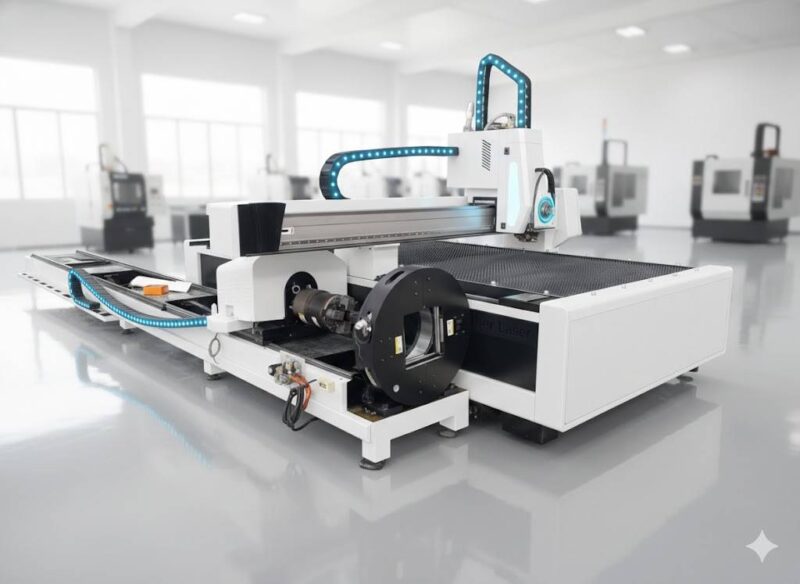
By utilizing a three-chuck or four-chuck system, the machine can pass the workpiece through the chucks dynamically. This ensures that the material is always supported and grounded, allowing the laser to execute cuts within millimeters of the chuck face. For large-diameter pipes used in tank nozzles and structural supports, this technology increases material utilization rates to nearly 99%. From an industrial engineering perspective, the reduction in scrap directly correlates to a lower Bill of Materials (BOM) cost and a reduced carbon footprint per vessel produced.
Consolidated Workflow: Punch, Mark, and Cut
One of the most significant advantages of modern fiber laser systems is the ability to perform three distinct operations in a single program sequence. This multi-tasking capability eliminates the cumulative error associated with moving workpieces between different workstations.
Precision Hole Punching and Piercing
Unlike mechanical punching, which induces physical stress and potential deformation around the hole perimeter, the fiber laser utilizes high-frequency pulsing to pierce the material. This is critical for pressure vessels where stress concentrations must be minimized. The laser can create bolt holes, manway openings, and drainage ports with a dimensional accuracy of ±0.05mm. This level of precision ensures that auxiliary components fit perfectly during the assembly phase, reducing the need for field corrections.
Automated Marking for Traceability
The oil and gas industry is governed by strict regulatory standards (such as ASME Section VIII). Every component of a tank must be traceable. By adjusting the laser’s frequency and power output, the machine can “etch” or mark heat numbers, part ID codes, and alignment guides directly onto the metal surface. Because this marking is done in the same coordinate system as the cutting, the placement is perfect, ensuring that fit-up marks for subsequent assembly are mathematically exact.
High-Definition Cutting and Beveling
The final stage is the high-definition cut. For tank shells and heads, the fiber laser provides a kerf width that is significantly narrower than other thermal processes. This results in a minimal Heat Affected Zone (HAZ), preserving the metallurgical properties of the alloy. Furthermore, 5-axis laser heads allow for the creation of complex weld preparations (V, Y, K, and X-bevels) during the initial cut. This eliminates the need for secondary beveling machines or manual torch work.
Eliminating Secondary Grinding and Surface Preparation
A primary bottleneck in tank manufacturing is the post-cut cleanup. Traditional thermal methods leave dross, slag, and a hardened nitrided layer that must be ground away to ensure a high-quality weld. The fiber laser, when used with optimized assist gases (typically Nitrogen for stainless or Oxygen for carbon steel), produces a clean, dross-free edge.
The surface roughness (Ra) of a fiber laser cut is sufficiently low that it meets the requirements for automated welding processes immediately. By removing the grinding stage, the facility reduces labor costs, eliminates the noise and dust associated with abrasives, and improves the overall safety of the workshop environment. More importantly, it ensures that the joint geometry remains consistent, which is a prerequisite for high-quality seam integrity in high-pressure environments.
Thermal Management and Structural Integrity
In the fabrication of large-diameter oil tanks, thermal distortion is a constant challenge. The localized heat input of a fiber laser is extremely focused. The high cutting speeds (often exceeding 10m/min depending on thickness) mean that the total heat energy transferred to the workpiece is relatively low. This prevents the warping of thin-walled vessels and maintains the circularity of cylindrical sections.
From an engineering standpoint, maintaining the geometric stability of the tank segments during the cutting process simplifies the downstream assembly. When segments are aligned, the gap consistency is maintained, which leads to more reliable and repeatable automated welds. The lack of thermal deformation also means that internal baffles and support structures fit within the shell without the use of excessive force or specialized jigging.
Economic Evaluation and ROI for Tank Manufacturers
The capital expenditure for a fiber laser system with zero-tailing capability is offset by several key performance indicators (KPIs):
- Material Yield: Reduction of scrap by up to 15% through zero-tailing and optimized nesting.
- Cycle Time: Reduction of total part processing time by 40-60% through the elimination of manual layout and grinding.
- Consumables: Lower operating costs compared to older technologies, as fiber lasers have high wall-plug efficiency and longer-lasting optical components.
- Labor Allocation: Transitioning from manual operators to system technicians, allowing for higher throughput with a smaller, more specialized workforce.
Conclusion: The Future of Tank Fabrication
The transition to fiber laser cutting machines equipped with Zero-tailing technology represents a strategic shift toward lean manufacturing in the oil and gas sector. By leveraging the precision of 1.06-micron laser energy, manufacturers can achieve a level of “first-time-right” quality that was previously unattainable. The ability to punch, mark, and cut in a single operation while utilizing nearly every millimeter of raw material ensures that production facilities can meet the rigorous demands of the energy industry while maintaining a competitive cost structure. For the modern industrial engineer, the integration of these systems is not merely an upgrade but a necessity for high-volume, high-compliance pressure vessel production.
-


LT240S tube laser cutting machine
-
LT120S tube laser cutting machine
-
Sale

Tank Fillet Welding Machine
Original price was: $1,000.00.$900.00Current price is: $900.00. -
Sale

MAK100 tube laser cutting machine
Original price was: $5,500.00.$5,000.00Current price is: $5,000.00. -

portable plasma air cutting machine
$1,200.00 -

2in1 fiber laser cutting machine
-

Air cooling Laser welding machine
-

HF h beam laser cutting machine
-

LT240 laser cutting machine
-

Laser welding machine
-


Cobot Welding Station
-

Gantry welding robot solution
-

Tracked Wheeled AGV Welding robot
-

LFH6020 Fiber laser cutting machine
-
LFP6020
-

robotic welidng machine
Advanced Fiber Laser Tube Processing Technology
Our CNC Fiber Laser Tube Cutting systems revolutionize metal fabrication by integrating high-precision cutting, punching, and profiling into a single automated workflow. Designed for versatility, this technology handles a wide array of profiles including Round, Square, Rectangular, and Oval tubes, as well as complex L-shaped and U-shaped channels.
- Precision Punching: High-speed hole punching with micron-level accuracy, eliminating the need for mechanical drilling or die-stamping.
- Complex Profiling: Advanced 3D pathing allows for intricate interlocking joints and specialized notch cuts, ideal for structural frames.
- High Material Efficiency: Intelligent nesting software minimizes scrap, reducing raw material costs across large production runs.
- Clean Finish: Delivers oxide-free, burr-free edges that require zero secondary grinding before welding.

Seamlessly processing multiple profiles with consistent precision.
Global Delivery & Logistics



From our high-tech manufacturing facility directly to your global site. PCL WeldCut ensures secure packaging, professional handling, and reliable international logistics to safeguard your equipment throughout the entire journey.