Engineering Optimization in Oil & Gas Tank Fabrication
In the high-stakes environment of Oil & Gas infrastructure, the structural integrity of storage tanks and pressure vessels is non-negotiable. Traditional fabrication workflows often suffer from throughput bottlenecks and material wastage. The introduction of the Fiber Laser Cutting Machine has redefined the baseline for precision in this sector. By utilizing a high-density coherent light beam delivered via optical fiber, engineers can achieve tolerances that were previously unattainable with legacy mechanical or thermal cutting methods. This transition is not merely a technological upgrade but a fundamental shift in production philosophy, moving from “approximate fabrication” to “precision engineering.”
The Mechanics of Zero-Tailing Technology
Material costs represent a significant portion of the Total Cost of Ownership (TCO) in tank manufacturing, especially when dealing with specialized stainless steels or high-tensile carbon steels. Zero-tailing technology addresses this by optimizing the tail-end of the raw material—typically a tube or a large-format plate. In traditional setups, a substantial portion of the workpiece remains unusable due to the physical limitations of the machine’s clamping or chucking mechanism.
Advanced fiber laser systems utilize a multi-chuck synchronized movement system. By employing a three-chuck or four-chuck configuration, the machine can pass the workpiece through the cutting head without losing grip, allowing the laser to process material up to the final millimeter. From an industrial engineering perspective, this improves the nesting coefficient by 10% to 15%. When extrapolated over a year of production for Oil & Gas Tanks, the reduction in scrap translates directly into improved bottom-line margins and a smaller environmental footprint.
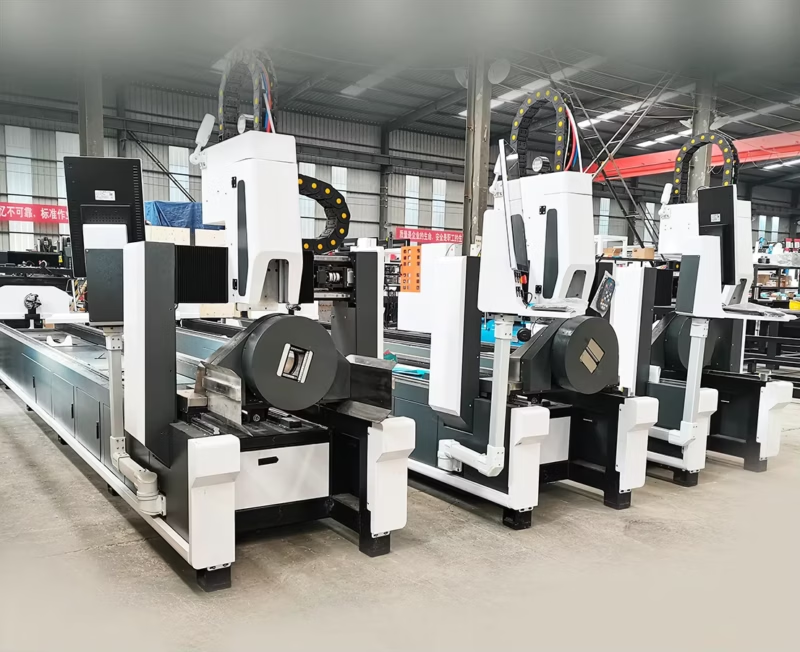
Consolidated Workflow: Punch, Mark, and Cut
One of the primary drivers of inefficiency in heavy fabrication is the movement of work-in-progress (WIP) between different workstations. A conventional workflow might require a part to be moved from a layout station to a punching station, and finally to a cutting station. Each movement introduces the risk of dimensional error and increases labor costs.
Integrated Marking and Identification
The fiber laser head is capable of performing high-speed surface etching. This allows for the immediate application of heat numbers, part IDs, and alignment marks for downstream assembly. Because these marks are generated using the same CNC coordinates as the cut profile, their placement is accurate to within microns. This ensures that every component of the tank shell or nozzle assembly is perfectly traceable and indexed.
Precision Punching and Small-Hole Geometries
While mechanical punching can distort thin-walled materials, the fiber laser uses a high-frequency pulsing technique to “punch” holes. This process provides a perfectly cylindrical aperture with no mechanical stress on the surrounding grain structure. For Oil & Gas Tanks, where flange bolt patterns must align perfectly with internal baffles, this high precision ensures that assembly occurs without the need for manual reaming or adjustment.
Eliminating the Grinding Phase
Perhaps the most significant impact of fiber laser technology on the production floor is the elimination of secondary grinding operations. Conventional thermal cutting methods often leave behind a thick layer of dross or a wide Heat Affected Zone (HAZ) that hardens the edge of the material. This hardened edge is detrimental to the structural integrity of the tank and must be ground away to reach “clean” metal.
The fiber laser’s kerf width is exceptionally narrow—often less than 0.2mm. The energy is so concentrated that the material is vaporized instantly, leaving a smooth, square edge with an Rz surface roughness value that meets or exceeds international standards for direct assembly. By eliminating grinding, the facility reduces noise pollution, decreases the consumption of abrasives, and removes a labor-intensive step that often accounts for 20% of total fabrication time. The resulting edge is ready for the next stage of the assembly process immediately after the cut is completed.
Thermal Management and Material Integrity
In the Oil & Gas sector, the metallurgical properties of the tank walls are critical. Excessive heat input during the cutting process can lead to grain growth or the precipitation of carbides, which compromises the corrosion resistance of the material. Fiber lasers operate at a wavelength (typically around 1.06 microns) that is highly absorbed by metals, allowing for faster cutting speeds at lower total heat inputs compared to other thermal processes.
This rapid processing limits the duration of thermal exposure. Industrial engineers can fine-tune the pulse frequency and duty cycle of the laser to manage the thermal gradient across the workpiece. This ensures that the base metal retains its engineered properties, which is vital for tanks designed to hold volatile or corrosive chemicals under pressure.
Data-Driven Efficiency and CNC Integration
The modern fiber laser is a node in the Industrial Internet of Things (IIoT). The CNC controllers on these machines provide real-time data on gas consumption (Nitrogen or Oxygen), power usage, and cutting time per part. This data allows industrial engineers to perform precise cost-benefit analyses and optimize production schedules. The integration with advanced nesting software ensures that the zero-tailing logic is applied automatically, calculating the most efficient path for the laser head to minimize “dead travel” time.
Furthermore, the high repeatability of fiber laser systems (often ±0.03mm) means that the first part produced is identical to the thousandth. In large-scale tank farm projects where dozens of identical storage units are required, this consistency simplifies the logistics of assembly and ensures that all components are interchangeable.
Conclusion: The Competitive Edge
The adoption of Fiber Laser Cutting Machines with Zero-tailing technology represents a strategic investment in manufacturing excellence. For producers of Oil & Gas Tanks, the benefits are clear: reduced material waste through optimized nesting, the elimination of costly secondary grinding, and the consolidation of marking and cutting into a single, high-speed process. By prioritizing high precision and lean manufacturing principles, companies can meet the rigorous quality standards of the energy industry while maintaining a significant competitive advantage in production efficiency and lead-time reduction.
-


Cantilever Welding Robot solution
-


GF laser cutting machine
-

P3015 plasma cutting machine
-

LFP3015 Fiber Laser Cutter
-

pipe plasma cutting machine
-
LFH 4020 Fiber Laser Cutting Machine
-
LFP4020
-

gantry plasma air cutting machine
-

3D robot cutting machine
-

8 axis plasma cutting machine
-

5 axis plasma cutting machine
-

LT360 tube laser cutting machine
-

robot welding workstation
-

SF6060 fiber laser cutting machine
Advanced Fiber Laser Tube Processing Technology
Our CNC Fiber Laser Tube Cutting systems revolutionize metal fabrication by integrating high-precision cutting, punching, and profiling into a single automated workflow. Designed for versatility, this technology handles a wide array of profiles including Round, Square, Rectangular, and Oval tubes, as well as complex L-shaped and U-shaped channels.
- Precision Punching: High-speed hole punching with micron-level accuracy, eliminating the need for mechanical drilling or die-stamping.
- Complex Profiling: Advanced 3D pathing allows for intricate interlocking joints and specialized notch cuts, ideal for structural frames.
- High Material Efficiency: Intelligent nesting software minimizes scrap, reducing raw material costs across large production runs.
- Clean Finish: Delivers oxide-free, burr-free edges that require zero secondary grinding before welding.

Seamlessly processing multiple profiles with consistent precision.
Global Delivery & Logistics



From our high-tech manufacturing facility directly to your global site. PCL WeldCut ensures secure packaging, professional handling, and reliable international logistics to safeguard your equipment throughout the entire journey.