Optimization of LNG Infrastructure Fabrication via Fiber Laser Technology
The fabrication of components for Liquefied Natural Gas (LNG) projects demands a level of precision that exceeds standard industrial requirements. LNG storage tanks, regasification units, and distribution manifolds utilize specialized alloys, primarily stainless steels and high-nickel compositions, to withstand cryogenic temperatures. Traditional mechanical cutting and legacy thermal methods often introduce heat-affected zones (HAZ) or mechanical stresses that compromise material integrity. The adoption of Fiber Laser Cutting has shifted the paradigm, offering a non-contact, high-velocity thermal process that ensures metallurgical stability and dimensional accuracy.
The Engineering Advantage of Zero-Tailing Technology
In large-scale LNG projects, the cost of raw materials, particularly thick-walled stainless steel piping, represents a substantial portion of the capital expenditure. Conventional laser tube cutting machines typically leave a “tail” or “remnant” of 200mm to 500mm due to the physical distance between the chuck and the cutting head. Zero-tailing technology utilizes a multi-chuck system—often employing three or four independent synchronized chucks—to move the workpiece through the cutting zone without losing grip.
From an industrial engineering perspective, this eliminates the “dead zone” of the material. By allowing the chucks to leapfrog each other, the machine can process the pipe to the very end of the stock. For a project involving thousands of meters of cryogenic piping, the cumulative reduction in scrap translates directly into significant cost savings and a lower environmental footprint. The ability to achieve nearly 100% material utilization is a critical KPI for modern LNG fabrication facilities.
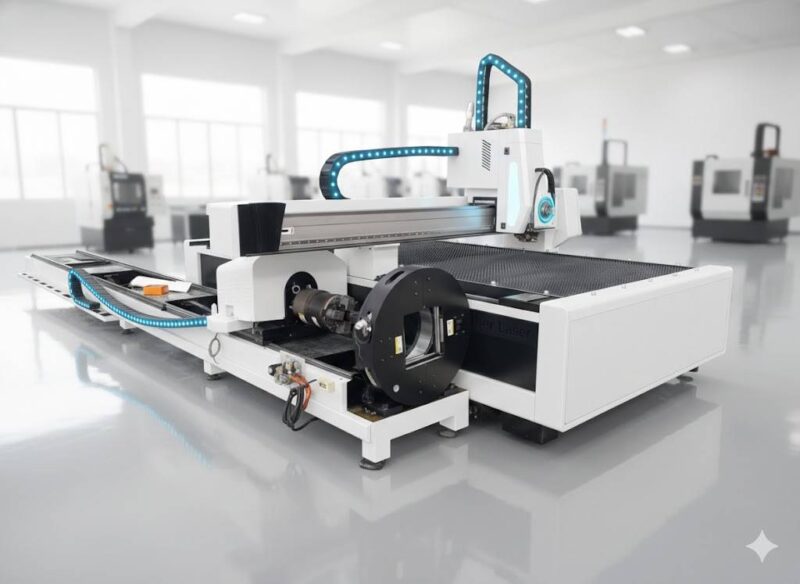
High-Precision Processing without Secondary Grinding
One of the most significant bottlenecks in LNG pipe spool production is the requirement for edge preparation. When using traditional methods, the resulting edge often requires manual or automated grinding to remove dross, oxidation, or irregularities before the next phase of assembly. High-power Fiber Laser Cutting systems, operating in the 12kW to 30kW range, produce a beam with a high power density that vaporizes the metal instantaneously.
When coupled with high-pressure nitrogen assist gas, the resulting cut is characterized by a mirror-like finish and zero oxidation. This “clean cut” technology means that parts can move directly from the laser bed to the assembly jig. for LNG Projects, where the purity of the joint is paramount to prevent leaks in high-pressure gas systems, the elimination of grinding not only saves labor hours but also removes the risk of manual error and surface contamination.
Integrated Punching, Marking, and Cutting Workflows
Modern LNG projects rely on complex logistics and traceability. Every segment of pipe and every bracket must be indexed and tracked throughout the lifecycle of the facility. Advanced fiber laser systems incorporate multi-functional processing capabilities that allow for punching, marking, and cutting in a single continuous cycle.
Instead of moving a component between a drill press, a stamping station, and a cutting tool, the fiber laser performs all three functions. The laser can “punch” holes with diameters smaller than the material thickness—a feat difficult for mechanical drills—while maintaining perfect circularity. Simultaneously, the laser can etch 2D barcodes, heat numbers, and alignment marks onto the surface. This integrated approach ensures that traceability data is permanently etched into the component before it even leaves the machine bed, reducing the likelihood of part mix-ups during the massive assembly phases of an LNG terminal.
Dimensional Accuracy and Kerf Control
The kerf width of a fiber laser is exceptionally narrow, typically ranging from 0.1mm to 0.3mm depending on the material thickness. This allows for extremely tight tolerances, often within ±0.03mm. In the context of LNG manifold construction, where multiple branches must align perfectly with header pipes, this precision is non-negotiable. The fiber laser’s CNC system compensates for any deviation in the pipe’s roundness or straightness in real-time using capacitive sensing, ensuring that the cut profile always matches the theoretical CAD model.
Thermal Management and Metallurgical Integrity
LNG components are often made from 304L or 316L stainless steel to maintain ductility at -162°C. Excessive heat during the cutting process can lead to carbide precipitation, which reduces corrosion resistance. The high speed of Fiber Laser Cutting minimizes the duration of thermal exposure. The concentrated energy beam ensures that the heat-affected zone is microscopic, preserving the base metal’s cryogenic properties. This is a vital consideration for engineers responsible for the long-term structural integrity of gasification plants.
Economic Impact and ROI for Contractors
While the initial capital investment in a fiber laser with zero-tailing technology is higher than traditional tools, the return on investment (ROI) is accelerated by three primary factors:
1. Material Savings: Reducing remnant waste from 10% to less than 1% across an entire LNG project can save millions in raw material costs.
2. Labor Reduction: By eliminating the need for secondary grinding and manual marking, the man-hours required per spool are reduced by approximately 40-60%.
3. Throughput: The rapid traverse speeds and high cutting velocities of fiber lasers allow for faster project completion times, enabling contractors to meet stringent commissioning deadlines.
Conclusion: The New Standard in Gas Infrastructure
As the global demand for energy continues to rise, the efficiency of LNG infrastructure construction must evolve. The integration of Fiber Laser Cutting with advanced material-saving technologies represents a significant leap forward. By combining high precision, integrated processing, and maximum material utilization, industrial engineers can ensure that LNG projects are delivered with higher quality, lower costs, and superior structural reliability. The transition from legacy mechanical processing to synchronized fiber laser systems is no longer an option but a necessity for competitive fabrication in the cryogenic sector.
-


LT240S tube laser cutting machine
-
LT120S tube laser cutting machine
-
Sale

Tank Fillet Welding Machine
Original price was: $1,000.00.$900.00Current price is: $900.00. -
Sale

MAK100 tube laser cutting machine
Original price was: $5,500.00.$5,000.00Current price is: $5,000.00. -

portable plasma air cutting machine
$1,200.00 -

2in1 fiber laser cutting machine
-

Air cooling Laser welding machine
-

HF h beam laser cutting machine
-

LT240 laser cutting machine
-

Laser welding machine
-


Cobot Welding Station
-

Gantry welding robot solution
-

Tracked Wheeled AGV Welding robot
-

LFH6020 Fiber laser cutting machine
-
LFP6020
-

robotic welidng machine
Advanced Fiber Laser Tube Processing Technology
Our CNC Fiber Laser Tube Cutting systems revolutionize metal fabrication by integrating high-precision cutting, punching, and profiling into a single automated workflow. Designed for versatility, this technology handles a wide array of profiles including Round, Square, Rectangular, and Oval tubes, as well as complex L-shaped and U-shaped channels.
- Precision Punching: High-speed hole punching with micron-level accuracy, eliminating the need for mechanical drilling or die-stamping.
- Complex Profiling: Advanced 3D pathing allows for intricate interlocking joints and specialized notch cuts, ideal for structural frames.
- High Material Efficiency: Intelligent nesting software minimizes scrap, reducing raw material costs across large production runs.
- Clean Finish: Delivers oxide-free, burr-free edges that require zero secondary grinding before welding.

Seamlessly processing multiple profiles with consistent precision.
Global Delivery & Logistics



From our high-tech manufacturing facility directly to your global site. PCL WeldCut ensures secure packaging, professional handling, and reliable international logistics to safeguard your equipment throughout the entire journey.