Technical Integration of Fiber Laser Technology in Heavy Construction Fabrication
The fabrication of construction machinery—ranging from excavator booms to crane lattice structures—requires high-load structural integrity and extreme dimensional accuracy. Traditional methods of component preparation often involve multiple disparate stages, leading to cumulative tolerances and increased labor costs. The adoption of Fiber Laser Cutting systems represents a shift toward a consolidated manufacturing cell. These systems utilize solid-state laser sources to generate a high-density beam, delivered via flexible fiber optics to a cutting head. For construction equipment, where material thicknesses often exceed 10mm, the stability of the fiber source ensures consistent kerf width and perpendicularity across large work envelopes.
Zero-Tailing Technology: Engineering Material Efficiency
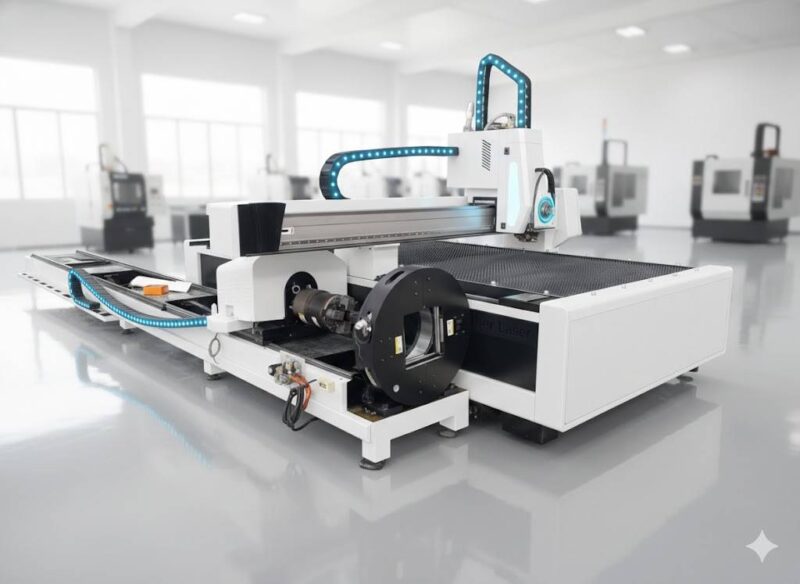
In the context of tube and profile processing for construction frames, material waste at the end of a workpiece—commonly known as the “tailing”—is a significant cost driver. Zero-tailing technology utilizes a multi-chuck configuration, typically involving three or four independent pneumatic or hydraulic chucks, to manipulate the material through the cutting zone.
The mechanical logic involves the synchronized handoff of the workpiece between the feeding chuck, the middle support chuck, and the finished-part chuck. This allows the laser head to process the final centimeters of a pipe or beam while the material is still rigidly supported. In industrial applications, reducing the tailing to effectively zero millimeters optimizes the nesting of parts, directly impacting the bottom line by increasing the yield per raw stock unit. For high-tensile steel alloys used in heavy machinery, where raw material costs fluctuate, this efficiency is critical for maintaining competitive margins.
High-Precision Processing without Secondary Operations
Precision in construction machinery is not merely a matter of fitment but a requirement for structural safety. Fiber laser systems operate with a positioning accuracy of ±0.03mm and repeatability of ±0.02mm. This level of precision is achieved through high-torque servo motors and precision rack-and-pinion drive systems.
Elimination of the Grinding Phase
A primary bottleneck in heavy fabrication is the manual deburring and grinding of edges. Fiber laser cutting produces a minimal heat-affected zone (HAZ) and a smooth surface finish (low roughness values) due to the high-frequency modulation of the laser beam and the use of optimized assist gases. When the cutting parameters—such as gas pressure, focal position, and feed rate—are correctly calibrated, the resulting edge requires no grinding. The components can move directly from the laser bed to the assembly or painting stages. This clean edge is particularly vital for structural joints where stress concentrations must be minimized to prevent fatigue failure under dynamic loads.
Integrated Punching and Marking Functionality
Modern CNC fiber laser controllers allow for “all-in-one” processing of structural members. Beyond simple profile cutting, the laser can be programmed for high-speed piercing, which serves as a functional replacement for mechanical punching.
Precision Piercing and Punching
The laser’s ability to “punch” holes through thick-walled tubing is governed by multi-stage piercing cycles. These cycles use varying power levels and frequency pulses to melt through the material without causing excessive spatter or damaging the nozzle. This allows for the creation of bolt holes, drainage ports, and assembly slots with diameters as small as the material thickness, a feat difficult to achieve with mechanical drills or punches without significant tool wear.
Automated Part Marking
Traceability is mandatory in the construction machinery industry. Fiber lasers facilitate integrated marking by reducing power output to etch serial numbers, assembly directions, or QR codes directly onto the part surface during the cutting cycle. This no grinding marking process ensures that identification remains legible throughout the manufacturing lifecycle without compromising the structural integrity of the component.
Mechanical Stability and Dynamic Response
The structural demands of cutting heavy-duty box sections and large-diameter pipes for cranes require a machine bed with high damping characteristics. Industrial-grade fiber laser machines feature a heavy-duty, heat-treated machine bed, often made of flake graphite cast iron or high-tensile welded steel, to resist thermal deformation and vibration.
The dynamic response of the cutting head is managed by capacitance-based height sensors that maintain a constant distance from the material surface. In construction machinery fabrication, where tubes may have slight deviations in straightness, this real-time adjustment ensures that the focal point remains optimal, preventing dross formation and maintaining the high precision required for complex geometries like interlocking “fish-mouth” joints.
Operational Cost Analysis: Fiber vs. Traditional Methods
From an industrial engineering perspective, the total cost of ownership (TCO) for a fiber laser system with zero-tailing capability is weighed against its high throughput and low consumable costs. Fiber lasers have an electrical conversion efficiency of over 30%, significantly higher than CO2 counterparts.
The reduction in waste via zero-tailing mechanisms can result in a 5% to 15% reduction in annual material expenditure. Furthermore, the integration of marking and piercing eliminates the need for standalone drills and marking stations, reducing the factory footprint and the labor required for material handling between stations. The reliability of the fiber source, which often exceeds 100,000 hours of operation before significant degradation, ensures that the production line for heavy equipment remains consistent across multi-shift operations.
Conclusion on Industrial Application
The deployment of Fiber Laser Cutting machines with Zero-tailing technology provides a decisive advantage for Construction Machinery manufacturers. By focusing on the synergy between CNC precision, mechanical material handling, and the inherent quality of the fiber beam, facilities can produce higher-quality components at a lower per-unit cost. The removal of secondary grinding and the optimization of every millimeter of raw material represent the pinnacle of lean manufacturing in heavy industry. As global demand for infrastructure and specialized machinery grows, the transition to these high-efficiency, multi-functional laser cells becomes an operational necessity.
-


LT240S tube laser cutting machine
-
LT120S tube laser cutting machine
-
Sale

Tank Fillet Welding Machine
Original price was: $1,000.00.$900.00Current price is: $900.00. -
Sale

MAK100 tube laser cutting machine
Original price was: $5,500.00.$5,000.00Current price is: $5,000.00. -

portable plasma air cutting machine
$1,200.00 -

2in1 fiber laser cutting machine
-

Air cooling Laser welding machine
-

HF h beam laser cutting machine
-

LT240 laser cutting machine
-

Laser welding machine
-


Cobot Welding Station
-

Gantry welding robot solution
-

Tracked Wheeled AGV Welding robot
-

LFH6020 Fiber laser cutting machine
-
LFP6020
-

robotic welidng machine
Advanced Fiber Laser Tube Processing Technology
Our CNC Fiber Laser Tube Cutting systems revolutionize metal fabrication by integrating high-precision cutting, punching, and profiling into a single automated workflow. Designed for versatility, this technology handles a wide array of profiles including Round, Square, Rectangular, and Oval tubes, as well as complex L-shaped and U-shaped channels.
- Precision Punching: High-speed hole punching with micron-level accuracy, eliminating the need for mechanical drilling or die-stamping.
- Complex Profiling: Advanced 3D pathing allows for intricate interlocking joints and specialized notch cuts, ideal for structural frames.
- High Material Efficiency: Intelligent nesting software minimizes scrap, reducing raw material costs across large production runs.
- Clean Finish: Delivers oxide-free, burr-free edges that require zero secondary grinding before welding.

Seamlessly processing multiple profiles with consistent precision.
Global Delivery & Logistics



From our high-tech manufacturing facility directly to your global site. PCL WeldCut ensures secure packaging, professional handling, and reliable international logistics to safeguard your equipment throughout the entire journey.