Fiber Laser Cutting Machine with Narrow Gap welding for Steel Structure
In this article
- Optimizing Steel Structure Fabrication via Fiber Laser Precision
- The Triple-Action Workflow: Punch, Mark, and Cut
- Achieving Edge Quality Without Secondary Grinding
- Synergy with Narrow Gap welding Requirements
- Tolerances and Geometric Consistency
- Minimizing the Heat Affected Zone (HAZ)
- Economic Impact on Large-Scale Steel Projects
- Conclusion
Optimizing Steel Structure Fabrication via Fiber Laser Precision
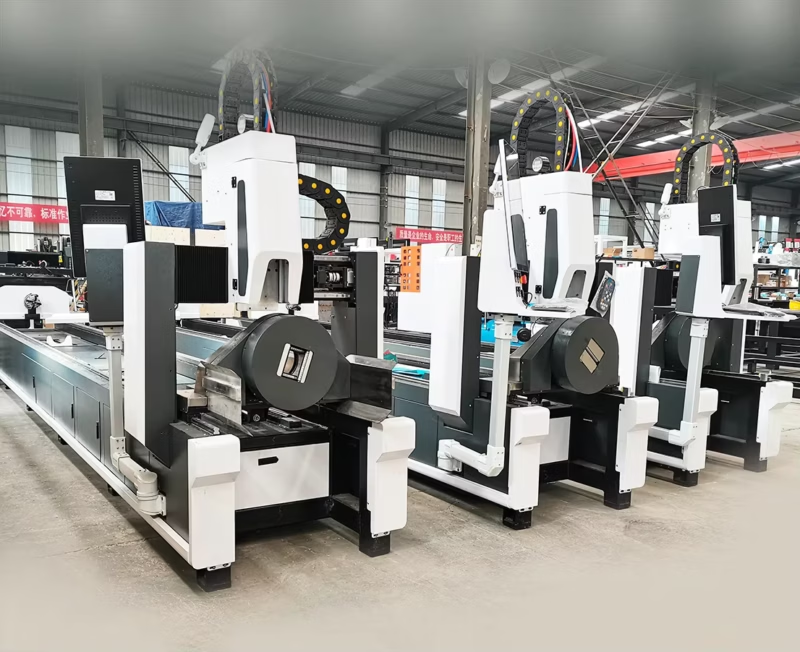
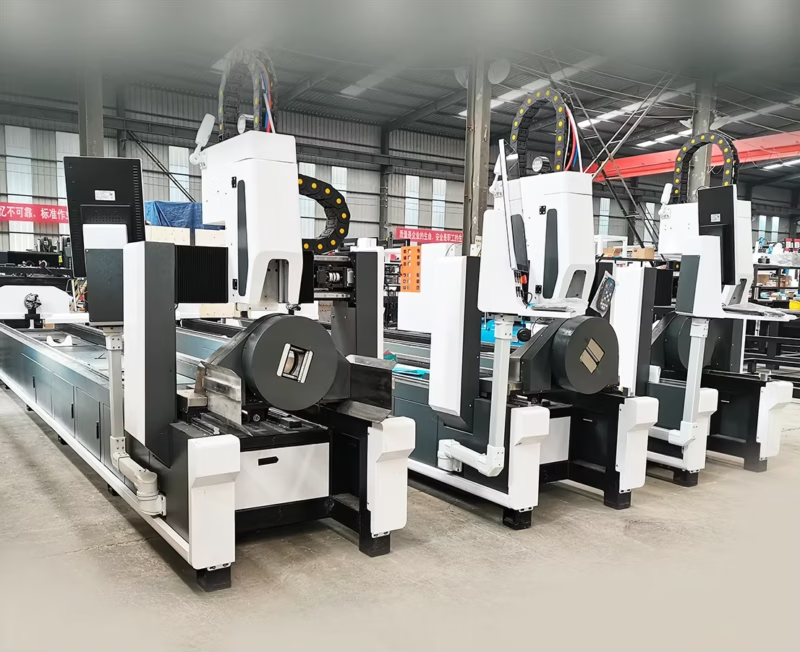
The evolution of Steel Structure Fabrication has shifted from manual layout and mechanical cutting toward fully integrated thermal processes. In high-stakes structural engineering, the margin for error in joint fit-up is shrinking. Traditional methods often require significant post-processing to meet the geometric requirements of modern assembly. The adoption of high-power Fiber Laser Cutting Machines addresses these inefficiencies by providing a localized, high-energy density beam that maintains material integrity while delivering micron-level accuracy.
Industrial engineering workflows favor the fiber laser due to its solid-state architecture, which requires less maintenance than gas-based systems and offers superior absorption rates in reflective materials and carbon steels. When fabricating heavy-duty beams, gusset plates, and trusses, the objective is to produce a “weld-ready” edge directly from the machine bed. This eliminates the labor-intensive grinding phase, which is a significant bottleneck in traditional production lines.
The Triple-Action Workflow: Punch, Mark, and Cut
One of the primary advantages of a modern fiber laser system is the ability to consolidate multiple fabrication steps into a single CNC program. This is not merely an incremental improvement but a fundamental change in the production sequence. By utilizing the laser head for three distinct functions—punching (piercing), marking, and cutting—manufacturers reduce material handling time and eliminate the stack-up of tolerances that occurs when moving workpieces between different stations.
Precision Piercing and Hole Production
High-speed pulsing parameters allow the fiber laser to “punch” or pierce through thick plate steel with minimal slag projection. Unlike mechanical punching, which can cause micro-fractures around the hole circumference, or slower thermal methods that create large heat-affected zones (HAZ), the fiber laser maintains the structural hardness of the material. This is critical for bolt-hole alignment in structural steel, where even a half-millimeter deviation can compromise the integrity of a multi-story assembly.
Automated Marking for Traceability and Assembly
Marking is an often-overlooked component of industrial efficiency. Fiber lasers can be tuned to a lower power frequency to etch part numbers, fold lines, and welding symbols directly onto the steel surface. This internal “blueprinting” ensures that downstream assemblers have immediate visual confirmation of part orientation. In a Fiber Laser Cutting environment, this marking occurs at high speed between cutting paths, ensuring that every component is traceable and correctly identified for its specific location in the master structure.
Achieving Edge Quality Without Secondary Grinding
In conventional steel fabrication, the “as-cut” edge is rarely suitable for high-quality welding without mechanical intervention. Oxides and dross must typically be removed via hand grinding or shot blasting. However, fiber laser cutting utilizes high-pressure nitrogen or oxygen assist gases to blow away molten material instantly, leaving a clean, square edge with a roughness profile that often meets or exceeds ISO 9013 Grade 2 standards.
For industrial engineers, the “no grinding” mandate is a key KPI. It reduces consumables (grinding discs), lowers noise pollution on the shop floor, and most importantly, prevents the thinning of the base metal that occurs during manual cleaning. By maintaining a perfectly square edge, the machine ensures that the volumetric calculation for the weld filler metal remains constant across the entire length of the joint.
Synergy with Narrow Gap welding Requirements
The primary driver for high-precision cutting in modern steel structures is the implementation of Narrow Gap Welding. This technique is designed to join thick sections of steel using a significantly reduced groove angle, typically between 1 and 5 degrees, as opposed to the wide V-grooves used in standard processes. The benefits are clear: less filler material, lower heat input, and reduced residual stress. However, narrow gap processes are extremely sensitive to joint fit-up.
Tolerances and Geometric Consistency
Narrow gap welding requires a precise and consistent root gap. If the edge of the steel plate varies by even a single millimeter over a long span, the automated welding head may experience fusion defects or excessive penetration. Fiber Laser Cutting provides the necessary Dimensional Accuracy to ensure that long-form structural members maintain a perfectly linear edge. When two laser-cut plates are aligned, the resulting gap is uniform, allowing for stable arc characteristics and consistent bead morphology.
Minimizing the Heat Affected Zone (HAZ)
In structural steel, the HAZ is a region where the grain structure of the metal has been altered by heat, often resulting in localized brittleness. Fiber lasers operate at high speeds with a very narrow beam waist, which concentrates the energy and minimizes the thermal footprint on the surrounding material. A smaller HAZ translates to a more predictable metallurgical transition during the subsequent welding process. This is particularly vital in narrow gap applications where the weld volume is small and the cooling rates are rapid.
Optimizing the Fusion Line
Because the laser-cut edge is free from heavy carbonization or contamination, the fusion line between the base metal and the weld nugget is more robust. In narrow gap configurations, where the sidewall fusion is critical for the joint’s load-bearing capacity, the cleanliness of the laser-cut surface ensures maximum wetting and atomic bonding. This level of preparation is the baseline for meeting stringent building codes and seismic requirements in infrastructure projects.
Economic Impact on Large-Scale Steel Projects
From an industrial engineering perspective, the transition to fiber laser technology must be justified by the Total Cost of Ownership (TCO) and Return on Investment (ROI). The initial capital expenditure for a large-format fiber laser is offset by the dramatic reduction in cycle time and the elimination of tertiary processes.
Reduction in Material Waste
Advanced nesting software paired with the thin kerf (cut width) of a fiber laser allows for tighter part spacing. In a massive steel project involving thousands of tons of material, a 3% to 5% improvement in nesting efficiency can result in six-figure savings. Furthermore, the ability to cut complex geometries without needing lead-ins or large start-holes further maximizes the usable area of each steel plate.
Labor Reallocation
By automating the punch, mark, and cut sequence, a single operator can manage a workflow that previously required multiple teams. The elimination of the grinding department allows for the reallocation of skilled labor to more critical tasks, such as specialized welding or quality assurance inspection. This shift reduces the overall “man-hours per ton” metric, which is a standard benchmark for competitiveness in the structural steel industry.
Conclusion
The integration of high-precision fiber laser cutting systems represents a strategic imperative for modern steel structure fabrication. By delivering a “cut-to-weld” finish that facilitates Narrow Gap Welding, these machines solve the traditional conflicts between speed and accuracy. The ability to perform punching and marking within the same cycle further streamlines the production floor, ensuring that every component meets the rigorous demands of industrial design without the need for manual rectification. As structural requirements become more complex, the reliance on the precision and efficiency of fiber laser technology will only continue to intensify.






