Fiber Laser Cutting Machine with Narrow Gap welding for Pressure Vessels
In this article
Optimizing Pressure Vessel Fabrication via Fiber Laser Precision
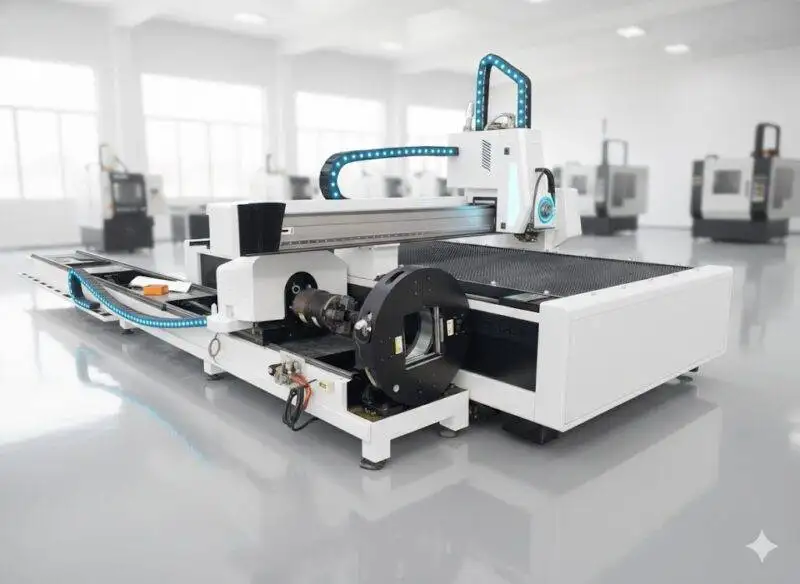
In the demanding field of pressure vessel manufacturing, the transition from raw plate to a weld-ready component is a critical path that dictates both the structural integrity and the total cost of production. Traditional methods of plate preparation often involve multi-stage processing, leading to cumulative errors and excessive labor costs. However, the implementation of Fiber Laser Cutting technology has revolutionized this workflow. By providing a unified platform for high-precision thermal cutting, industrial engineers can now streamline the fabrication of shells, heads, and nozzles with unprecedented accuracy.
The primary objective in pressure vessel construction is to ensure that every seam meets stringent code requirements, such as those defined by ASME Section VIII. Achieving the tight tolerances necessary for Narrow Gap Welding requires an edge quality that conventional thermal cutting methods simply cannot provide. Fiber lasers, operating at a wavelength of approximately 1.06 microns, offer a concentrated energy density that allows for extremely narrow kerf widths and minimal thermal distortion, which are essential for the tight fit-ups required in high-pressure applications.
Eliminating Secondary Grinding Processes
One of the most significant bottlenecks in traditional heavy plate fabrication is the requirement for secondary grinding. Mechanical or lower-quality thermal edges often present slag, dross, or heavy oxidation layers that compromise weld chemistry and joint penetration. Fiber laser cutting produces a surface finish that is frequently “weld-ready” immediately after the cut. The high-velocity assist gas (typically oxygen or nitrogen) clears the molten material efficiently, leaving a square, smooth edge with a roughness value often below 30 microns.
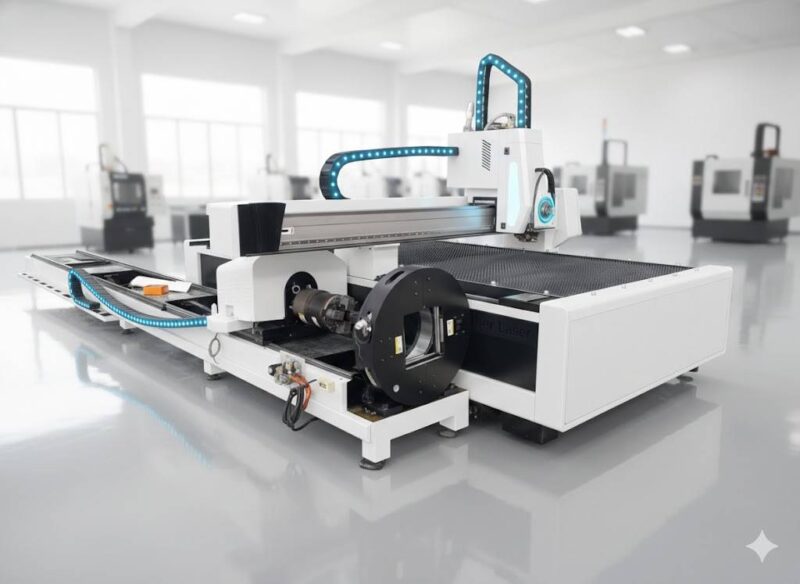
From an industrial engineering perspective, the elimination of grinding represents a massive reduction in non-value-added time. It removes the need for manual labor-intensive stations, reduces the consumption of abrasives, and improves the factory environment by minimizing airborne metallic dust. Furthermore, because the heat-affected zone (HAZ) of a fiber laser is significantly narrower than other thermal processes, the metallurgical properties of the base metal remain largely intact, ensuring that the subsequent narrow gap weld is bonding to a stable, unaltered substrate.
The Punch, Mark, and Cut Workflow
Modern Fiber Laser Cutting systems are not merely cutting tools; they are integrated fabrication centers. The ability to perform three distinct functions—punching (piercing), marking, and cutting—within a single CNC program is a game changer for Pressure Vessel Fabrication.
First, the laser’s piercing capability allows for rapid, high-precision hole starts even in thick-walled plates. This “punching” phase is controlled by advanced pulsing algorithms that prevent blowouts and ensure that the hole geometry is perfectly cylindrical from the start. Second, the laser can be detuned to perform surface marking. This is used for etching part numbers, heat numbers, and, more importantly, layout lines for nozzle fitments and support brackets. By etching these directly onto the plate with the same precision as the cut, the risk of human error in manual layout is eliminated.
Finally, the cutting phase executes the complex geometries required for shell courses and manway openings. Because all three operations happen in one setup, the spatial relationship between the mark and the cut remains perfect. This ensures that when the plate is rolled into a cylinder, the alignment for the narrow gap weld is mathematically precise.
Enabling Advanced Narrow Gap Welding Geometry
Narrow gap welding is favored in the industry for its ability to reduce the volume of filler metal required and to lower the total heat input into the vessel. However, this technique is notoriously sensitive to joint fit-up variations. A variation of even 0.5mm in the root gap can lead to lack of fusion or burn-through. This is where the fiber laser becomes an enabling technology.
The CNC precision of a fiber laser ensures that the bevel angles and root faces are consistent across the entire length of a longitudinal or circumferential seam. When two laser-cut edges are brought together, the uniformity of the gap allows for the use of Automated Weld Preparation parameters. This level of repeatability is the foundation of Industry 4.0 in heavy manufacturing, where the cutting machine communicates its output precision directly to the robotic welding cells.
Material Efficiency and Nesting Strategy
The precision of fiber laser technology also allows for tighter nesting of components on a single sheet of high-alloy steel. Pressure vessels often utilize expensive materials such as 316L stainless steel or chrome-moly alloys. A fiber laser’s narrow kerf means parts can be placed closer together without the risk of heat from one cut compromising the integrity of an adjacent part.
Industrial engineers can optimize nesting software to utilize every square inch of the plate, reducing scrap rates by up to 15% compared to traditional methods. When multiplied across a year of production, the material savings alone can often justify the capital investment in high-kilowatt fiber laser systems. Moreover, the speed of the fiber laser on medium-to-thick plates ensures that the cutting department is never a bottleneck for the assembly and welding departments.
Quality Control and Structural Integrity
In the context of pressure-retaining components, quality control is non-negotiable. Fiber laser cutting supports superior NDT (Non-Destructive Testing) results. Because the edges are clean and the geometry is exact, ultrasonic and radiographic testing of the narrow gap welds are less likely to reveal inclusions or voids that typically stem from poor fit-up or edge contamination.
The consistency of the laser process also aids in maintaining the circularity of the vessel. When plates are cut with high precision, the circumference is exactly as designed, which prevents “peaking” at the longitudinal joints during the rolling process. This geometric perfection ensures a more uniform stress distribution during hydrostatic testing and throughout the vessel’s operational lifespan.
Conclusion: The Engineering Standard for Modern Vessels
The integration of fiber laser cutting into the pressure vessel production cycle represents a shift toward higher manufacturing maturity. By focusing on the precision of the initial cut, engineers can solve problems before they reach the welding floor. The “no grinding” philosophy, supported by the punch, mark, and cut capabilities, provides a streamlined path to Narrow Gap Welding success.
As the industry moves toward higher pressures and more exotic materials, the reliance on high-precision fiber laser systems will only increase. It is the most effective tool for ensuring that the fabricated components meet the rigorous standards of safety, efficiency, and durability required in the modern industrial landscape. By prioritizing edge quality and dimensional accuracy at the source, manufacturers secure their position at the forefront of engineering excellence.






