The Paradigm Shift in Steel Structure Fabrication
The steel structure industry is currently undergoing a significant transition toward automation and high-precision execution. Traditional methods of preparing large-scale components—such as H-beams, box columns, and bridge sections—often involve fragmented processes that introduce cumulative errors. The introduction of the Fiber Laser Cutting machine mounted on a magnetic crawler represents a pivotal shift. This system merges the mobility of robotics with the surgical precision of fiber optics, allowing for on-site or shop-floor processing that meets the most stringent engineering tolerances.
From an industrial engineering perspective, the primary goal is the reduction of non-value-added time. Conventional thermal cutting often leaves dross and significant heat-affected zones (HAZ) that require manual grinding and edge preparation. By utilizing high-power fiber laser sources, these secondary operations are eliminated, allowing components to move directly from the cutting station to the assembly or bolting phase.
Mechanical Synergy: The Magnetic Crawler Platform
The Magnetic Crawler serves as the mobile foundation for the laser head. It utilizes high-strength permanent magnets or switchable electromagnets to adhere to the steel substrate, regardless of orientation. This allows for vertical, horizontal, and even overhead cutting paths on large workpieces that would be impossible to fit into a standard flatbed laser machine.
The motion control system of the crawler is engineered for high stability. Even minor vibrations can disrupt the focal point of a fiber laser, which typically operates with a beam diameter of less than 0.2mm. Therefore, the crawler employs high-resolution encoders and precision gear drives to maintain a constant feed rate. This stability is critical for ensuring that the kerf width remains uniform throughout the entire length of the cut, which is essential for the structural integrity of the final assembly.
Fiber Laser Precision and Material Interaction
The core advantage of fiber laser technology lies in its wavelength—typically around 1.07 microns. This wavelength is highly absorbed by carbon steel and stainless steel, resulting in an extremely high energy density at the focal point. When applied to Steel Structure Fabrication, this allows for narrow kerfs and minimal thermal distortion.
Because the energy is so concentrated, the surrounding material experiences a much lower thermal load compared to other thermal cutting methods. This prevents the warping of thin-gauge plates and maintains the metallurgical properties of high-strength structural steels. The precision of the cut is such that bolt holes can be “punched” (laser-cut with high circularity) to within tolerances of +/- 0.1mm, meeting the requirements for friction-grip bolted joints without the need for mechanical drilling.
Eliminating Secondary Processes: No Grinding Required
In industrial steel fabrication, grinding is a labor-intensive bottleneck. It creates dust, noise, and safety hazards while significantly increasing the cost per ton of fabricated steel. The fiber laser crawler produces a finished edge surface that is virtually free of dross and oxidation when used with appropriate assist gases like oxygen or nitrogen.
The resulting surface roughness (Ra) is low enough to meet bridge and architectural standards immediately. For engineers, this means the design calculations for fatigue life and edge distance remain valid without accounting for the micro-cracking often associated with coarser cutting methods. The “ready-to-assemble” output significantly compresses the production timeline.
Multifunctional Capabilities: Punching, Marking, and Cutting
Modern Automated Motion Control software integrated into the magnetic crawler allows for a three-in-one functional approach. The system does not merely cut the perimeter of a part; it executes a comprehensive fabrication program in a single setup.
Precision Punching and Hole Cutting
The system can interpolate complex hole patterns, including slotted holes for expansion joints or countersunk profiles. By varying the pulse frequency and duty cycle of the laser, the machine “punches” through thick plate with a perpendicularity that traditional methods struggle to achieve on large-scale curved surfaces.
Industrial Marking and Traceability
Traceability is a mandatory requirement in modern construction (ISO 9001, EN 1090). The fiber laser can be de-focused or set to a lower power density to etch part numbers, heat numbers, and weld symbols directly onto the steel surface. This permanent marking survives the transport and assembly process, ensuring that every beam and plate is correctly identified throughout the lifecycle of the project.
Optimizing the Fabrication Lifecycle
Integrating a magnetic crawler fiber laser into a production line changes the calculus of throughput. Traditional fabrication requires moving massive steel members to a centralized machine. The crawler flips this logic: it brings the machine to the workpiece. This reduces crane time and the logistics of material handling, which often account for up to 40% of shop labor costs.
Furthermore, the software integration allows for direct import of BIM (Building Information Modeling) files or CAD data. This digital-to-physical workflow ensures that the “as-built” component matches the “as-designed” model with extreme fidelity. The reduction in human error during layout and marking alone provides a rapid return on investment.
Technical Specifications and Performance Metrics
When evaluating these systems, several key performance indicators (KPIs) must be considered:
– Power Range: Typically 3kW to 12kW depending on plate thickness.
– Travel Speed: Up to 15m/min for marking and 1-3m/min for high-quality cutting of 20mm steel.
– Positioning Accuracy: Within 0.05mm over a 1000mm run.
– Adhesion Force: Magnetic pull-off force often exceeds 500kg to ensure safety and stability in vertical orientations.
Conclusion: The Future of High-Efficiency Construction
The combination of fiber laser precision and magnetic crawler mobility is more than a marginal improvement; it is a fundamental shift in how steel structures are realized. By focusing on high-speed, high-precision execution that eliminates the need for manual grinding and mechanical drilling, manufacturers can achieve unprecedented levels of efficiency. As global infrastructure projects demand tighter schedules and higher quality standards, the adoption of automated, mobile fiber laser systems will become the benchmark for competitive steel fabrication facilities.
-


LT240S tube laser cutting machine
-
LT120S tube laser cutting machine
-
Sale

Tank Fillet Welding Machine
Original price was: $1,000.00.$900.00Current price is: $900.00. -
Sale

MAK100 tube laser cutting machine
Original price was: $5,500.00.$5,000.00Current price is: $5,000.00. -

portable plasma air cutting machine
$1,200.00 -

2in1 fiber laser cutting machine
-

Air cooling Laser welding machine
-

HF h beam laser cutting machine
-

LT240 laser cutting machine
-

Laser welding machine
-


Cobot Welding Station
-

Gantry welding robot solution
-

Tracked Wheeled AGV Welding robot
-

LFH6020 Fiber laser cutting machine
-
LFP6020
-

robotic welidng machine
Advanced Fiber Laser Tube Processing Technology
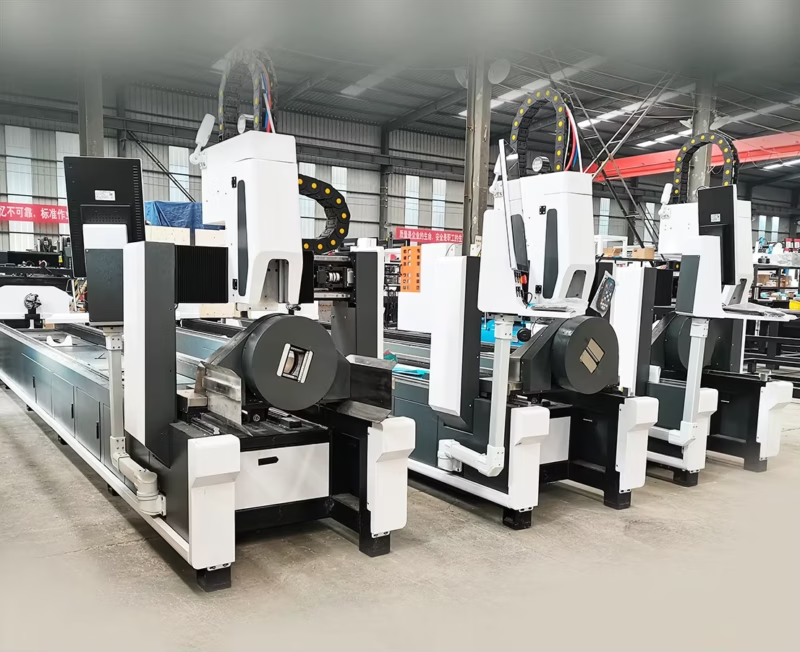
Our CNC Fiber Laser Tube Cutting systems revolutionize metal fabrication by integrating high-precision cutting, punching, and profiling into a single automated workflow. Designed for versatility, this technology handles a wide array of profiles including Round, Square, Rectangular, and Oval tubes, as well as complex L-shaped and U-shaped channels.
- Precision Punching: High-speed hole punching with micron-level accuracy, eliminating the need for mechanical drilling or die-stamping.
- Complex Profiling: Advanced 3D pathing allows for intricate interlocking joints and specialized notch cuts, ideal for structural frames.
- High Material Efficiency: Intelligent nesting software minimizes scrap, reducing raw material costs across large production runs.
- Clean Finish: Delivers oxide-free, burr-free edges that require zero secondary grinding before welding.

Seamlessly processing multiple profiles with consistent precision.
Global Delivery & Logistics



From our high-tech manufacturing facility directly to your global site. PCL WeldCut ensures secure packaging, professional handling, and reliable international logistics to safeguard your equipment throughout the entire journey.