Technical Overview of Mobile Fiber Laser Systems in Naval Construction
Shipbuilding involves the fabrication of massive steel structures where dimensional accuracy is critical for modular assembly. Traditional methods often struggle with the scale and geometry of hull sections. The introduction of fiber Laser Cutting technology coupled with Magnetic Crawler carriers addresses the limitations of stationary gantry systems. This mobile solution brings the tool to the workpiece, allowing for high-precision processing on large, often curved, steel plates without the need for extensive material handling.
The core of this system is a high-brightness fiber laser source, typically ranging from 6kW to 20kW. This power density enables rapid sublimation of ship-grade steel, producing a narrow kerf and a minimal heat-affected zone (HAZ). When integrated with a magnetic crawler, the laser head travels along the surface of the workpiece, held in place by powerful permanent magnets or electromagnets. This configuration ensures stability on vertical and inclined planes, which is frequent in the assembly of bulkheads and hull skins.
The Mechanics of Magnetic Crawler Integration
The magnetic crawler acts as a mobile CNC platform. It utilizes a multi-axle drive system to navigate the contours of a ship’s structure. The adhesion force must be calculated to support the weight of the laser head, the gas delivery lines, and the fiber optic cables, while maintaining a consistent standoff distance. Sensors continuously monitor the surface to adjust the focal point of the laser, ensuring that the high-precision edge quality is maintained regardless of surface irregularities or slight plate deformations.
Motion Control and Positional Accuracy
In an industrial engineering context, the precision of a crawler is defined by its encoder feedback and motion algorithms. By using high-resolution optical encoders, the crawler can track its position relative to a datum point on the steel plate. This allows the system to execute complex nesting patterns and intricate geometries. The synchronization between the laser’s pulse frequency and the crawler’s travel speed is vital for maintaining a smooth cut front and avoiding dross accumulation on the underside of the plate.
Advanced Processing Capabilities: Punching, Marking, and Cutting
A primary advantage of using a fiber laser on a crawler system is the ability to consolidate multiple manufacturing steps into a single pass. In shipbuilding, plates require identification marks, hole locations for fasteners, and final profile cuts. The fiber laser system manages these through varying power settings and modulation.
Precision Punching and Hole Piercing
Unlike mechanical punching, which induces physical stress on the material, fiber laser piercing is a non-contact process. The laser can create high-aspect-ratio holes with diameters smaller than the thickness of the plate. This is particularly useful for creating pilot holes or drainage points in structural reinforcements. The speed of the pierce is optimized through “on-the-fly” piercing techniques, reducing the total cycle time per plate compared to traditional drilling or mechanical methods.
Integrated Marking and Layout Traceability
Shipbuilding requires rigorous traceability and clear assembly instructions marked directly on the steel. The shipbuilding automation software controls the laser to etch alphanumeric codes, QR codes, and alignment lines onto the surface. By reducing the laser intensity, the system creates a permanent mark that survives subsequent coating processes but does not compromise the structural integrity of the steel. This eliminates the need for manual layout teams and reduces the risk of human error in part identification.
High-Speed Profile Cutting
The final stage is the profile cut. Fiber lasers excel in this area due to their 1.06-micron wavelength, which is highly absorbed by carbon steel and stainless steel. This absorption efficiency results in cutting speeds several times faster than older CO2 technology. Because the beam is focused to a very small spot, the kerf is extremely narrow, allowing for tight nesting of parts and maximizing material utilization. This is a critical metric for industrial engineers focused on cost reduction and waste management.
Eliminating Secondary Operations: No Grinding Required
A significant bottleneck in traditional ship fabrication is the requirement for secondary edge preparation. Rough cuts often necessitate grinding to remove dross or to meet the stringent tolerances required for automated welding. The fiber laser crawler system produces an edge finish that typically meets or exceeds ISO 9013 Grade 1 or 2 standards.
Thermal Control and Reduced Distortion
Because the fiber laser delivers energy so precisely, the total heat input into the plate is significantly lower than other thermal cutting methods. This reduction in heat input minimizes “bowing” or thermal distortion of large plates. For shipbuilders, this means that parts fit together perfectly during the “block assembly” phase, reducing the need for hydraulic pulling or corrective heating. The magnetic crawler system further aids this by providing a localized heat sink through its contact with the plate, although the primary benefit remains the laser’s inherent efficiency.
Edge Chemistry and Paint Adhesion
The use of nitrogen or oxygen as a shielding gas allows the engineer to control the chemistry of the cut edge. When cutting with fiber lasers, the oxide layer is either non-existent (with nitrogen) or extremely thin and stable (with oxygen). This results in an edge that is ready for immediate priming and painting. In the corrosive marine environment, the quality of this edge is paramount for long-term coating integrity and rust prevention.
Efficiency and ROI in the Shipyard Environment
From a production management perspective, the deployment of a mobile fiber laser crawler represents a shift from “material-to-machine” to “machine-to-material.” This reduces the reliance on massive overhead cranes and simplifies the logistics of the shop floor. The crawler can be deployed directly on the assembly floor or even inside the dry dock for retrofitting and repair work.
Labor Reduction and Throughput
Automating the cutting and marking process reduces the man-hours required for layout and edge cleaning. A single operator can oversee multiple crawler units, significantly increasing the square footage of steel processed per shift. The reduction in downtime for setup—since the crawler can be quickly repositioned—directly correlates to a higher Overall Equipment Effectiveness (OEE) rating.
Energy Consumption and Maintenance
Fiber lasers are remarkably energy-efficient, often boasting wall-plug efficiencies of over 30%. This is a sharp contrast to older laser technologies. Furthermore, since the beam is delivered through a flexible fiber optic cable rather than a series of mirrors and bellows, the maintenance requirements are minimal. There are no optical components to align on the crawler, which is essential for a tool that must withstand the vibrations and dust of a shipyard environment.
Future Directions in Mobile Laser Fabrication
The trajectory for this technology involves deeper integration with Digital Twin and CAD/CAM systems. By importing the 3D model of the ship directly into the crawler’s controller, the system can use onboard vision sensors to orient itself and compensate for any deviations between the “as-designed” and “as-built” structure. This level of autonomy is the next step in the evolution of naval architecture and industrial engineering, ensuring that the precision of a laboratory-grade laser is successfully applied to the heavy-duty demands of ship construction.
-


Cantilever Welding Robot solution
-


GF laser cutting machine
-

P3015 plasma cutting machine
-

LFP3015 Fiber Laser Cutter
-

pipe plasma cutting machine
-
LFH 4020 Fiber Laser Cutting Machine
-
LFP4020
-

gantry plasma air cutting machine
-

3D robot cutting machine
-

8 axis plasma cutting machine
-

5 axis plasma cutting machine
-

LT360 tube laser cutting machine
-

robot welding workstation
-

SF6060 fiber laser cutting machine
Advanced Fiber Laser Tube Processing Technology
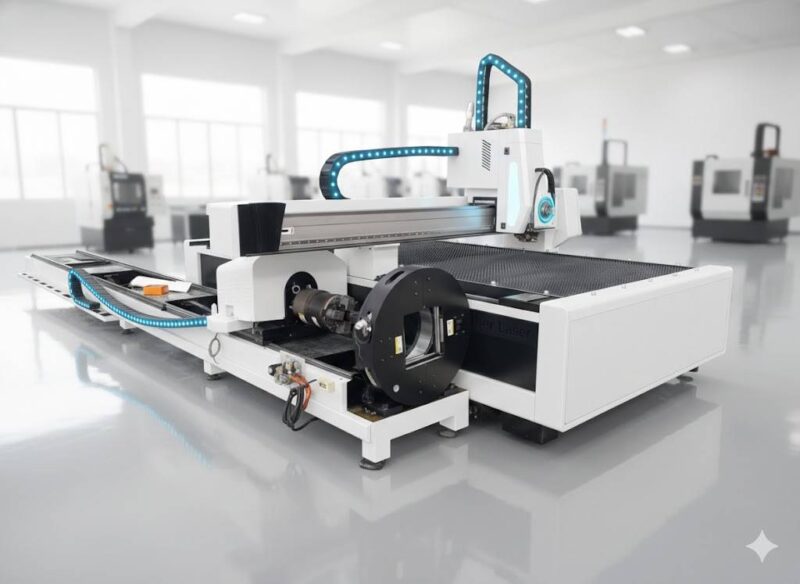
Our CNC Fiber Laser Tube Cutting systems revolutionize metal fabrication by integrating high-precision cutting, punching, and profiling into a single automated workflow. Designed for versatility, this technology handles a wide array of profiles including Round, Square, Rectangular, and Oval tubes, as well as complex L-shaped and U-shaped channels.
- Precision Punching: High-speed hole punching with micron-level accuracy, eliminating the need for mechanical drilling or die-stamping.
- Complex Profiling: Advanced 3D pathing allows for intricate interlocking joints and specialized notch cuts, ideal for structural frames.
- High Material Efficiency: Intelligent nesting software minimizes scrap, reducing raw material costs across large production runs.
- Clean Finish: Delivers oxide-free, burr-free edges that require zero secondary grinding before welding.

Seamlessly processing multiple profiles with consistent precision.
Global Delivery & Logistics



From our high-tech manufacturing facility directly to your global site. PCL WeldCut ensures secure packaging, professional handling, and reliable international logistics to safeguard your equipment throughout the entire journey.