Advanced Integration of Fiber Laser Cutting in Vessel Fabrication
The fabrication of pressure vessels requires rigorous adherence to geometric tolerances and material integrity. Traditional methods often involve multi-stage processes including manual layout, mechanical cutting, and intensive post-processing. The shift toward a Fiber Laser Cutting Machine mounted on a magnetic crawler represents a significant leap in industrial engineering efficiency. This system leverages the high power density of fiber optics and the mobility of automated crawlers to perform complex cuts directly on the vessel shell.
Unlike traditional mechanical methods, fiber laser technology utilizes a concentrated beam of light to melt and vaporize material with extreme precision. When coupled with a magnetic crawler, the laser head can traverse the circumference or longitudinal axis of a vessel without the need for fixed rails or heavy gantry structures. This mobility is essential for large-diameter tanks where transporting the workpiece to a stationary laser bed is logistically impractical.
Mechanical Stability via Magnetic Crawler Systems
The magnetic crawler serves as the mobile platform for the laser processing head. It utilizes high-strength permanent magnets or switchable electromagnets to maintain a constant attractive force against the vessel wall. This force must be calibrated to counteract the weight of the laser head and the umbilical cables containing the fiber optic delivery line, assist gases, and power supply. For industrial engineers, the stability of this platform is the primary determinant of “kerf” consistency and path accuracy.
In pressure vessel applications, the crawler must navigate the curvature of the shell. Sophisticated drive systems with multi-wheel configurations ensure that the laser nozzle maintains a perpendicular orientation to the surface, or a specific programmed angle for beveling. By utilizing a magnetic crawler, the setup time is reduced from hours to minutes, as the machine can be “snapped” onto the workpiece at any location, eliminating the constraints of traditional CNC bed sizes.
The Three Pillars of Fiber Laser Processing: Punch, Mark, and Cut
A primary advantage of utilizing fiber laser technology in this configuration is the ability to execute multiple production steps in a single program pass. This consolidation minimizes the margin of error introduced by re-positioning tools or manual layout marking.
Precision Punching and Pilot Holes
Before a full cut is initiated, the fiber laser can perform high-speed punching. This is particularly useful for creating pilot holes or start-points for internal cutouts, such as manways or instrument nozzles. The localized heat input of the fiber laser ensures that the surrounding grain structure of the pressure vessel steel remains stable, preventing the micro-cracking often associated with mechanical punching or high-heat traditional methods.
Automated Marking for Assembly
Industrial engineers emphasize traceability and assembly accuracy. The fiber laser can be de-tuned or modulated to act as a marking tool. It etches heat numbers, centerlines, and alignment markers directly onto the vessel surface. Because these marks are generated from the same CAD/CAM data as the cuts, their spatial accuracy is absolute. This eliminates the need for manual chalk lines or template-based marking, which are prone to human error.
High-Speed Precision Cutting
The core function remains the high-speed cut. Fiber lasers, typically ranging from 3kW to 12kW for vessel applications, provide a narrow kerf width and a minimal heat-affected zone (HAZ). For pressure vessel components, maintaining the metallurgical properties of the base metal is critical. The speed of the fiber laser allows for rapid cooling, ensuring that the material properties required by ASME or ISO standards are not compromised during the cutting process.
Elimination of Secondary Grinding Processes
In conventional vessel fabrication, the edge quality of a cut usually requires secondary grinding to remove dross, slag, or carbonization before the next stage of production. The fiber laser, however, produces an exceptionally clean edge. By optimizing assist gas flow—typically oxygen for carbon steel or nitrogen for stainless steel—the dross is blown away from the cut in real-time.
From a lean manufacturing perspective, the “no grinding” result is a massive cost saver. It reduces man-hours and eliminates the ergonomic hazards and dust associated with manual grinding. The surface finish achieved by the fiber laser is often ready for immediate fit-up, ensuring that the structural integrity of the joint is maintained without the risk of embedding abrasive particles into the metal surface.
Optimizing Material Utilization and Throughput
The integration of CNC path planning with the magnetic crawler allows for optimized nesting of nozzle openings. When engineers can program the crawler to move across the vessel surface with precision, they can place openings closer together or in more complex configurations than manual methods allow. This optimization reduces material waste and ensures that the vessel’s structural reinforcement zones are respected with millimeter accuracy.
Thermal Management and Safety Considerations
Fiber lasers are highly efficient, converting a large percentage of electrical energy into light. However, the intensity of the beam requires strict safety protocols. Magnetic crawlers used in these applications are often equipped with local shielding or “dark boxes” that move with the laser head to prevent stray reflections. Additionally, because the fiber laser is delivered via a flexible cable, there are no mirrors to align, which increases the uptime and reliability of the system in harsh workshop environments.
Conclusion for Industrial Applications
For pressure vessel manufacturers, the adoption of a fiber laser cutting machine with Magnetic Crawler integration represents an move toward Industry 4.0. By centralizing the marking, punching, and cutting tasks into a single mobile unit, the workflow transitions from a labor-intensive manual process to a high-throughput automated system. The elimination of secondary grinding and the achievement of high-precision tolerances directly impact the bottom line by reducing lead times and increasing the quality of the final pressurized component. This technology ensures that the stringent requirements of heavy industry are met with modern efficiency and repeatable accuracy.
-


LT240S tube laser cutting machine
-
LT120S tube laser cutting machine
-
Sale

Tank Fillet Welding Machine
Original price was: $1,000.00.$900.00Current price is: $900.00. -
Sale

MAK100 tube laser cutting machine
Original price was: $5,500.00.$5,000.00Current price is: $5,000.00. -

portable plasma air cutting machine
$1,200.00 -

2in1 fiber laser cutting machine
-

Air cooling Laser welding machine
-

HF h beam laser cutting machine
-

LT240 laser cutting machine
-

Laser welding machine
-


Cobot Welding Station
-

Gantry welding robot solution
-

Tracked Wheeled AGV Welding robot
-

LFH6020 Fiber laser cutting machine
-
LFP6020
-

robotic welidng machine
Advanced Fiber Laser Tube Processing Technology
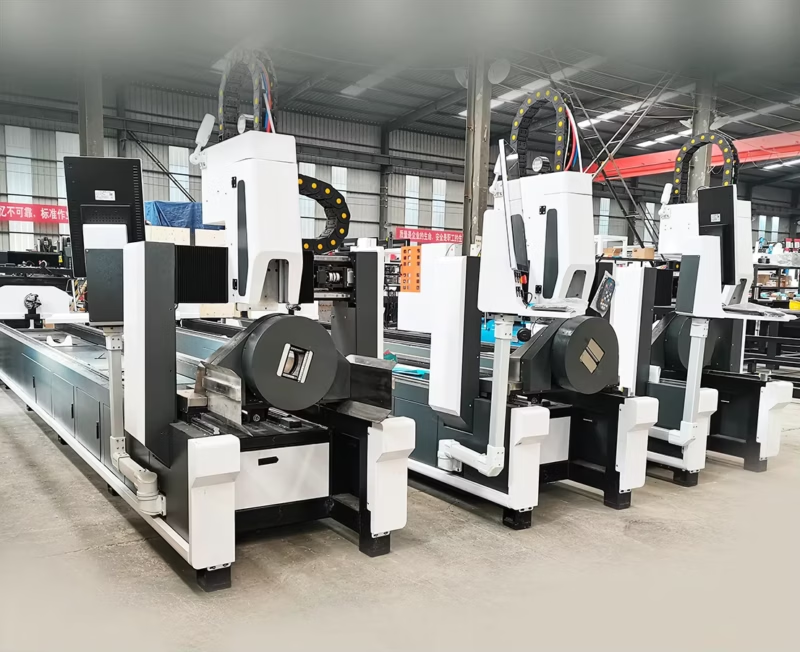
Our CNC Fiber Laser Tube Cutting systems revolutionize metal fabrication by integrating high-precision cutting, punching, and profiling into a single automated workflow. Designed for versatility, this technology handles a wide array of profiles including Round, Square, Rectangular, and Oval tubes, as well as complex L-shaped and U-shaped channels.
- Precision Punching: High-speed hole punching with micron-level accuracy, eliminating the need for mechanical drilling or die-stamping.
- Complex Profiling: Advanced 3D pathing allows for intricate interlocking joints and specialized notch cuts, ideal for structural frames.
- High Material Efficiency: Intelligent nesting software minimizes scrap, reducing raw material costs across large production runs.
- Clean Finish: Delivers oxide-free, burr-free edges that require zero secondary grinding before welding.

Seamlessly processing multiple profiles with consistent precision.
Global Delivery & Logistics



From our high-tech manufacturing facility directly to your global site. PCL WeldCut ensures secure packaging, professional handling, and reliable international logistics to safeguard your equipment throughout the entire journey.