Advanced Integration of Fiber Laser Technology in Vessel Manufacturing
The fabrication of pressure vessels, including storage tanks, boilers, and heat exchangers, demands extreme geometric accuracy and material integrity. Traditional methods often involve manual layout and mechanical cutting, which introduce significant human error and material deformation. The emergence of the Fiber Laser Cutting Machine mounted on a mobile magnetic crawler represents a paradigm shift in industrial engineering. This system brings the tool to the workpiece, rather than moving massive cylindrical shells to a stationary gantry. This mobility, combined with the coherent light of a fiber laser, ensures that large-scale components meet ASME and ISO standards with minimal deviation.
The Mechanics of the Magnetic Crawler System
The magnetic crawler is a specialized robotic platform equipped with high-intensity permanent magnets or switchable electromagnets. These magnets provide the necessary adhesion force to allow the crawler to traverse the curved surfaces of carbon steel and ferritic stainless steel vessels. In an industrial setting, the crawler eliminates the need for expensive, large-format flatbed lasers that are often limited by the diameter of the vessel shell.
Stability and Path Control
Engineered with high-torque servo motors and precision encoders, the crawler maintains a constant stand-off distance between the laser nozzle and the vessel surface. This is critical for maintaining the focal point of the fiber laser. The integrated CNC system uses specialized algorithms to compensate for the curvature of the shell, ensuring that nozzle holes and longitudinal cuts are mathematically perfect. The Magnetic Crawler ensures that even during vertical or inverted operation, the cutting head remains stabilized against gravitational pull, maintaining a kerf width as narrow as 0.1mm.
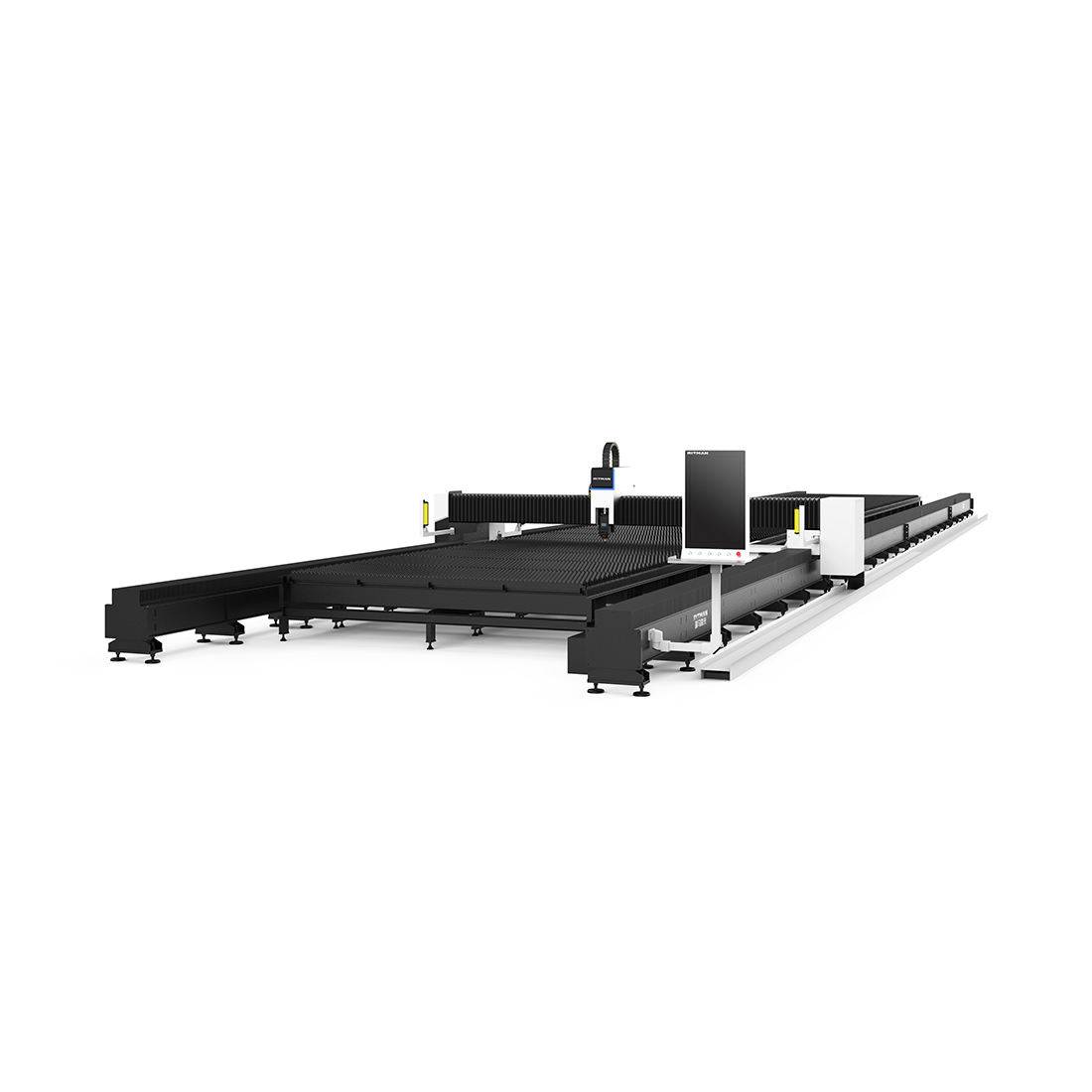
The Fiber Laser Advantage: Punch, Mark, and Cut
One of the most significant advantages of fiber laser technology in this application is its versatility in performing multiple operations in a single setup. The “Punch, Mark, and Cut” sequence is a streamlined workflow that maximizes throughput.
High-Speed Piercing (Punching)
Fiber lasers utilize high power density to “punch” or pierce through thick plate steel in a fraction of a second. Unlike mechanical punching, this process is non-contact, meaning there is no tool wear or mechanical stress applied to the vessel wall. The rapid piercing capability allows for immediate transition into the cutting phase, reducing the overall dwell time per hole.
Precision Marking for Assembly
Before the final cut, the fiber laser can be modulated to a lower power setting for surface marking. This allows the machine to etch part numbers, alignment lines, or orientation guides directly onto the vessel shell. This eliminates the need for manual chalking or ink marking, which can be wiped away during handling. The marking is permanent and highly legible, facilitating downstream assembly and quality control tracking.
Final Contour Cutting
The final phase is the high-precision cut. Because the fiber laser beam is delivered via a flexible fiber optic cable, the crawler can maneuver through complex geometries, such as saddle cuts for nozzle intersections. The Pressure Vessel Fabrication process benefits from the laser’s ability to handle complex 3D paths that would be impossible for traditional mechanical tools.
Eliminating Secondary Processes: No Grinding Required
In traditional thermal cutting, the resulting edge often suffers from a significant Heat Affected Zone (HAZ) and heavy dross or slag accumulation. This necessitates extensive secondary grinding to prepare the edge for code-quality work. Non-Contact Precision cutting with a fiber laser virtually eliminates these requirements.
Superior Edge Quality and HAZ Reduction
Fiber lasers operate at a wavelength of approximately 1.06 microns, which is highly absorbed by metallic materials. This leads to a very concentrated heat source, resulting in an extremely narrow HAZ. The grain structure of the base metal remains largely undisturbed, which is a vital factor in maintaining the fatigue life of a pressure vessel. The resulting edge is smooth, with a surface finish that often meets or exceeds the requirements for immediate fit-up.
Dross-Free Results
By utilizing high-pressure assist gases—such as oxygen for carbon steel or nitrogen for stainless steel—the molten metal is efficiently ejected from the kerf. This produces a clean, dross-free underside. By removing the grinding step, manufacturers reduce labor costs, minimize the noise and dust in the shop environment, and accelerate the transition from the cutting bay to the assembly floor.
Technical Specifications and Material Versatility
Modern magnetic crawler fiber systems are typically equipped with power sources ranging from 2kW to 6kW. This range is optimal for the thicknesses commonly found in mid-to-large scale pressure vessels (typically 6mm to 25mm).
Material Compatibility
While the magnetic crawler requires a ferromagnetic substrate for adhesion, the fiber laser itself is capable of cutting a wide array of alloys. For non-magnetic vessels like high-grade austenitic stainless steel or aluminum, specialized track systems can be used, though the magnetic crawler remains the gold standard for carbon steel shells. The ability of the fiber laser to cut reflective materials without back-reflection damage to the resonator is a key technical evolution over older CO2 laser technologies.
Accuracy and Repeatability
The positioning accuracy of the crawler system is typically within +/- 0.5mm over a large surface area, while the laser’s own repeatability is even finer. In the context of a 10-meter long vessel shell, this level of precision ensures that longitudinal seams align perfectly, reducing the need for excessive force during fit-up and ensuring a more uniform distribution of stress in the final product.
Economic Impact on Industrial Production
From an industrial engineering perspective, the implementation of a fiber laser crawler system is justified through the reduction of “total cost per part.” While the initial capital expenditure for fiber laser technology is significant, the operational savings are found in the speed of the process and the elimination of consumables associated with mechanical cutting.
Furthermore, the reduction in cycle time is dramatic. A process that once took hours of layout, manual cutting, and subsequent grinding can now be completed in minutes of automated laser operation. The reliability of fiber laser sources, which often boast a lifespan of over 100,000 hours, ensures that the downtime for maintenance is negligible compared to the upkeep required for traditional mechanical or older thermal cutting systems.
Conclusion
The integration of fiber laser cutting heads with Magnetic Crawler movement represents the pinnacle of current pressure vessel manufacturing technology. By focusing on the “punch, mark, and cut” capability, industrial facilities can achieve a level of precision that removes the burden of secondary grinding and manual layout. This technology not only enhances the structural integrity of the vessels produced but also provides a scalable, efficient, and highly repeatable solution for the demanding requirements of modern energy and chemical processing industries.
-


LT240S tube laser cutting machine
-
LT120S tube laser cutting machine
-
Sale

Tank Fillet Welding Machine
Original price was: $1,000.00.$900.00Current price is: $900.00. -
Sale

MAK100 tube laser cutting machine
Original price was: $5,500.00.$5,000.00Current price is: $5,000.00. -

portable plasma air cutting machine
$1,200.00 -

2in1 fiber laser cutting machine
-

Air cooling Laser welding machine
-

HF h beam laser cutting machine
-

LT240 laser cutting machine
-

Laser welding machine
-


Cobot Welding Station
-

Gantry welding robot solution
-

Tracked Wheeled AGV Welding robot
-

LFH6020 Fiber laser cutting machine
-
LFP6020
-

robotic welidng machine
Advanced Fiber Laser Tube Processing Technology
Our CNC Fiber Laser Tube Cutting systems revolutionize metal fabrication by integrating high-precision cutting, punching, and profiling into a single automated workflow. Designed for versatility, this technology handles a wide array of profiles including Round, Square, Rectangular, and Oval tubes, as well as complex L-shaped and U-shaped channels.
- Precision Punching: High-speed hole punching with micron-level accuracy, eliminating the need for mechanical drilling or die-stamping.
- Complex Profiling: Advanced 3D pathing allows for intricate interlocking joints and specialized notch cuts, ideal for structural frames.
- High Material Efficiency: Intelligent nesting software minimizes scrap, reducing raw material costs across large production runs.
- Clean Finish: Delivers oxide-free, burr-free edges that require zero secondary grinding before welding.

Seamlessly processing multiple profiles with consistent precision.
Global Delivery & Logistics



From our high-tech manufacturing facility directly to your global site. PCL WeldCut ensures secure packaging, professional handling, and reliable international logistics to safeguard your equipment throughout the entire journey.