Advancing Tank Fabrication with Magnetic Crawler Fiber Lasers
In the oil and gas industry, the structural integrity of storage tanks depends heavily on the precision of the initial plate preparation. Traditional methods often result in significant thermal deformation or mechanical inaccuracies that necessitate labor-intensive secondary operations. The introduction of the magnetic crawler fiber laser represents a fundamental shift toward automated, high-precision onsite fabrication. This technology utilizes a compact, high-power fiber laser source mounted on a mobile chassis that adheres to the tank shell via high-intensity permanent magnets, allowing for vertical and horizontal cutting with sub-millimeter accuracy.
Technical Specifications of Fiber Laser Integration
The core of this system is the fiber laser oscillator, typically ranging from 3kW to 6kW for standard tank shell thicknesses. Unlike CO2 lasers that require complex mirror paths, fiber lasers deliver the beam via a flexible optical fiber directly to the cutting head on the crawler. This allows for a lightweight, agile motion system capable of navigating the vast surface area of oil and gas tanks.
The wavelength of a fiber laser—approximately 1.07 microns—is highly absorbed by carbon steel and stainless steel, the primary materials in tank construction. This high absorption rate translates into a narrow heat affected zone (HAZ), which is critical for maintaining the metallurgical properties of the parent metal. By concentrating energy into a minuscule focal point, the system achieves a nominal kerf width, ensuring that the dimensional tolerances of the tank plates are held within strict engineering limits.
Automated Magnetic Adhesion and Motion Control
The crawler utilizes a drive system powered by high-torque servo motors combined with a magnetic array. This array provides sufficient clamping force to overcome gravity and the reactionary forces of high-pressure assist gases. From an industrial engineering perspective, the stability of the platform is paramount to maintaining the focal length of the laser. Any deviation in the standoff distance would compromise the cut quality.
Advanced sensors on the crawler continuously monitor the surface curvature of the tank. The CNC controller adjusts the Z-axis in real-time, ensuring that the laser nozzle remains perpendicular to the workpiece. This constant adjustment is what allows the machine to perform complex geometries, such as manhole cutouts or pipe penetration apertures, without manual repositioning.
The Punch-Mark-Cut Workflow Strategy
One of the most significant advantages of this system is its ability to perform multiple operations in a single setup. This “Punch-Mark-Cut” sequence streamlines the automated tank fabrication process, reducing the total man-hours per shell ring.
High-Precision Marking
Before the cutting begins, the fiber laser operates in a low-power, high-frequency pulsing mode to mark layout lines, reference points, and identification numbers directly onto the steel surface. This eliminates the need for manual chalking or physical stamping, which are prone to human error. These marks are permanent enough for assembly but do not penetrate deep enough to cause stress risers in the material.
Precision Punching and Piercing
For bolt holes or small apertures, the system utilizes a high-energy piercing sequence. By modulating the laser pulse, the machine creates a clean entry point with minimal dross. This “punching” capability ensures that holes are perfectly circular and ready for fastener insertion without requiring reaming or deburring.
Final Profile Cutting
The final phase is the continuous wave (CW) cutting of the plate profile. Because the fiber laser provides a highly concentrated energy density, the resulting edge is remarkably smooth. In the context of oil and gas engineering, this is vital. A smooth edge reduces the likelihood of fatigue cracks and ensures a perfect fit-up during the assembly phase.
Elimination of Secondary Grinding Processes
Traditional thermal cutting methods often leave a thick oxide layer or a ragged edge that requires manual grinding. Grinding is not only a bottleneck in the production timeline but also presents significant health and safety risks, including metal dust inhalation and noise pollution. The fiber laser oscillator produces a cut surface with a low Rz value (surface roughness). When optimized with the correct assist gas—oxygen for carbon steel or nitrogen for stainless steel—the edge remains clean and free of slag.
From a cost-benefit analysis, the elimination of grinding translates to a 30-40% reduction in labor costs per plate. Furthermore, the absence of mechanical grinding ensures that the plate thickness remains uniform up to the very edge of the cut, maintaining the structural calculations specified in the tank’s design phase.
Gas Dynamics and Surface Integrity
The role of assist gas in fiber Laser Cutting cannot be overstated. The magnetic crawler system is equipped with a high-pressure gas delivery manifold that blows the molten metal out of the kerf. This process is highly controlled to prevent “self-burning” or excessive oxidation. For high-alloy tanks, using nitrogen as an assist gas allows for a “cold cut” where the temperature of the surrounding material remains low, further shrinking the heat affected zone and preventing the precipitation of carbides that could lead to corrosion in harsh oil and gas environments.
Accuracy and Geometric Fidelity
Industrial standards such as API 650 specify rigorous tolerances for tank verticality and roundness. Using a magnetic crawler ensures that the cuts are synchronized with the actual geometry of the tank as it stands. Manual cutting often fails to account for the slight irregularities in large-scale plates. The crawler’s CNC system can import CAD files directly, ensuring that every cutout for nozzles, vents, and hatches is located with a precision of ±0.1mm.
Safety and Environmental Impact
Automating the cutting process on a magnetic platform significantly improves the safety profile of the job site. Operators can control the magnetic crawler fiber laser from a distance using a wireless pendant or a remote workstation. This removes personnel from the immediate vicinity of the cutting arc and potential falling debris. Additionally, the efficiency of the fiber laser means less energy consumption and lower gas usage compared to legacy thermal methods, contributing to a more sustainable construction process.
Conclusion: The Future of Onsite Processing
The integration of fiber laser technology with magnetic mobility is a logical evolution for the oil and gas industry. As projects demand faster turnaround times and higher safety standards, the ability to punch, mark, and cut with extreme precision without the need for secondary grinding becomes a competitive necessity. By focusing on the inherent strengths of the fiber laser—high energy density, minimal thermal impact, and superior beam quality—engineers can ensure that the next generation of storage infrastructure is built with the highest level of structural integrity and operational efficiency.
-


Cantilever Welding Robot solution
-


GF laser cutting machine
-

P3015 plasma cutting machine
-

LFP3015 Fiber Laser Cutter
-

pipe plasma cutting machine
-
LFH 4020 Fiber Laser Cutting Machine
-
LFP4020
-

gantry plasma air cutting machine
-

3D robot cutting machine
-

8 axis plasma cutting machine
-

5 axis plasma cutting machine
-

LT360 tube laser cutting machine
-

robot welding workstation
-

SF6060 fiber laser cutting machine
Advanced Fiber Laser Tube Processing Technology
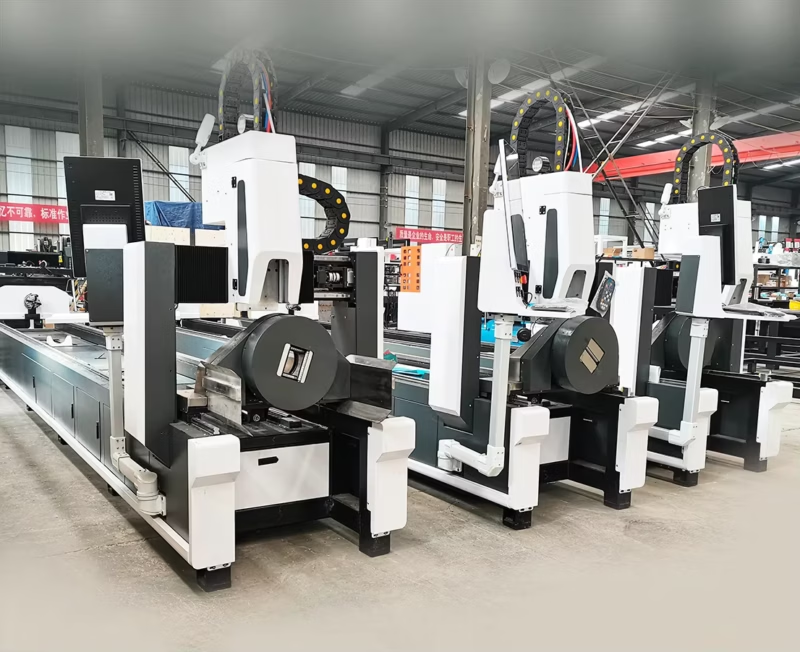
Our CNC Fiber Laser Tube Cutting systems revolutionize metal fabrication by integrating high-precision cutting, punching, and profiling into a single automated workflow. Designed for versatility, this technology handles a wide array of profiles including Round, Square, Rectangular, and Oval tubes, as well as complex L-shaped and U-shaped channels.
- Precision Punching: High-speed hole punching with micron-level accuracy, eliminating the need for mechanical drilling or die-stamping.
- Complex Profiling: Advanced 3D pathing allows for intricate interlocking joints and specialized notch cuts, ideal for structural frames.
- High Material Efficiency: Intelligent nesting software minimizes scrap, reducing raw material costs across large production runs.
- Clean Finish: Delivers oxide-free, burr-free edges that require zero secondary grinding before welding.

Seamlessly processing multiple profiles with consistent precision.
Global Delivery & Logistics



From our high-tech manufacturing facility directly to your global site. PCL WeldCut ensures secure packaging, professional handling, and reliable international logistics to safeguard your equipment throughout the entire journey.