Technical Integration of Fiber Laser Cutting in Tank Construction
In the construction of large-scale oil and gas storage tanks, the precision of shell plate preparation directly dictates the integrity of the final structure. Traditional methods often involve significant manual labor and low-precision mechanical cutting, which necessitates extensive post-processing. The transition to a magnetic crawler fiber laser system represents a shift toward automated precision. This system utilizes a high-power fiber laser source mounted on a mobile, magnetically adhered platform that traverses the vertical and horizontal surfaces of tank shells.
The core advantage of fiber laser technology in this application is the wavelength—typically around 1.06 microns. This allows for high absorption rates in carbon steel and stainless steel, the primary materials used in the oil and gas sector. By concentrating energy into a minuscule spot size, the system achieves a power density that vaporizes metal instantly, resulting in a narrow kerf and a negligible heat-affected zone (HAZ). From an industrial engineering perspective, this precision eliminates the need for edge grinding, as the cut surface meets the stringent roughness requirements for subsequent assembly phases.
Mechanical Stability and Magnetic Adhesion Logic
Operating a laser cutting head on a vertical or curved plane requires constant focal distance maintenance. The magnetic crawler utilizes high-strength permanent magnets or switchable electromagnets to generate sufficient clamping force to counteract the weight of the laser head and the umbilical cables. This adhesion must be balanced against the torque requirements of the drive motors to ensure smooth, jitter-free motion.
Real-Time Gap Sensing and Focal Control
The crawler is equipped with non-contact capacitive sensors that monitor the distance between the laser nozzle and the tank surface. Since tank plates often exhibit slight undulations or deviations from a perfect radius, the system must adjust the Z-axis in real-time. This ensures that the focal point remains optimized within the material thickness, preventing dross accumulation and ensuring a square cut edge.
Load Distribution and Traction
The drive system typically employs high-friction synthetic treads or wheels integrated with the magnetic modules. This configuration ensures that the crawler can maintain its path accuracy even when encountering surface contaminants like light rust or mill scale. The precision of the movement is governed by high-resolution encoders, allowing for a positional accuracy within ±0.1mm over several meters of travel.
Multifunctional Process Flow: Punching, Marking, and Cutting
One of the primary efficiency drivers of the fiber laser crawler is its ability to perform multiple operations in a single setup. In traditional workflows, layout marks for nozzles, manways, and structural attachments are applied manually using templates and chalk lines. The automated tank cutting system replaces these manual steps with digital precision.
Precision Laser Marking
Before the cutting phase, the laser operates in a low-power, high-speed mode to etch layout lines and identification codes directly onto the steel plate. This ensures that all downstream assembly components are aligned with sub-millimeter accuracy. Because the marking is done by the same CNC program that handles the cutting, there is zero risk of cumulative measurement error.
High-Speed Piercing Protocols
For internal cutouts, such as nozzle apertures, the fiber laser employs multi-stage piercing sequences. By modulating the frequency and duty cycle of the laser pulse, the system creates a clean entry point without significant blowback or damage to the nozzle tip. This is critical for maintaining the longevity of consumables and ensuring the consistency of the cut starting point.
Final Edge Profiling
The final cutting stage utilizes a continuous wave (CW) mode to execute the programmed geometry. The high beam quality of the fiber laser allows for feed rates that significantly exceed mechanical methods. Furthermore, the narrow kerf minimizes material waste, which, when scaled across a project involving dozens of tanks, results in measurable material cost savings.
Elimination of Post-Processing and Grinding
In standard industrial fabrication, the edge quality of a cut is often the bottleneck. Mechanical shearing or oxygen-fuel cutting leaves behind a hardened edge or thick slag that must be removed via manual grinding to prevent weld defects. The fiber laser process, however, produces a “weld-ready” edge.
The heat-affected zone reduction achieved by fiber lasers is a critical metric for oil and gas applications where material properties, such as grain structure and corrosion resistance, must be preserved. By minimizing the thermal input, the system prevents the formation of martensite in the edge region, ensuring that the parent metal retains its ductility and toughness. This eliminates the labor-intensive grinding stage, reducing the total man-hours per shell plate by an estimated 30-40%.
Industrial Engineering Impact on Project Timelines
From a project management standpoint, the deployment of a magnetic crawler fiber laser system transforms the critical path of tank farm construction. By shifting the cutting and marking process from a centralized shop to the field, or by increasing the speed of on-site pre-fabrication, the lead time for shell erection is truncated.
Workflow Synchronization
The ability to cut manways and nozzle openings after the shell has been rolled and tacked ensures that all openings are perfectly positioned relative to the final as-built geometry. This compensates for any minor shifts that occur during the rolling process. The integration of digital CAD/CAM files directly into the crawler’s controller ensures that the “as-built” matches the “as-designed” with high fidelity.
Safety and Environmental Considerations
Automating the cutting process removes operators from the immediate vicinity of the cutting zone, reducing exposure to thermal hazards and fine particulates. Since the fiber laser process is highly efficient, it generates less fume than traditional thermal methods, and the concentrated beam reduces the overall energy consumption per linear meter of cut.
Conclusion on Precision Laser Integration
The implementation of a fiber laser integrated with a magnetic crawler provides a robust solution for the technical challenges of oil and gas tank fabrication. By focusing on precision laser marking and high-speed cutting without the need for secondary finishing, manufacturers can achieve superior edge quality and dimensional accuracy. The reduction in total cycle time, combined with the elimination of manual grinding and layout errors, establishes this technology as a standard for high-throughput, high-quality industrial fabrication in the energy sector.
-


LT240S tube laser cutting machine
-
LT120S tube laser cutting machine
-
Sale

Tank Fillet Welding Machine
Original price was: $1,000.00.$900.00Current price is: $900.00. -
Sale

MAK100 tube laser cutting machine
Original price was: $5,500.00.$5,000.00Current price is: $5,000.00. -

portable plasma air cutting machine
$1,200.00 -

2in1 fiber laser cutting machine
-

Air cooling Laser welding machine
-

HF h beam laser cutting machine
-

LT240 laser cutting machine
-

Laser welding machine
-


Cobot Welding Station
-

Gantry welding robot solution
-

Tracked Wheeled AGV Welding robot
-

LFH6020 Fiber laser cutting machine
-
LFP6020
-

robotic welidng machine
Advanced Fiber Laser Tube Processing Technology
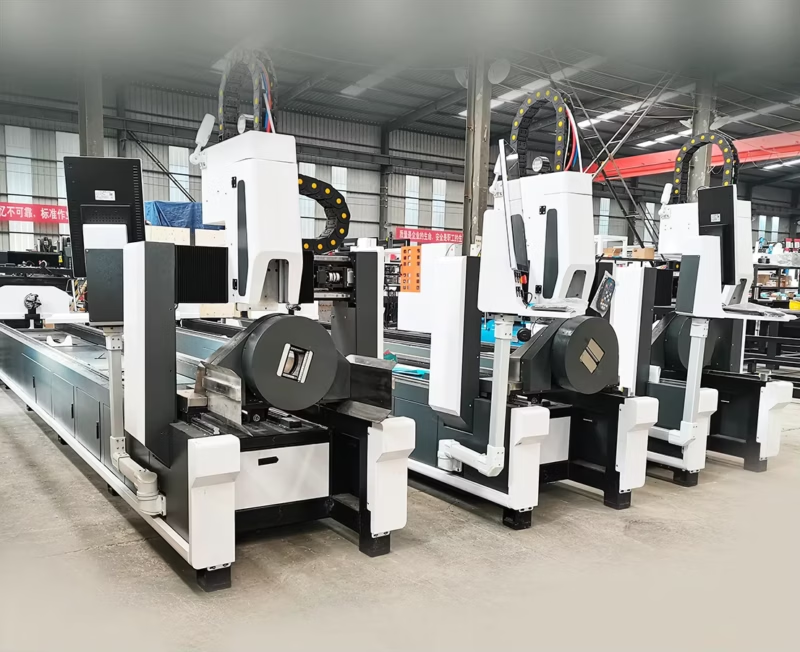
Our CNC Fiber Laser Tube Cutting systems revolutionize metal fabrication by integrating high-precision cutting, punching, and profiling into a single automated workflow. Designed for versatility, this technology handles a wide array of profiles including Round, Square, Rectangular, and Oval tubes, as well as complex L-shaped and U-shaped channels.
- Precision Punching: High-speed hole punching with micron-level accuracy, eliminating the need for mechanical drilling or die-stamping.
- Complex Profiling: Advanced 3D pathing allows for intricate interlocking joints and specialized notch cuts, ideal for structural frames.
- High Material Efficiency: Intelligent nesting software minimizes scrap, reducing raw material costs across large production runs.
- Clean Finish: Delivers oxide-free, burr-free edges that require zero secondary grinding before welding.

Seamlessly processing multiple profiles with consistent precision.
Global Delivery & Logistics



From our high-tech manufacturing facility directly to your global site. PCL WeldCut ensures secure packaging, professional handling, and reliable international logistics to safeguard your equipment throughout the entire journey.
One thought on “Fiber Laser Cutting Machine with Magnetic Crawler for for Oil & Gas Tanks”
Been using this for a year now. Still running like a beast. Very reliable.