Precision Engineering in LNG Infrastructure: The Role of Fiber Laser Magnetic Crawlers
The construction of Liquefied Natural Gas (LNG) storage tanks and transport systems requires a level of structural integrity that traditional mechanical methods struggle to meet. As projects scale, the demand for high-speed, high-precision cutting on large-format curved surfaces—such as spherical tanks and massive diameter piping—has necessitated a shift toward mobile automation. The Fiber Laser Cutting Machine equipped with a magnetic crawler represents the pinnacle of this evolution. By combining the mobility of a localized robotic platform with the extreme energy density of a fiber laser beam quality, engineers can now achieve shop-floor precision directly on the assembly site.
The Mechanics of Magnetic Crawler Integration
A magnetic crawler serves as the mobile foundation for the laser head. In LNG projects, where materials are often thick-walled 9% Nickel steel or specific stainless steel alloys, the crawler utilizes high-strength permanent magnets or electromagnets to adhere to the workpiece. This allows for vertical, horizontal, and even overhead cutting operations without the need for fixed tracks or bulky gantries. The integration of fiber laser technology into this mobile unit is driven by the fiber’s ability to be delivered via a flexible optical cable, which remains unaffected by the crawler’s movement or orientation.
The primary engineering challenge solved by the magnetic crawler is the maintenance of a constant focal distance. Sophisticated sensors within the cutting head provide real-time feedback to a height control system, adjusting the Z-axis dynamically as the crawler traverses uneven surfaces or curvatures. This ensures that the laser’s focal point remains optimal, resulting in a consistent kerf width across the entire length of the cut.
The “Punch, Mark, and Cut” Workflow Efficiency
One of the most significant advantages of the fiber laser crawler is its multi-functional processing capability. In a single deployment, the machine executes a three-stage workflow that significantly reduces the project timeline:
1. Precision Punching and Piercing
Initial penetration of the material is handled through high-frequency laser pulsing. Unlike mechanical drilling, fiber laser piercing is non-contact and instantaneous. This prevents mechanical stress on the plate and ensures that the starting point of the cut is clean, which is critical for maintaining the vacuum-tight requirements of LNG vessels.
2. Automated Marking for Assembly
Before the final cut, the laser is tuned to a lower power setting to mark the surface. This includes etching layout lines, part numbers, and welding preparation guides. Because the marking is performed by the same motion control synchronization as the cutting, the spatial accuracy between the mark and the cut is absolute. This eliminates the manual layout errors that often plague large-scale field assembly.
3. High-Speed Final Cutting
The final cutting stage utilizes the full power of the fiber source. The high energy density allows for rapid vaporization of the metal, supported by assist gases (typically Oxygen or Nitrogen) to blow away the molten material. The resulting edge is of such high quality that it meets the stringent ISO 9013 standards for thermal cutting without further intervention.
Eliminating Post-Process Grinding
In traditional LNG fabrication, edge preparation often requires extensive grinding to remove dross or to correct the Heat Affected Zone (HAZ). Fiber laser cutting changes this paradigm. Due to the concentrated nature of the laser beam, the heat input into the surrounding material is minimized. This restricted HAZ ensures that the specialized metallurgical properties of 9% Nickel steel—designed for cryogenic toughness—are not compromised during the cutting process.
The edge finish produced by a fiber laser crawler is characterized by its smoothness and perpendicularity. For engineers, this means the components can move directly from the cutting stage to the fit-up stage. Eliminating the grinding phase not only reduces labor costs but also removes a significant source of metallic dust and noise on the job site, improving overall safety and environmental conditions.
Technical Specifications and Material Suitability
The application of fiber lasers in LNG projects typically involves power ranges from 3kW to 12kW, depending on the plate thickness. The fiber laser operates at a wavelength of approximately 1.06 microns, which is highly absorbable by metallic surfaces. This absorption rate is far superior to CO2 lasers, especially when dealing with reflective alloys used in cryogenic applications.
Key Performance Indicators:
Standard cutting speeds for 12mm 9% Ni steel can exceed 2.5 meters per minute with a 6kW source, maintaining a kerf deviation of less than 0.1mm. The magnetic crawler’s drive system is typically geared for high torque to ensure steady movement at these speeds, even when fighting gravity on the side of a storage tank.
Advanced Thermal Management
In LNG project environments, ambient temperatures and material surface temperatures can vary. The fiber laser system employs a closed-loop cooling circuit for the laser source and the cutting head. More importantly, the non-contact thermal processing inherent in laser cutting prevents the warping often seen in mechanical shearing. By managing the thermal profile through precise pulse modulation, the crawler can execute complex geometries and small-diameter openings in thick plates without inducing significant residual stress in the workpiece.
Software Integration and Digital Twin Compatibility
Modern magnetic crawler systems are driven by CNC controllers that support direct CAD/CAM integration. Engineers can upload nesting patterns directly to the crawler’s onboard computer. This digital integration allows for “Just-In-Time” cutting of replacement parts or modifications on-site. Furthermore, the data logged by the crawler—including cutting speed, gas pressure, and laser power—can be integrated into the project’s Quality Management System (QMS), providing a digital birth certificate for every cut made on the LNG tank.
Conclusion: The Economic Impact on LNG Projects
From an industrial engineering perspective, the deployment of a fiber laser cutting machine with a magnetic crawler is an investment in process compression. By combining high-precision cutting, marking, and punching into a single mobile operation, the necessity for secondary finishing is removed. This leads to a measurable reduction in the “total time to weld” and increases the throughput of the fabrication site. As the global demand for LNG infrastructure grows, the adoption of these high-precision, low-grind technologies will be the defining factor in meeting aggressive project timelines while adhering to the highest safety and quality standards.
-


LT240S tube laser cutting machine
-
LT120S tube laser cutting machine
-
Sale

Tank Fillet Welding Machine
Original price was: $1,000.00.$900.00Current price is: $900.00. -
Sale

MAK100 tube laser cutting machine
Original price was: $5,500.00.$5,000.00Current price is: $5,000.00. -

portable plasma air cutting machine
$1,200.00 -

2in1 fiber laser cutting machine
-

Air cooling Laser welding machine
-

HF h beam laser cutting machine
-

LT240 laser cutting machine
-

Laser welding machine
-


Cobot Welding Station
-

Gantry welding robot solution
-

Tracked Wheeled AGV Welding robot
-

LFH6020 Fiber laser cutting machine
-
LFP6020
-

robotic welidng machine
Advanced Fiber Laser Tube Processing Technology
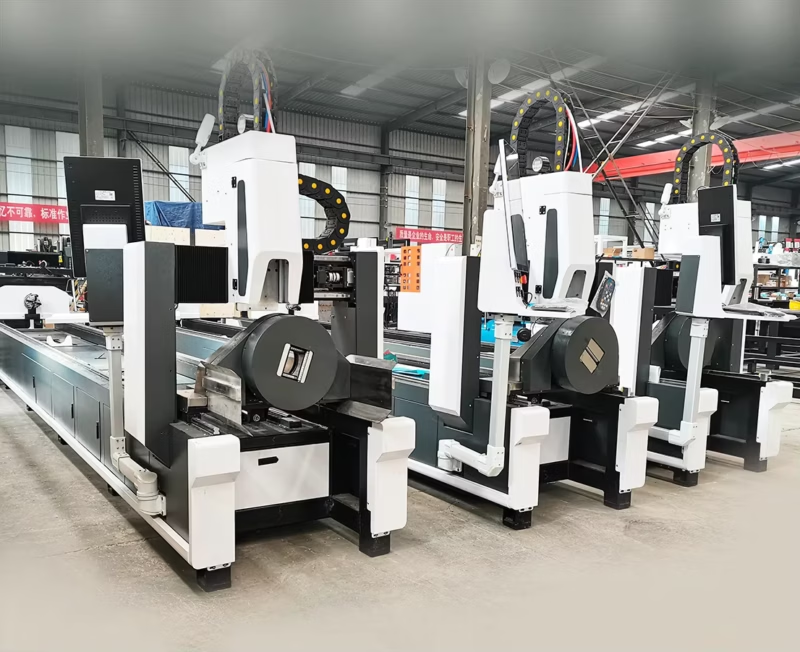
Our CNC Fiber Laser Tube Cutting systems revolutionize metal fabrication by integrating high-precision cutting, punching, and profiling into a single automated workflow. Designed for versatility, this technology handles a wide array of profiles including Round, Square, Rectangular, and Oval tubes, as well as complex L-shaped and U-shaped channels.
- Precision Punching: High-speed hole punching with micron-level accuracy, eliminating the need for mechanical drilling or die-stamping.
- Complex Profiling: Advanced 3D pathing allows for intricate interlocking joints and specialized notch cuts, ideal for structural frames.
- High Material Efficiency: Intelligent nesting software minimizes scrap, reducing raw material costs across large production runs.
- Clean Finish: Delivers oxide-free, burr-free edges that require zero secondary grinding before welding.

Seamlessly processing multiple profiles with consistent precision.
Global Delivery & Logistics



From our high-tech manufacturing facility directly to your global site. PCL WeldCut ensures secure packaging, professional handling, and reliable international logistics to safeguard your equipment throughout the entire journey.