Advancing LNG Tank Fabrication with Magnetic Crawler Fiber Lasers
The global demand for Liquefied Natural Gas (LNG) has necessitated the construction of massive storage terminals requiring unprecedented levels of structural precision. At the center of this industrial push is the need for highly efficient fabrication methods for 9% Nickel steel and high-grade carbon steels. Traditional manual methods often fall short of the rigorous tolerances required for cryogenic safety. The introduction of the fiber Laser Cutting machine mounted on a magnetic crawler represents a paradigm shift in how large-scale plate processing is executed on-site.
Unlike stationary shop-based lasers, the magnetic crawler system brings the precision of the factory floor directly to the vertical walls of the storage tank. This mobile platform utilizes high-strength permanent magnets or electromagnetic tracks to adhere to the curved surfaces of the shell plates. By integrating a fiber laser source via flexible optical cabling, engineers can execute complex geometries with a level of accuracy that was previously unattainable in field conditions.
High-Precision Kinematics and Adhesion Mechanics
The engineering challenge of cutting on a vertical or overhead plane involves managing both gravity and the vibration of the cutting head. The magnetic crawler is designed with a low center of gravity and high-torque stepper motors to ensure uniform travel speeds. Constant velocity is critical in fiber laser applications; any fluctuation in speed can lead to variations in the kerf width or dross accumulation.
Industrial engineers prioritize these systems because they utilize advanced CNC algorithms to compensate for the curvature of the tank. The system maintains a constant standoff distance—the gap between the laser nozzle and the workpiece—using capacitive height sensors. This real-time adjustment is vital for maintaining the focal point of the beam, ensuring that the high precision required for LNG Projects is consistent across every linear meter of the cut.
Multi-Functional Capabilities: Punch, Mark, and Cut
Efficiency in LNG projects is measured by the reduction of “man-hours per ton.” Traditional workflows require separate tools for layout marking, bolt-hole punching, and final edge trimming. A crawler-mounted fiber laser consolidates these into a single-pass operation. By modulating the power output and frequency of the laser, the system can perform three distinct functions:
First, the system performs laser marking, etching identification codes and alignment guides directly onto the plate. Second, it executes high-speed punching or piercing for nozzle attachments or structural fasteners. Finally, it transitions to the primary cutting phase. This integrated workflow eliminates the cumulative error associated with switching between different tools and reduces the physical handling of massive steel plates, which is a significant safety and logistical advantage in restricted site environments.
Eliminating Secondary Processes: No Grinding Required
In the context of LNG tank construction, the quality of the cut edge is paramount. Standard thermal cutting methods often leave behind a thick layer of oxidized slag and a wide heat-affected zone (HAZ). This usually necessitates hours of manual grinding to reach a clean, metallic finish suitable for inspection. However, the fiber laser operates at a wavelength (typically around 1.06 microns) that is highly absorbed by metals, resulting in an extremely narrow kerf and a localized heat input.
The result of this localized energy is a “ready-to-use” edge. Industrial engineers value this no grinding outcome because it preserves the metallurgical properties of the nickel-alloy steel. In cryogenic applications, excessive heat can lead to grain growth or carbon precipitation, which compromises the material’s impact toughness at -162 degrees Celsius. By using a fiber laser, the HAZ is so negligible that the structural integrity of the base metal remains intact, passing stringent radiographic and ultrasonic testing without the need for mechanical remediation.
Thermal Management and Material Integrity
The use of 9% Ni steel in LNG projects is strictly regulated due to its role in containment. When cutting these expensive alloys, minimizing material waste and thermal distortion is a priority. The fiber laser cutting process utilizes high-pressure assist gases (typically Nitrogen or Oxygen) to blow away molten material instantly. This rapid cooling effect, combined with the high travel speed of the crawler, prevents the “bowing” or warping of large plates.
From a quality assurance perspective, the consistency of the fiber laser ensures that the edge bevels are perfectly uniform. Since the system does not rely on mechanical force, there is no risk of the crawler shifting or vibrating out of alignment, which is a common issue with mechanical milling or manual torch guiding. The precision of the CNC pathing ensures that every plate segment fits perfectly into the tank’s circumference, reducing the need for “gap filling” or corrective measures during the final assembly.
Operational ROI and Future Outlook
The capital investment in a magnetic crawler fiber laser system is offset by the dramatic reduction in post-processing labor. By eliminating the need for a dedicated grinding crew and reducing the time spent on layout and marking, project managers can accelerate the construction timeline of an LNG terminal by several weeks. Furthermore, the reduction in consumable use—since the fiber laser has no electrodes or mechanical bits to wear out—contributes to a lower long-term operational cost.
As the industry moves toward more automated and data-driven construction sites, the integration of magnetic crawler technology with high-wattage fiber lasers is becoming the standard. The ability to monitor cutting parameters in real-time and log data for every cut provides a level of traceability that is essential for modern energy infrastructure. For industrial engineers focused on LNG projects, the goal is clear: achieve maximum precision with minimal secondary handling, ensuring safety and longevity in the most demanding cryogenic environments on Earth.
-


LT240S tube laser cutting machine
-
LT120S tube laser cutting machine
-
Sale

Tank Fillet Welding Machine
Original price was: $1,000.00.$900.00Current price is: $900.00. -
Sale

MAK100 tube laser cutting machine
Original price was: $5,500.00.$5,000.00Current price is: $5,000.00. -

portable plasma air cutting machine
$1,200.00 -

2in1 fiber laser cutting machine
-

Air cooling Laser welding machine
-

HF h beam laser cutting machine
-

LT240 laser cutting machine
-

Laser welding machine
-


Cobot Welding Station
-

Gantry welding robot solution
-

Tracked Wheeled AGV Welding robot
-

LFH6020 Fiber laser cutting machine
-
LFP6020
-

robotic welidng machine
Advanced Fiber Laser Tube Processing Technology
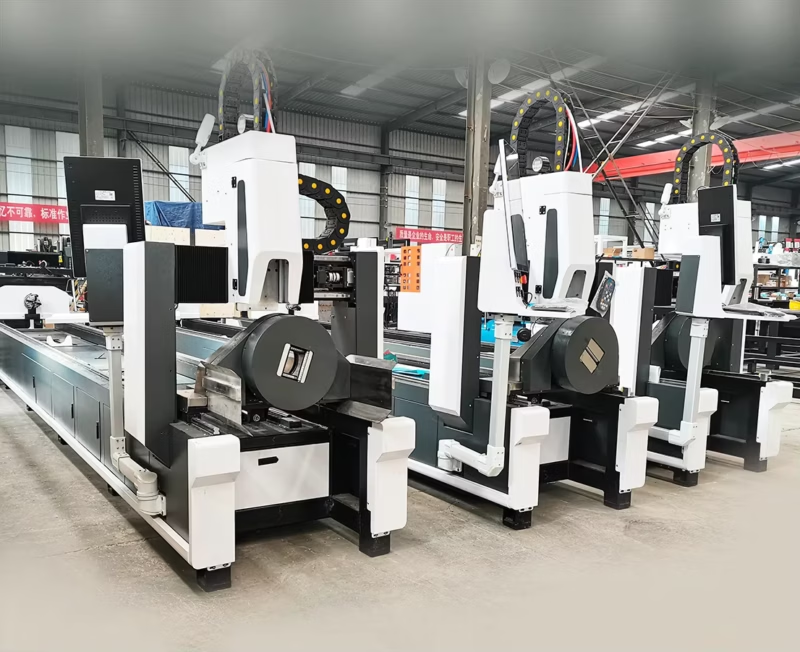
Our CNC Fiber Laser Tube Cutting systems revolutionize metal fabrication by integrating high-precision cutting, punching, and profiling into a single automated workflow. Designed for versatility, this technology handles a wide array of profiles including Round, Square, Rectangular, and Oval tubes, as well as complex L-shaped and U-shaped channels.
- Precision Punching: High-speed hole punching with micron-level accuracy, eliminating the need for mechanical drilling or die-stamping.
- Complex Profiling: Advanced 3D pathing allows for intricate interlocking joints and specialized notch cuts, ideal for structural frames.
- High Material Efficiency: Intelligent nesting software minimizes scrap, reducing raw material costs across large production runs.
- Clean Finish: Delivers oxide-free, burr-free edges that require zero secondary grinding before welding.

Seamlessly processing multiple profiles with consistent precision.
Global Delivery & Logistics



From our high-tech manufacturing facility directly to your global site. PCL WeldCut ensures secure packaging, professional handling, and reliable international logistics to safeguard your equipment throughout the entire journey.