Technological Convergence in Infrastructure Engineering
Bridge truss fabrication demands exceptional dimensional accuracy and structural integrity. Traditional manufacturing workflows often suffer from throughput bottlenecks due to the physical scale of bridge members, such as chord sections and diagonal braces. The emergence of the Magnetic Crawler System paired with high-power fiber laser heads offers a decentralized solution to these challenges. Unlike stationary CNC machines, the magnetic crawler utilizes high-density permanent magnets or electromagnets to adhere directly to the steel surface, allowing for precision cutting in any orientation—horizontal, vertical, or overhead.
From an industrial engineering perspective, the primary objective is the reduction of non-value-added activities. Conventional methods require moving massive steel sections to a fixed cutting station, which consumes crane time and increases the risk of material damage. By bringing the fiber laser to the workpiece, the material handling cycle is drastically compressed. The fiber laser’s ability to maintain a consistent focal point via high-speed capacitive height sensing ensures that even on slightly uneven bridge plates, the kerf remains uniform and the cut quality meets stringent ISO standards.
Fiber Laser Advantage: Precision and Thermal Management
The core of this system is the fiber laser source, typically ranging from 3kW to 12kW depending on the thickness of the truss plates. The beam quality of a fiber laser is characterized by a high BPP (Beam Parameter Product), allowing for a concentrated energy density that vaporizes steel instantly. This rapid processing results in a minimal Heat Affected Zone (HAZ), which is critical for maintaining the metallurgical properties of high-strength bridge steels like Q345QD or Q420q.
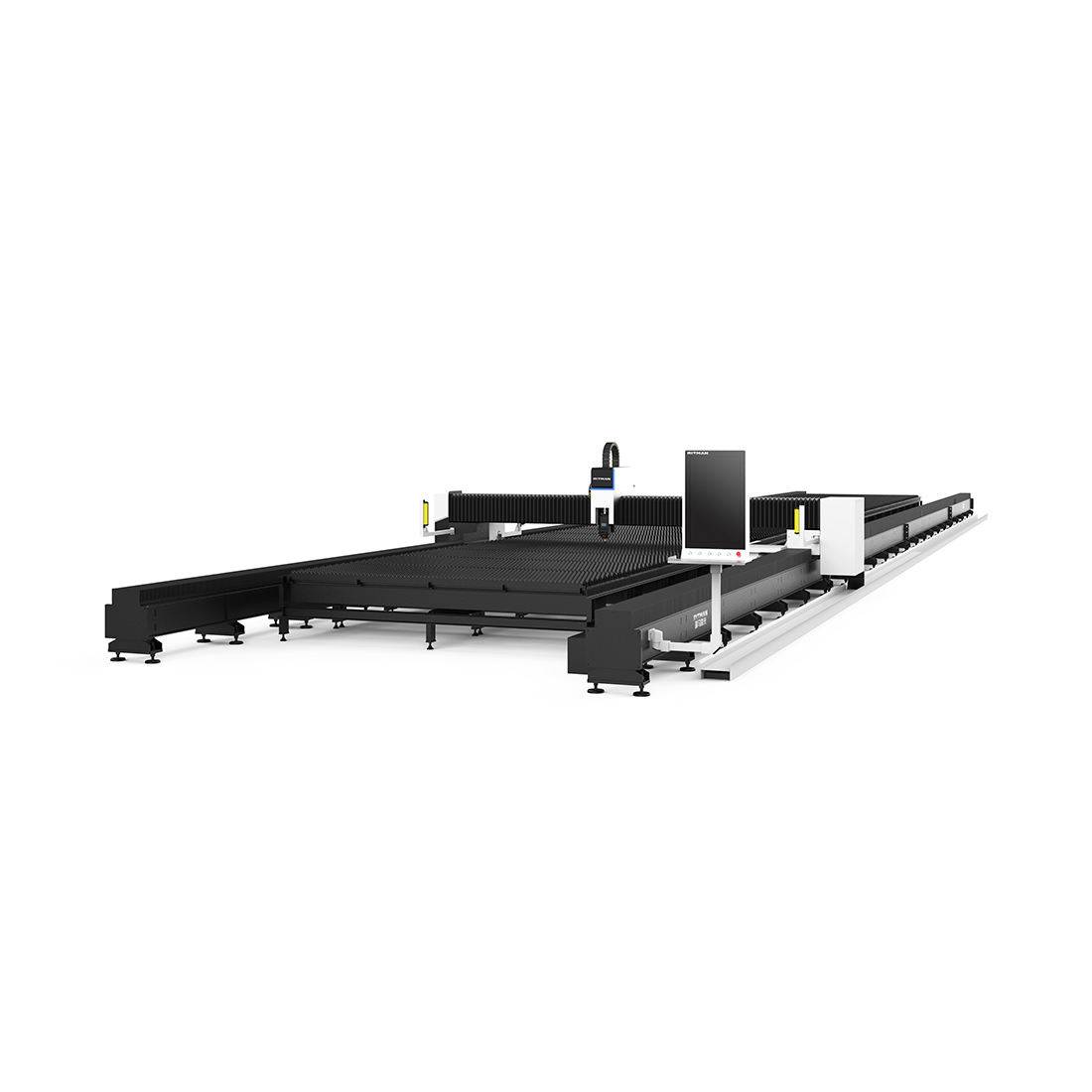
Elimination of Post-Processing Grinding
One of the most significant cost drivers in bridge construction is the requirement for edge finishing. Standard thermal cutting often leaves behind dross or hardened edges that require manual grinding to meet fatigue resistance specifications. Fiber Laser Cutting produces a surface roughness (Ra) that often falls between 6.3 and 12.5 microns. This level of finish typically bypasses the need for secondary grinding, moving the component directly from the cutting stage to the assembly or coating phase. The precision of the fiber laser also ensures that the perpendicularity of the cut edge is maintained within a 0.05mm tolerance, which is essential for the tight fit-up required in truss nodes.
Operational Capabilities: Punch, Mark, and Cut
The magnetic crawler is not merely a transport mechanism; it is a mobile CNC platform capable of executing complex Bridge Truss Fabrication tasks in a single program sequence. Modern industrial controllers allow the laser to modulate its power output and frequency to perform three distinct functions without changing tools or stopping the machine.
High-Speed Surface Marking
Before the cutting begins, the fiber laser operates in a low-power, high-frequency mode to etch assembly lines, part numbers, and orientation markers directly onto the steel surface. This permanent marking is vital for downstream logistics and ensures that complex truss assemblies are joined correctly. Because the marking is performed in the same coordinate system as the cutting, the positional accuracy of these marks is perfect relative to the holes and edges.
Automated Hole Punching and Fine Feature Cutting
Bolt holes in bridge trusses must be perfectly circular to ensure load distribution across the fastener group. While traditional drilling is slow and mechanical punching can deform the surrounding material, Automated Hole Punching via fiber laser provides a high-velocity alternative. The laser can “punch” through thick plate and then immediately transition into a circular interpolation move to cut the hole. The result is a clean, taper-free hole that meets the strict tolerance requirements for friction-grip bolted joints. This capability eliminates the need for manual layout and center-punching, further reducing labor costs.
Structural Stability and Magnetic Adhesion Mechanics
The reliability of the crawler depends on its ability to maintain a constant gap between the laser nozzle and the workpiece while resisting the gravitational forces acting on its chassis. The magnetic modules are engineered to provide a safety factor of at least 3:1 relative to the machine’s weight. This ensures that even in the event of a power fluctuation (in the case of permanent-magnet hybrids), the crawler remains locked to the truss member.
Motion Control and Path Optimization
Advanced motion control algorithms compensate for the specific dynamics of magnetic traction. Since the crawler moves on wheels or tracks over a steel surface, the system must account for potential slippage. Integrated encoders and laser-based vision systems provide real-time feedback, allowing the CNC to adjust the path dynamically. This level of automation is essential for cutting large-radius curves on chord members or complex geometries on gusset plates where manual intervention would be imprecise.
Economic Impact and ROI Analysis
For a bridge fabrication facility, the ROI for a magnetic crawler fiber laser is calculated across three primary vectors: throughput, labor, and consumables.
Reduction in Labor Hours
By integrating marking, punching, and cutting, the total man-hours per truss section are reduced by approximately 40-60%. The elimination of manual grinding alone can save hundreds of hours on a medium-sized bridge project. Furthermore, the high cutting speed of fiber lasers—often exceeding 2 meters per minute on 20mm plate—outpaces traditional methods by a factor of three or more.
Consumable Efficiency
Fiber lasers operate with an electrical efficiency of nearly 30-40%, compared to the much lower efficiency of older laser technologies. Additionally, because there are no physical drill bits to sharpen or mechanical punches to replace, the consumable cost is limited primarily to nitrogen or oxygen assist gases and the occasional protective window for the laser head. This leads to a significantly lower cost-per-meter of cut.
Safety and Environmental Considerations
Implementing fiber laser crawlers also improves the industrial environment. The localized nature of the laser cut, combined with integrated dust extraction modules that move with the crawler, significantly reduces the airborne particulates usually associated with metal fabrication. From a safety perspective, the ability to operate the crawler via remote terminal keeps technicians away from the cutting zone and eliminates the ergonomic strain associated with manual cutting and grinding tools.
Conclusion: The Future of Modular Infrastructure Production
The transition toward more automated, mobile, and precise fabrication tools is inevitable in the bridge building industry. The magnetic crawler Fiber Laser Cutting Machine represents the pinnacle of this transition. By delivering high-precision edges, eliminating the need for post-cut grinding, and combining marking and punching into a single workflow, this technology enables engineers to build safer, more reliable bridge trusses with unprecedented efficiency. As infrastructure projects grow in complexity and scale, the ability to deploy high-precision CNC capabilities directly onto the raw material will remain a decisive competitive advantage for fabricators worldwide.
-


LT240S tube laser cutting machine
-
LT120S tube laser cutting machine
-
Sale

Tank Fillet Welding Machine
Original price was: $1,000.00.$900.00Current price is: $900.00. -
Sale

MAK100 tube laser cutting machine
Original price was: $5,500.00.$5,000.00Current price is: $5,000.00. -

portable plasma air cutting machine
$1,200.00 -

2in1 fiber laser cutting machine
-

Air cooling Laser welding machine
-

HF h beam laser cutting machine
-

LT240 laser cutting machine
-

Laser welding machine
-


Cobot Welding Station
-

Gantry welding robot solution
-

Tracked Wheeled AGV Welding robot
-

LFH6020 Fiber laser cutting machine
-
LFP6020
-

robotic welidng machine
Advanced Fiber Laser Tube Processing Technology
Our CNC Fiber Laser Tube Cutting systems revolutionize metal fabrication by integrating high-precision cutting, punching, and profiling into a single automated workflow. Designed for versatility, this technology handles a wide array of profiles including Round, Square, Rectangular, and Oval tubes, as well as complex L-shaped and U-shaped channels.
- Precision Punching: High-speed hole punching with micron-level accuracy, eliminating the need for mechanical drilling or die-stamping.
- Complex Profiling: Advanced 3D pathing allows for intricate interlocking joints and specialized notch cuts, ideal for structural frames.
- High Material Efficiency: Intelligent nesting software minimizes scrap, reducing raw material costs across large production runs.
- Clean Finish: Delivers oxide-free, burr-free edges that require zero secondary grinding before welding.

Seamlessly processing multiple profiles with consistent precision.
Global Delivery & Logistics



From our high-tech manufacturing facility directly to your global site. PCL WeldCut ensures secure packaging, professional handling, and reliable international logistics to safeguard your equipment throughout the entire journey.
One thought on “Fiber Laser Cutting Machine with Magnetic Crawler for for Bridge Trusses”
Highly recommend for any professional aerospace workshop. Precision is top-notch.