Precision Engineering in Wind Tower Production
The fabrication of wind turbine towers demands rigorous adherence to dimensional tolerances and structural standards. As these structures grow in height and capacity, the thickness and scale of the carbon steel plates used in their construction increase accordingly. Traditional thermal cutting methods often struggle with the thermal expansion and material irregularities inherent in large-scale plate processing. The implementation of Fiber Laser Cutting technology offers a transformative solution, providing the high-power density required to penetrate thick sections with minimal kerf width and a negligible heat-affected zone.
From an industrial engineering perspective, the objective is to maximize “uptime” and minimize “total cycle time.” Fiber lasers achieve this through superior wall-plug efficiency and the absence of complex beam-delivery optics found in older CO2 systems. When applied to wind tower sections—specifically the longitudinal and circumferential cuts for the conical shells—fiber lasers provide a level of repeatability that eliminates the variability common in manual or semi-automated processes.
Advanced Laser Seam Tracking Systems
One of the primary challenges in wind tower fabrication is the physical size of the workpieces. Large plates, often exceeding 10 meters in length, are susceptible to slight deviations in flatness and alignment during the loading and positioning stages. Laser Seam Tracking serves as the “vision” for the cutting head. Utilizing a triangulation sensor or a high-speed optical feedback loop, the system maps the material surface in real-time, adjusting the Z-axis (nozzle height) and X/Y coordinates to compensate for any structural undulations or plate shifting.
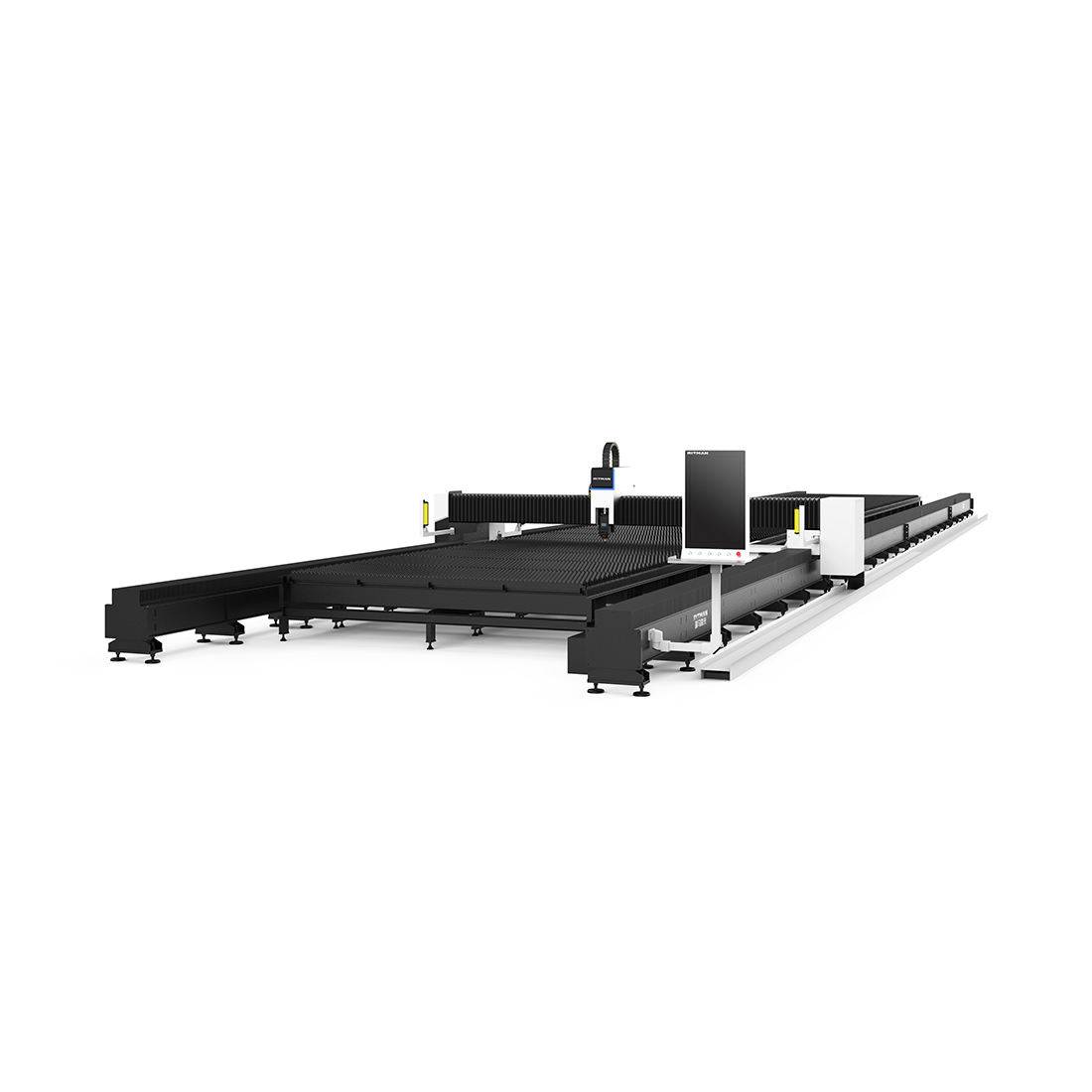
This dynamic adjustment ensures that the focal point of the laser remains constant relative to the material surface. In the context of wind towers, where a consistent edge profile is mandatory for subsequent assembly phases, seam tracking prevents “dross” formation and prevents “thermal bowing” from affecting the cut path. The result is a high-fidelity cut that mirrors the digital CAD model with sub-millimeter precision.
Eliminating Secondary Grinding and Post-Processing
In conventional heavy-plate fabrication, the edges of thermal-cut parts typically require mechanical grinding to remove oxide layers and achieve the necessary surface roughness for structural certification. Fiber laser technology, particularly when utilizing nitrogen or high-pressure oxygen as an assist gas, produces an edge finish so clean that secondary grinding is rendered obsolete.
The high-frequency pulse capabilities of the fiber laser allow for a smooth transition between the pierces and the main cut path. By controlling the melt pool dynamics with extreme precision, the machine leaves a perpendicular, smooth surface. This “no-grinding” workflow significantly reduces labor costs and shop floor noise while accelerating the overall production timeline. For Wind Tower Fabrication, this means plates can move directly from the cutting table to the rolling and assembly stations without manual intervention.
Integrated Functionality: Punch, Mark, and Cut
The versatility of modern fiber laser workstations allows for the consolidation of multiple manufacturing steps into a single CNC program. This is often referred to as the “All-in-One” plate processing cycle, which includes:
1. Automated Piercing (Punching): High-power fiber lasers utilize multi-stage piercing sequences. By modulating power and frequency, the laser “punches” through thick plate without creating the large “blowouts” or craters common in less refined processes. This protects the nozzle and ensures the integrity of the starting point of the cut.
2. Precision Marking: Before the final geometry is cut, the laser head can be tuned to a lower wattage to etch layout lines, part numbers, or alignment marks directly onto the steel surface. This internal marking eliminates the need for manual chalking or secondary inkjet labeling, ensuring that part traceability is maintained throughout the life of the tower.
3. High-Speed Cutting: Once the marking and piercing are complete, the system transitions seamlessly into full-power cutting. The fiber laser’s ability to maintain high feed rates on thick carbon steel ensures that the throughput of the fabrication facility is limited only by the material handling capabilities of the overhead cranes and loading systems.
Thermal Management and Material Integrity
Industrial engineers prioritize the structural properties of the base metal. Excessive heat input during the cutting process can lead to grain growth and localized hardening of the steel, which can be detrimental in the high-stress environment of a wind farm. The concentrated beam of a fiber laser—typically with a wavelength around 1.06 microns—delivers energy so efficiently that the heat-affected zone is significantly smaller than that of any other thermal cutting method.
This precise thermal management ensures that the mechanical properties of the wind tower segments remain within the specified ranges. By maintaining the metallurgical integrity of the plate edges, the fiber laser process supports the long-term fatigue resistance required for offshore and onshore wind installations.
Operational Efficiency and Consumable Optimization
A critical metric in any wind tower facility is the cost per meter of cut. Fiber Laser Cutting machines are designed with a low-maintenance architecture. Unlike older technologies, there are no mirrors to align or turbos to rebuild. The solid-state nature of the laser source means the beam is delivered through a flexible fiber optic cable directly to the cutting head, which is integrated with the Laser Seam Tracking sensor.
The reduction in consumables—primarily consisting of nozzles and protective windows—combined with the high energy efficiency of the laser source, results in a lower operational expenditure (OPEX). When scaled to the massive volume of steel required for a single wind farm project, these savings represent a significant competitive advantage.
Conclusion: The Future of Energy Infrastructure Fabrication
The shift toward Fiber Laser Cutting in the wind energy sector is driven by the need for higher precision, faster turnaround times, and lower manual labor requirements. By integrating real-time seam tracking with the multi-functional capabilities of punching, marking, and cutting, manufacturers can produce wind tower components that meet the highest global standards. The elimination of secondary grinding and the preservation of material properties ensure that the resulting structures are not only cost-effective to produce but are also built to withstand the rigors of decades-long service lives. In the pursuit of industrial optimization, the fiber laser remains the pinnacle of plate processing technology.
-


Cantilever Welding Robot solution
-


GF laser cutting machine
-

P3015 plasma cutting machine
-

LFP3015 Fiber Laser Cutter
-

pipe plasma cutting machine
-
LFH 4020 Fiber Laser Cutting Machine
-
LFP4020
-

gantry plasma air cutting machine
-

3D robot cutting machine
-

8 axis plasma cutting machine
-

5 axis plasma cutting machine
-

LT360 tube laser cutting machine
-

robot welding workstation
-

SF6060 fiber laser cutting machine
Advanced Fiber Laser Tube Processing Technology
Our CNC Fiber Laser Tube Cutting systems revolutionize metal fabrication by integrating high-precision cutting, punching, and profiling into a single automated workflow. Designed for versatility, this technology handles a wide array of profiles including Round, Square, Rectangular, and Oval tubes, as well as complex L-shaped and U-shaped channels.
- Precision Punching: High-speed hole punching with micron-level accuracy, eliminating the need for mechanical drilling or die-stamping.
- Complex Profiling: Advanced 3D pathing allows for intricate interlocking joints and specialized notch cuts, ideal for structural frames.
- High Material Efficiency: Intelligent nesting software minimizes scrap, reducing raw material costs across large production runs.
- Clean Finish: Delivers oxide-free, burr-free edges that require zero secondary grinding before welding.

Seamlessly processing multiple profiles with consistent precision.
Global Delivery & Logistics



From our high-tech manufacturing facility directly to your global site. PCL WeldCut ensures secure packaging, professional handling, and reliable international logistics to safeguard your equipment throughout the entire journey.