Optimizing Wind Tower Production via Fiber Laser Technology
In the current industrial landscape for renewable energy, the fabrication of onshore and offshore wind towers demands unprecedented levels of precision and throughput. The transition from traditional thermal cutting to the use of a high-capacity Fiber Laser Cutting Machine has moved from an experimental upgrade to an operational necessity. As tower heights increase and plate thicknesses grow to accommodate larger turbine nacelles, the mechanical tolerances of the base sections must be held to tighter specifications. Industrial engineers are now prioritizing fiber laser systems due to their ability to deliver high-energy density at the focal point, resulting in narrow kerf widths and minimal thermal distortion.
The Physics of High-Power Fiber Laser Cutting
The core advantage of fiber laser technology lies in its beam delivery system. Unlike CO2 lasers that rely on complex mirror arrays, fiber lasers generate the beam through a bank of diodes and deliver it via a flexible fiber optic cable. For wind tower fabrication, which involves processing large-format structural steel (typically S355 grades), the 1.06-micron wavelength of the fiber laser provides superior absorption rates in metallic substrates. This efficiency translates directly into cutting speeds that can exceed 2 meters per minute even on thicknesses surpassing 20mm, depending on the kilowatt rating of the oscillator.
A high-power fiber laser system, often ranging from 20kW to 40kW in modern facilities, enables a “cold-to-the-touch” edge quality. This is achieved by the high velocity of the assist gas—usually oxygen or nitrogen—which evacuates the molten material so rapidly that the heat conduction into the surrounding base metal is negligible. This creates a Heat Affected Zone (HAZ) that is significantly smaller than any other thermal process, ensuring the structural integrity of the tower segments remains uncompromised during the subsequent rolling and assembly stages.
Precision Real-Time Calibration with Laser Seam Tracking
One of the primary challenges in large-scale plate fabrication is the inherent variance in material flatness and the physical size of the workpieces. When dealing with plates that can exceed 12 meters in length, even a minor deviation in the gantry rails or a slight bow in the steel plate can throw the focal point out of alignment. This is where laser seam tracking becomes critical. This system utilizes a high-speed optical sensor mounted in tandem with the cutting head to scan the material surface ahead of the beam.
The seam tracking sensor uses laser triangulation to map the topography of the plate in real-time. This data is fed back to the CNC controller with millisecond latency, allowing for dynamic Z-axis adjustments. By maintaining a constant stand-off distance, the system ensures that the laser focus remains perfectly positioned within the material cross-section. This eliminates “lost cuts” and dross accumulation caused by focal shifts, which is vital for the long-term fatigue life of wind tower sections that must withstand decades of cyclic loading in harsh environments.
Eliminating Secondary Operations: The No-Grinding Mandate
In traditional fabrication environments, cutting is often viewed as the first of several steps. Plates usually require extensive edge grinding to remove heavy oxide layers or dross before they can proceed to the rolling station. However, the high-velocity discharge and precise frequency modulation of a fiber laser produce a surface finish that meets or exceeds ISO 9013 Grade 1 or 2 standards. The edge is remarkably clean and vertical, with squareness tolerances that allow for immediate fit-up.
By achieving a “ready-to-use” edge, the facility effectively removes the grinding station from the workflow. This not only reduces labor costs but also eliminates the environmental and health hazards associated with metal dust and noise. From an industrial engineering perspective, removing this bottleneck increases the Overall Equipment Effectiveness (OEE) of the entire fabrication hall, as the material moves seamlessly from the cutting table to the plate roller.
Integrated Punching, Marking, and Cutting Workflows
Modern fiber laser systems for wind tower production are designed as multi-functional work centers. The “Punch, Mark, and Cut” methodology allows the engineer to program the entire plate layout within a single CAD/CAM nesting software. Before the high-pressure cutting begins, the laser can be pulsed at lower power levels to perform layout marking and identification tagging. This includes part numbers, bend lines for internal brackets, and orientation markers for the assembly crew.
The “punching” capability refers to the high-speed piercing of bolt holes for the tower flanges. Unlike mechanical punching, which creates localized stress and work-hardening around the hole, the fiber laser pierces the material with a circularity and diameter tolerance of +/- 0.1mm. This precision ensures that when the tower sections are bolted together on-site, the alignment of the flanges is perfect, reducing the risk of structural failure and accelerating the installation timeline.
Metallurgical Integrity and Fatigue Resistance
Wind towers are subjected to extreme aerodynamic forces and must maintain their structural properties for a 25-to-30-year lifecycle. Any micro-cracking or excessive grain growth in the cut edge can serve as a stress riser for fatigue cracks. Fiber laser cutting minimizes these risks. The rapid cooling rate of the laser-cut edge prevents the formation of brittle martensitic structures in common structural steels. Because the process is non-contact and the thermal input is concentrated, the bulk of the plate remains at ambient temperature, preserving the original mechanical properties of the mill-certified steel.
System Architecture and Mechanical Stability
The gantry systems used in these machines are engineered for the rigors of heavy industry. To support the weight of high-power heads and the necessary laser seam tracking sensors, manufacturers utilize high-rigidity bridge structures driven by linear motors or precision rack-and-pinion systems. These drive mechanisms are protected by pressurized bellows to prevent the ingress of fine particulates. For the wind tower industry, where the scale of the material is massive, the stability of the machine base is paramount to ensuring that the 0.05mm positioning accuracy is maintained over the entire length of the cutting bed.
Economic Impact and Return on Investment
While the initial capital expenditure for a high-wattage fiber laser system is substantial, the ROI is realized through the drastic reduction in cycle time and the elimination of consumables associated with legacy systems. Fiber lasers have an electrical wall-plug efficiency of approximately 30-40%, which is significantly higher than older laser technologies. Furthermore, the absence of moving parts within the laser source reduces maintenance intervals, allowing for three-shift operations with minimal downtime. For a wind tower manufacturer, this means a higher “tower-per-month” output without a proportional increase in floor space or headcount.
Final Technical Assessment
The shift toward automated, high-precision plate preparation is the defining characteristic of modern wind energy manufacturing. The combination of a fiber laser cutting machine and laser seam tracking provides the metallurgical consistency, geometric accuracy, and operational speed required to meet global energy targets. By focusing on a single-setup “punch, mark, and cut” strategy, manufacturers can secure a competitive edge through superior edge quality and the total elimination of secondary processing steps like grinding. This technical evolution ensures that the foundations of our renewable energy infrastructure are built with the highest possible integrity and efficiency.
-


LT240S tube laser cutting machine
-
LT120S tube laser cutting machine
-
Sale

Tank Fillet Welding Machine
Original price was: $1,000.00.$900.00Current price is: $900.00. -
Sale

MAK100 tube laser cutting machine
Original price was: $5,500.00.$5,000.00Current price is: $5,000.00. -

portable plasma air cutting machine
$1,200.00 -

2in1 fiber laser cutting machine
-

Air cooling Laser welding machine
-

HF h beam laser cutting machine
-

LT240 laser cutting machine
-

Laser welding machine
-


Cobot Welding Station
-

Gantry welding robot solution
-

Tracked Wheeled AGV Welding robot
-

LFH6020 Fiber laser cutting machine
-
LFP6020
-

robotic welidng machine
Advanced Fiber Laser Tube Processing Technology
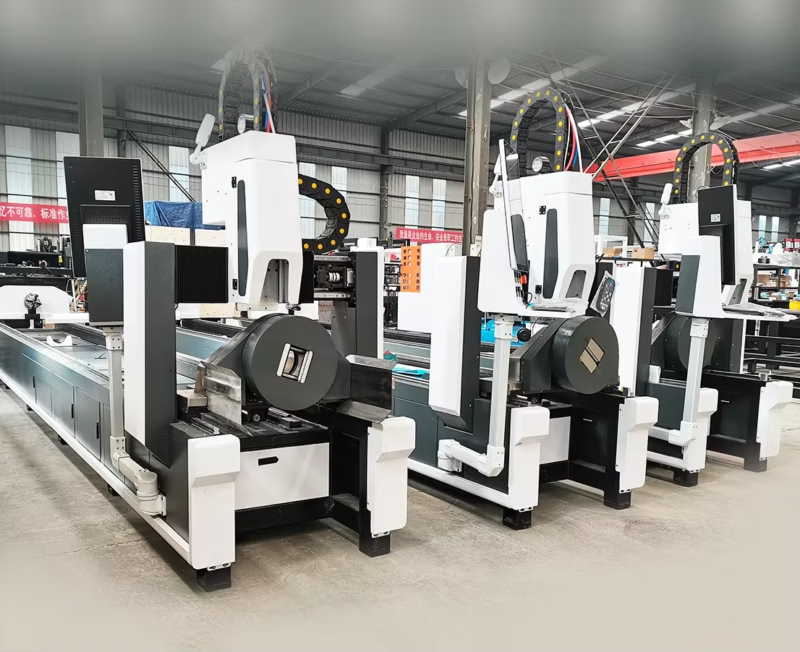
Our CNC Fiber Laser Tube Cutting systems revolutionize metal fabrication by integrating high-precision cutting, punching, and profiling into a single automated workflow. Designed for versatility, this technology handles a wide array of profiles including Round, Square, Rectangular, and Oval tubes, as well as complex L-shaped and U-shaped channels.
- Precision Punching: High-speed hole punching with micron-level accuracy, eliminating the need for mechanical drilling or die-stamping.
- Complex Profiling: Advanced 3D pathing allows for intricate interlocking joints and specialized notch cuts, ideal for structural frames.
- High Material Efficiency: Intelligent nesting software minimizes scrap, reducing raw material costs across large production runs.
- Clean Finish: Delivers oxide-free, burr-free edges that require zero secondary grinding before welding.

Seamlessly processing multiple profiles with consistent precision.
Global Delivery & Logistics



From our high-tech manufacturing facility directly to your global site. PCL WeldCut ensures secure packaging, professional handling, and reliable international logistics to safeguard your equipment throughout the entire journey.