Advanced Process Integration in Wind Tower Production
The fabrication of wind tower sections requires extreme dimensional accuracy and structural integrity due to the cyclical loading environments these structures inhabit. Traditional manufacturing workflows often suffer from fragmented processes where cutting, marking, and edge preparation are treated as isolated events. The implementation of high-power fiber Laser Cutting systems has shifted this paradigm, allowing for a unified production cycle. By utilizing a concentrated, high-density energy beam, fiber lasers achieve cutting speeds and edge qualities that were previously unattainable in heavy-plate thicknesses ranging from 15mm to 50mm.
The Mechanics of Laser Seam Tracking in Heavy Plate
In large-scale wind tower fabrication, material irregularities and structural deformations are inherent challenges. Even high-grade structural steel can exhibit slight variations in flatness or thickness across a 30-meter plate. Laser seam tracking solves this by employing high-resolution optical sensors that map the material surface in real-time. These sensors communicate directly with the CNC controller, adjusting the focal position and torch height at millisecond intervals.
This closed-loop feedback system ensures that the laser remains perfectly perpendicular to the material or at the exact specified angle for beveling, regardless of plate undulations. In the context of wind tower cans, where circularity is critical for subsequent longitudinal welding, the seam tracking system compensates for any deviation in the plate’s profile. This precision ensures that the circumference of each section is consistent, facilitating a perfect fit-up for the automated girth welding stations.
Eliminating Secondary Operations: No Grinding Workflows
One of the primary cost drivers in heavy industry is the labor-intensive requirement for secondary grinding. Mechanical cutting or lower-quality thermal processes often leave dross, slag, or a significant heat-affected zone (HAZ) that must be manually removed to meet international welding standards.
Fiber laser systems operate with such high energy density that the kerf width is minimized, and the transition zone between the melted edge and the base metal is nearly negligible. The resulting surface finish is often “weld-ready” directly from the machine. By eliminating the grinding phase, facilities reduce labor costs by 30-40% and significantly lower the environmental noise and dust levels on the shop floor. This “cut-to-weld” capability is essential for lean manufacturing initiatives within the renewable energy sector.
The Multi-Process Advantage: Punch, Mark, and Cut
Modern high-power fiber laser units are not merely cutting tools; they are multi-functional machining centers. For wind tower internals, such as door frames, flange attachments, and cable brackets, the system can execute several operations in a single program:
Precision Punching and Small Hole Geometry
Traditional thermal cutting often struggles with small-diameter holes in thick plate, typically requiring a 1:1 ratio between thickness and diameter. Fiber lasers, utilizing advanced pulsing techniques and beam modulation, can achieve a 0.5:1 ratio or better. This allows for the direct “punching” (precision cutting) of bolt holes for flanges and internal mounts, eliminating the need for post-process drilling.
Automated Part Marking
Traceability is a mandatory requirement in the energy sector. By modulating the laser power, the system can etch alphanumeric codes, QR codes, or alignment markers directly onto the steel surface. Unlike ink-jet marking, laser etching is permanent and resistant to the abrasive environments of blasting and coating. This ensures that every plate section is identifiable throughout its 20-year service life.
Bevel Cutting and Edge Preparation
Wind tower segments require complex edge geometries—V, X, K, or Y-shaped bevels—to ensure full penetration welds. 5-axis fiber laser heads can tilt dynamically during the cutting process. Because the laser seam tracking system is monitoring the plate’s topography, the bevel angle remains consistent even if the plate is not perfectly level. This level of repeatability is vital for the integrity of the structural joints.
Thermal Management and Material Integrity
The structural steels used in wind towers are sensitive to excessive heat input, which can alter the grain structure and reduce the toughness of the material. Fiber lasers excel here due to their high speed and narrow beam profile. The “dwell time” of the heat source at any single point is a fraction of what is seen in traditional methods.
This reduced heat input results in a minimal HAZ, preserving the mechanical properties of the steel. Furthermore, the localized heating reduces overall plate distortion. In wind tower fabrication, where long plates are cut into trapezoidal or rectangular shapes for rolling, maintaining the flat-pattern accuracy is essential. Minimal thermal distortion means the rolled cans will meet tighter tolerances for diameter and ovality, reducing the need for corrective “re-rolling” or mechanical forcing during assembly.
Operational Efficiency and Throughput Analysis
From an industrial engineering perspective, the throughput of a fiber laser system is measured by its “beam-on” time versus total cycle time. Integration of automated loading systems and specialized software allows for nesting strategies that maximize material yield.
1. Material Utilization: The narrow kerf of the fiber laser allows for tighter nesting of components, which can improve material yield by 3% to 5% over a year of production. Given the volume of steel consumed in a wind tower factory, this represents a significant capital saving.
2. Gas Consumption: While fiber lasers require assist gases (typically Oxygen or Nitrogen), the speed of the process means the total gas volume per meter of cut is lower than slower thermal processes.
3. Maintenance Cycles: Fiber lasers have no moving parts in the light-generating source and no mirrors that require frequent cleaning or alignment in the beam path. This leads to higher uptime and a more predictable maintenance schedule, crucial for 24/7 production environments.
Conclusion on Technical Superiority
The transition to fiber laser technology in the wind energy sector is a response to the need for higher precision and lower operational costs. The combination of high-power beam delivery and laser seam tracking allows for a level of automation that removes human error from the most critical stages of fabrication. By consolidating the punching, marking, and beveling into a single, high-speed operation that requires no post-cut grinding, manufacturers can achieve a streamlined flow from raw plate to the rolling station. This technological shift is a prerequisite for scaling production to meet global renewable energy targets while maintaining the rigorous safety standards required for massive offshore and onshore wind structures.
-


Cantilever Welding Robot solution
-


GF laser cutting machine
-

P3015 plasma cutting machine
-

LFP3015 Fiber Laser Cutter
-

pipe plasma cutting machine
-
LFH 4020 Fiber Laser Cutting Machine
-
LFP4020
-

gantry plasma air cutting machine
-

3D robot cutting machine
-

8 axis plasma cutting machine
-

5 axis plasma cutting machine
-

LT360 tube laser cutting machine
-

robot welding workstation
-

SF6060 fiber laser cutting machine
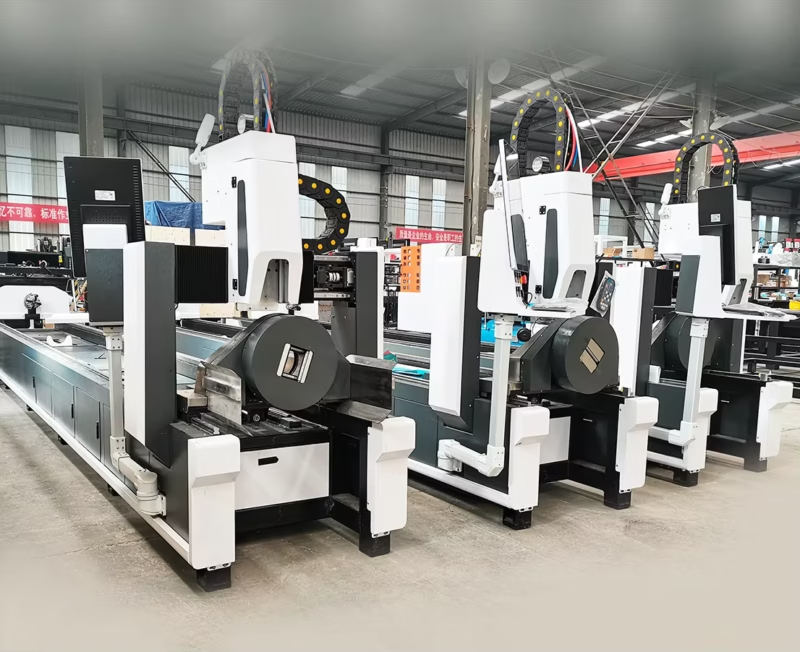
Advanced Fiber Laser Tube Processing Technology
Our CNC Fiber Laser Tube Cutting systems revolutionize metal fabrication by integrating high-precision cutting, punching, and profiling into a single automated workflow. Designed for versatility, this technology handles a wide array of profiles including Round, Square, Rectangular, and Oval tubes, as well as complex L-shaped and U-shaped channels.
- Precision Punching: High-speed hole punching with micron-level accuracy, eliminating the need for mechanical drilling or die-stamping.
- Complex Profiling: Advanced 3D pathing allows for intricate interlocking joints and specialized notch cuts, ideal for structural frames.
- High Material Efficiency: Intelligent nesting software minimizes scrap, reducing raw material costs across large production runs.
- Clean Finish: Delivers oxide-free, burr-free edges that require zero secondary grinding before welding.

Seamlessly processing multiple profiles with consistent precision.
Global Delivery & Logistics



From our high-tech manufacturing facility directly to your global site. PCL WeldCut ensures secure packaging, professional handling, and reliable international logistics to safeguard your equipment throughout the entire journey.
2 thoughts on “Fiber Laser Cutting Machine with Laser Seam Tracking for for Wind Tower fabrication”
Impressive performance on complex tube geometries. No deformation at all.
Excellent cut quality on 10mm carbon steel. The edges are clean and burr-free.