Advanced Integration of Fiber Laser Technology in Maritime Engineering
Modern shipbuilding demands an unprecedented balance between massive structural scale and mechanical precision. The shift toward modular construction requires components to fit with millimetric accuracy to ensure structural integrity and streamline assembly. A Fiber Laser Cutting Machine has become the primary driver of this efficiency. Unlike legacy thermal cutting processes, fiber laser technology utilizes a solid-state gain medium to generate a high-density beam, which is then delivered via flexible fiber optic cable to the cutting head. This configuration provides the beam stability and energy concentration necessary to penetrate thick carbon steel and specialized marine-grade alloys with minimal heat input.
The Role of Laser Seam Tracking in Large-Format Precision
One of the primary challenges in shipbuilding is the sheer size of the workpieces, often exceeding 12 to 24 meters in length. At this scale, even minor plate misalignments or thermal expansions during the cutting process can lead to significant dimensional deviations. Laser Seam Tracking technology mitigates these risks by utilizing a triangulation sensor mounted ahead of the cutting nozzle. This system scans the plate surface and edges in real-time, feeding spatial data back to the CNC controller.
From an industrial engineering perspective, this closed-loop feedback system ensures that the toolpath remains synchronized with the actual position of the material. If a plate exhibits slight warping or is not perfectly square to the gantry, the seam tracking sensor adjusts the Z-axis height and XY coordinates dynamically. This level of active compensation is critical for maintaining a consistent focal point, which directly influences the quality of the kerf and the perpendicularity of the cut edge.
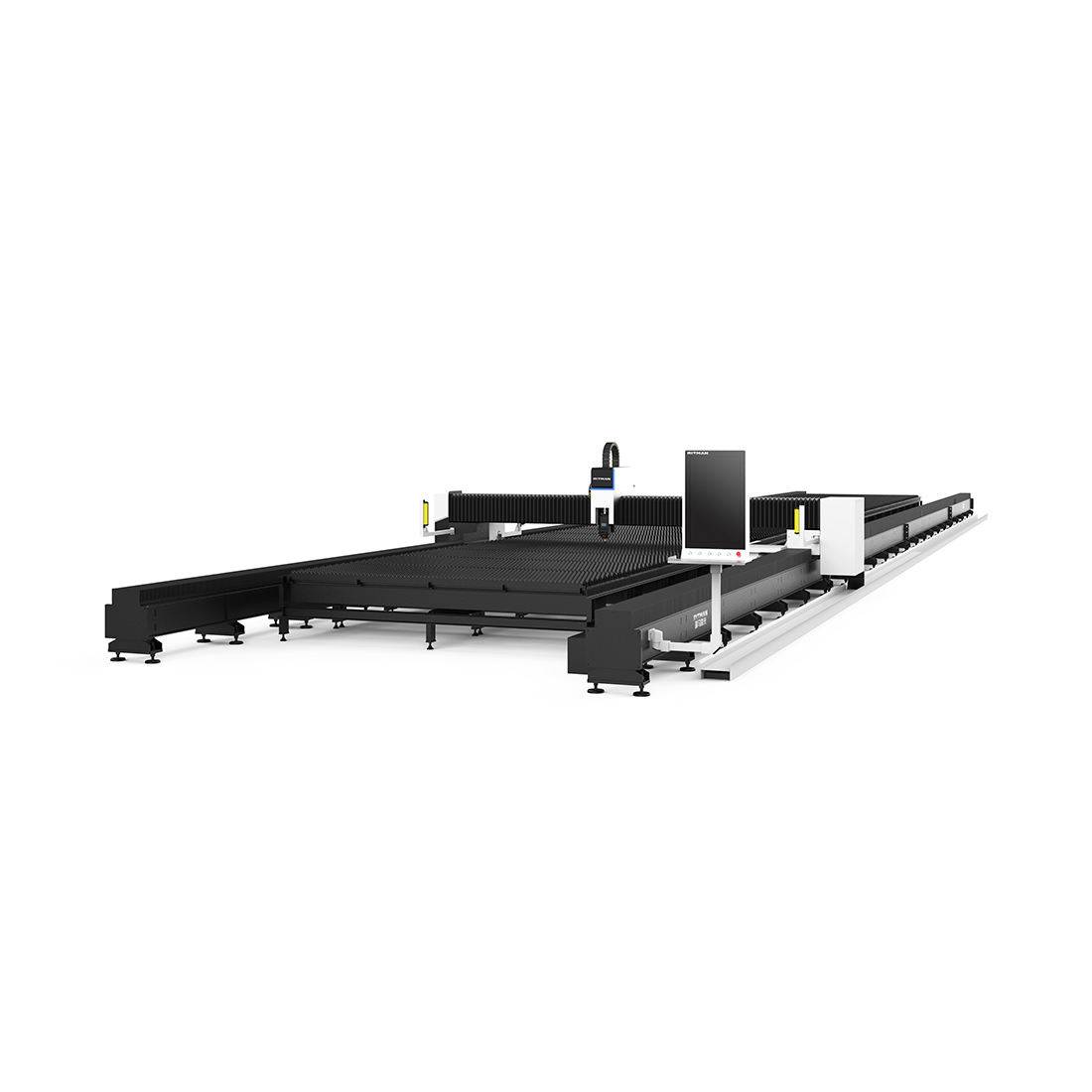
Three-in-One Workflow: Punching, Marking, and Cutting
Efficiency in a shipyard is measured by the reduction of “touches” per part. A high-spec fiber laser system optimizes the production flow by executing three distinct operations in a single programmed sequence:
1. Center Punching: The laser head uses a low-frequency, high-peak-power pulse to create precise indentation points for downstream drilling or locating. This eliminates the need for manual layout or secondary mechanical punching stations.
2. Automated Marking: Using the same laser source with modulated parameters, the system performs automated marking of part numbers, assembly codes, and bend lines. This high-speed etching is permanent and legible, ensuring that logistics and assembly teams can identify components without referring to paper blueprints.
3. High-Precision Profile Cutting: Once the layout and marking are complete, the system switches to full power for the final cut. The high energy density of the fiber laser results in a narrow kerf and a significantly smaller Heat Affected Zone (HAZ) compared to other thermal methods.
Elimination of Secondary Grinding Operations
In traditional maritime fabrication, the “cutting” stage is often followed by a labor-intensive “finishing” stage. Rough edges, dross, and oxidation layers usually require manual grinding before the parts can be moved to the assembly floor. The implementation of a High-precision cutting fiber laser system effectively deletes this entire step from the production cycle.
The superior beam quality of a fiber laser, combined with precise assist gas pressure control (typically oxygen for carbon steel or nitrogen for stainless), produces a surface finish that is often assembly-ready. Industrial engineers value this because it reduces man-hours, minimizes consumable costs for abrasives, and improves the safety environment of the shop floor by reducing dust and noise associated with manual grinding.
Thermal Management and Material Integrity
Shipbuilding involves high-strength steels that can be sensitive to thermal cycling. Excessive heat input can alter the grain structure of the metal, leading to brittleness at the edges. Fiber lasers operate at a wavelength of approximately 1.06 microns, which is highly absorbable by metals. This allows for faster cutting speeds, which in turn reduces the duration of heat exposure to the material. By maintaining a high feed rate and utilizing Laser Seam Tracking to ensure the beam never lingers unnecessarily, the metallurgical properties of the plate remain intact. This is vital for the fatigue life of the ship’s hull and internal structural members.
Nesting Efficiency and Resource Optimization
Beyond the physical cut, the software integration of fiber laser systems allows for hyper-efficient nesting. Because the fiber laser produces such a narrow kerf, parts can be nested more tightly than ever before. This maximizes material utilization—a critical KPI when dealing with expensive marine-grade plates. The precision of the laser also allows for “common-line cutting,” where two parts share a single cut path, further reducing cycle time and gas consumption. When these software capabilities are paired with a machine that can accurately track the seam of a massive plate, the result is a significant reduction in scrap rates.
Strategic ROI for Shipyard Modernization
The capital investment in a fiber laser system with seam tracking is justified through the drastic improvement in throughput. By integrating punching and marking, the shipyard removes bottlenecks in the layout department. By delivering a cut that requires no grinding, the shipyard removes bottlenecks in the prep department. The Fiber Laser Cutting Machine essentially acts as a multi-process workstation that delivers parts directly to the assembly jig.
From an operational standpoint, the reliability of fiber laser sources—which are solid-state and have no moving parts or mirrors in the beam path—translates to higher uptime. For a shipyard operating on tight delivery schedules, the ability to predictably produce thousands of unique, high-precision components per week is the ultimate competitive advantage. The data generated by the CNC system also allows for better shop floor tracking, providing management with real-time insights into material usage and production bottlenecks.
Conclusion: The Future of Maritime Fabrication
As the maritime industry moves toward more complex vessel designs and stricter regulatory requirements, the tolerance for error disappears. Fiber laser cutting with integrated seam tracking represents the pinnacle of current fabrication technology. By ensuring that every plate is punched, marked, and cut to exact specifications without the need for secondary corrections, shipyards can achieve the lean manufacturing goals necessary for 21st-century global competition. The focus remains clear: maximize precision, minimize heat, and eliminate redundant labor.
-


LT240S tube laser cutting machine
-
LT120S tube laser cutting machine
-
Sale

Tank Fillet Welding Machine
Original price was: $1,000.00.$900.00Current price is: $900.00. -
Sale

MAK100 tube laser cutting machine
Original price was: $5,500.00.$5,000.00Current price is: $5,000.00. -

portable plasma air cutting machine
$1,200.00 -

2in1 fiber laser cutting machine
-

Air cooling Laser welding machine
-

HF h beam laser cutting machine
-

LT240 laser cutting machine
-

Laser welding machine
-


Cobot Welding Station
-

Gantry welding robot solution
-

Tracked Wheeled AGV Welding robot
-

LFH6020 Fiber laser cutting machine
-
LFP6020
-

robotic welidng machine
Advanced Fiber Laser Tube Processing Technology
Our CNC Fiber Laser Tube Cutting systems revolutionize metal fabrication by integrating high-precision cutting, punching, and profiling into a single automated workflow. Designed for versatility, this technology handles a wide array of profiles including Round, Square, Rectangular, and Oval tubes, as well as complex L-shaped and U-shaped channels.
- Precision Punching: High-speed hole punching with micron-level accuracy, eliminating the need for mechanical drilling or die-stamping.
- Complex Profiling: Advanced 3D pathing allows for intricate interlocking joints and specialized notch cuts, ideal for structural frames.
- High Material Efficiency: Intelligent nesting software minimizes scrap, reducing raw material costs across large production runs.
- Clean Finish: Delivers oxide-free, burr-free edges that require zero secondary grinding before welding.

Seamlessly processing multiple profiles with consistent precision.
Global Delivery & Logistics



From our high-tech manufacturing facility directly to your global site. PCL WeldCut ensures secure packaging, professional handling, and reliable international logistics to safeguard your equipment throughout the entire journey.