Optimizing Shipbuilding Throughput with Fiber Laser Technology
The shipbuilding industry is undergoing a structural shift toward automation and higher precision standards. Traditional thermal cutting methods often necessitate extensive post-processing, including edge grinding and manual slag removal. The introduction of high-power fiber Laser Cutting systems has redefined the production floor by offering a narrow kerf, minimal heat-affected zones (HAZ), and superior edge quality. For an industrial engineer, the objective is the reduction of “dead time” between the cutting table and the assembly jig. Fiber lasers achieve this by maintaining structural integrity and dimensional accuracy that meets the rigorous standards of maritime classification societies.
The Role of Laser Seam Tracking in Heavy Plate Processing
Shipbuilding involves large-format steel plates, often measuring up to 12 or 24 meters in length. These plates, while theoretically flat, frequently exhibit “oil-canning” or slight warping due to internal stresses and storage conditions. Conventional cutting heads risk collision or focal drift if the distance between the nozzle and the workpiece varies. Laser seam tracking and surface sensing technology solve this by utilizing high-speed optical sensors to map the topography of the plate in real-time.
Dynamic Focal Length Compensation
The seam tracking system functions as a continuous feedback loop. As the gantry moves across the transverse and longitudinal axes, the sensor detects deviations in plate height. The CNC controller adjusts the Z-axis instantaneously, ensuring the focal point remains precisely at the optimal depth within the material thickness. This constant gap control is critical for maintaining a consistent dross-free edge, which is the primary requirement for eliminating secondary grinding operations.
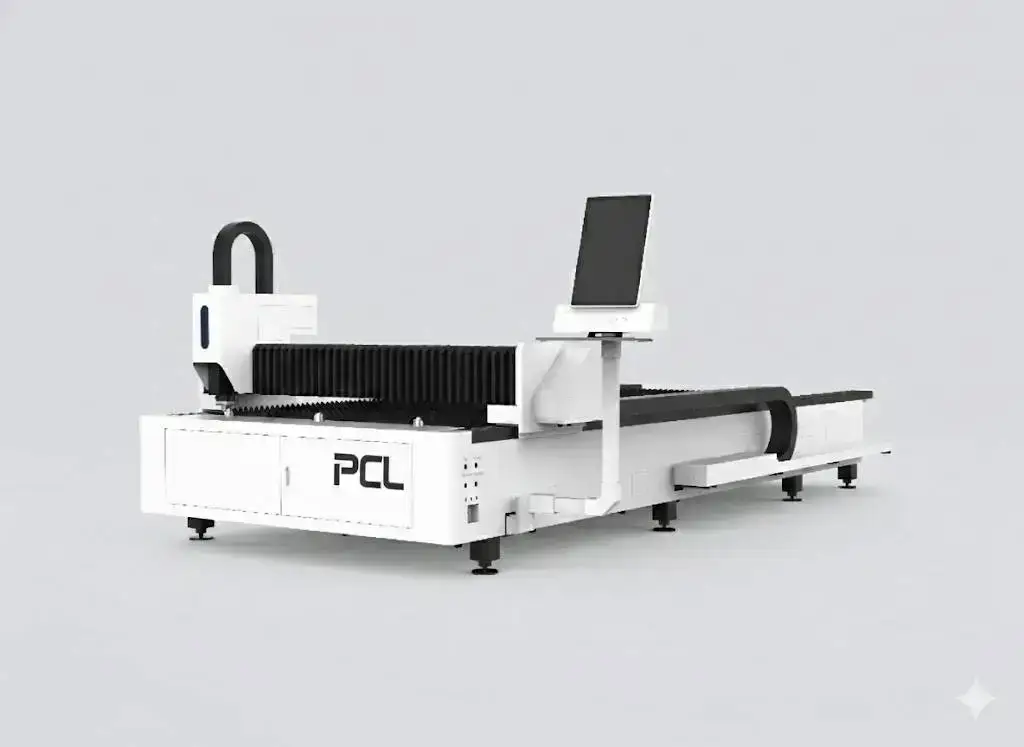
Automated Plate Alignment and Correction
Beyond height sensing, laser tracking allows the machine to identify the actual orientation of the plate on the bed. In a shipyard environment, loading a 20-ton plate perfectly square to the machine axis is time-consuming. The laser sensor scans the edges of the plate, and the software performs a coordinate transformation. This ensures that the nesting pattern aligns perfectly with the physical material, reducing scrap rates and ensuring that part geometries are not skewed by manual loading errors.
Integrated Workflow: Punch, Mark, and Cut
Efficiency in shipbuilding is measured by the “kit-to-assembly” speed. A modern Fiber Laser Cutting Machine is no longer just a profiling tool; it is a multi-process workstation. By utilizing the high-speed modulation capabilities of the fiber source, the machine can perform three distinct functions in a single program execution.
High-Speed Laser Marking
Part identification is a significant bottleneck in shipyard logistics. Fiber lasers can engrave alphanumeric codes, QR codes, and assembly lines directly onto the steel surface. Unlike ink-jet marking, laser engraving is permanent and survives the blast-cleaning and priming processes. The system can mark bending lines, weld margins, and stiffener locations with sub-millimeter precision, providing a clear roadmap for the assembly crews.
Precision Punching and Piercing
Mechanical punching of thick ship plates is loud, requires expensive tooling, and adds significant mechanical stress to the gantry. Fiber lasers perform “optical punching” by using high-frequency pulses to create clean, vertical holes for bolting or drainage. Because the laser does not exert physical force on the plate, there is no risk of plate shifting or tool wear. The resulting holes are perfectly circular with no taper, meeting the strict tolerances required for structural fasteners.
The Precision Cut: Eliminating the Grinding Station
The ultimate goal of adopting fiber laser technology is the “no-grind” workflow. In traditional methods, the edge of the plate becomes carbonized or heavily slagged. Fiber lasers, particularly those operating in the 12kW to 30kW range, utilize high-pressure nitrogen or oxygen assist gases to blow the molten material out of the kerf. The resulting surface finish often reaches a roughness (Ra) value that requires no further preparation before being sent to the assembly stage. This eliminates thousands of man-hours spent on manual grinding across a single hull project.
Material Integrity and Heat Affected Zone (HAZ) Control
From a metallurgical perspective, the heat affected zone is a critical variable in ship construction. Excessive heat can alter the grain structure of high-tensile steels (such as DH36 or EH36), leading to brittle edges that are prone to fatigue cracking under maritime stresses. Fiber lasers concentrate energy into an extremely small spot size. This high energy density allows for faster cutting speeds, which in turn reduces the total heat input into the base material. The resulting HAZ is significantly narrower than any other thermal cutting process, preserving the mechanical properties of the steel and ensuring compliance with international maritime safety standards.
Operational Economics: ROI for Shipyards
While the initial capital expenditure for a large-format fiber laser with tracking capabilities is higher than legacy systems, the Return on Investment (ROI) is realized through three specific vectors:
1. Consumable Cost Reduction
Fiber lasers have no internal moving parts in the resonator and no mirrors in the beam path (the beam is delivered via a fiber optic cable). This leads to significantly lower maintenance costs and higher uptime compared to CO2 or older technologies. The primary consumables are restricted to the copper nozzle and the protective window.
2. Energy Efficiency
Fiber lasers operate at wall-plug efficiencies of 30-40%, whereas traditional systems often hover around 10%. In a 24/7 shipyard operation, the reduction in electricity consumption represents a massive operational saving over the lifecycle of the machine.
3. Labor Reallocation
By automating the marking and punching process and eliminating the need for a dedicated grinding team, shipyards can reallocate skilled labor to high-value assembly and outfitting tasks. The laser seam tracking system also reduces the level of constant manual intervention required from the machine operator, allowing a single technician to oversee multiple gantries.
Technical Specifications for Maritime Applications
To successfully implement this technology, the following system parameters are typically optimized for Shipbuilding steel:
Power Density and Beam Profile
For plates ranging from 10mm to 50mm, power levels of 15kW to 20kW are recommended. The beam profile must be adjusted to ensure a wide enough kerf for effective melt expulsion, preventing “re-welding” of the slag at the bottom of the cut.
Gantry Dynamics
Due to the massive size of ship sections, the gantry must maintain high positioning accuracy (±0.05mm) over long distances. Linear motor drives are often preferred over rack-and-pinion systems to maintain the acceleration required for high-speed marking and complex geometric cutting.
Environmental Protection
Shipyards are harsh environments. The laser source and the seam tracking optics must be housed in pressurized, climate-controlled enclosures to prevent the ingress of metallic dust and humidity, ensuring the longevity of the optical components.
Conclusion
The integration of fiber laser cutting with advanced laser seam tracking represents the pinnacle of modern plate processing. By providing a clean, “ready-to-assemble” part directly from the cutting bed, shipyards can significantly compress their production timelines. The ability to mark, punch, and cut in a single pass with sub-millimeter precision ensures that the final vessel is built to a higher standard of structural integrity while simultaneously lowering the total cost of production.
-


Cantilever Welding Robot solution
-


GF laser cutting machine
-

P3015 plasma cutting machine
-

LFP3015 Fiber Laser Cutter
-

pipe plasma cutting machine
-
LFH 4020 Fiber Laser Cutting Machine
-
LFP4020
-

gantry plasma air cutting machine
-

3D robot cutting machine
-

8 axis plasma cutting machine
-

5 axis plasma cutting machine
-

LT360 tube laser cutting machine
-

robot welding workstation
-

SF6060 fiber laser cutting machine
Advanced Fiber Laser Tube Processing Technology
Our CNC Fiber Laser Tube Cutting systems revolutionize metal fabrication by integrating high-precision cutting, punching, and profiling into a single automated workflow. Designed for versatility, this technology handles a wide array of profiles including Round, Square, Rectangular, and Oval tubes, as well as complex L-shaped and U-shaped channels.
- Precision Punching: High-speed hole punching with micron-level accuracy, eliminating the need for mechanical drilling or die-stamping.
- Complex Profiling: Advanced 3D pathing allows for intricate interlocking joints and specialized notch cuts, ideal for structural frames.
- High Material Efficiency: Intelligent nesting software minimizes scrap, reducing raw material costs across large production runs.
- Clean Finish: Delivers oxide-free, burr-free edges that require zero secondary grinding before welding.

Seamlessly processing multiple profiles with consistent precision.
Global Delivery & Logistics



From our high-tech manufacturing facility directly to your global site. PCL WeldCut ensures secure packaging, professional handling, and reliable international logistics to safeguard your equipment throughout the entire journey.