Advanced Material Processing in Pressure Vessel Fabrication
In the current industrial landscape, the manufacturing of pressure vessels—ranging from storage tanks to complex heat exchangers—demands unprecedented levels of precision and structural integrity. Traditional methods of preparing shell plates and dished heads often involve labor-intensive mechanical cutting or thermal processes that necessitate extensive post-processing. The transition to Fiber Laser Cutting technology represents a paradigm shift in throughput and quality control. By leveraging short-wavelength laser beams, engineers can achieve superior absorption rates in carbon steel and stainless steel, resulting in a narrow kerf and a minimal heat-affected zone (HAZ).
The core objective for an industrial engineer is the optimization of the value stream. In pressure vessel production, the “bottleneck” frequently occurs during the preparation phase, where plates must be accurately sized, nozzle holes must be cut, and assembly marks must be applied. Utilizing a high-power fiber laser system allows for the consolidation of these disparate steps into a single CNC-controlled operation. This integration removes the variance associated with manual layout and ensures that every component meets the stringent tolerances required by international pressure vessel codes.
Dynamic Accuracy with Laser Seam Tracking
One of the primary challenges in cutting large-scale cylindrical shells is the inherent deviation in material geometry. Raw plates and rolled shells are rarely perfectly flat or perfectly round. This is where Laser Seam Tracking (or more accurately, surface-following and edge-finding sensor technology) becomes critical. For a laser to maintain a consistent cut quality, the distance between the cutting nozzle and the workpiece—the stand-off distance—must remain constant within a fraction of a millimeter.
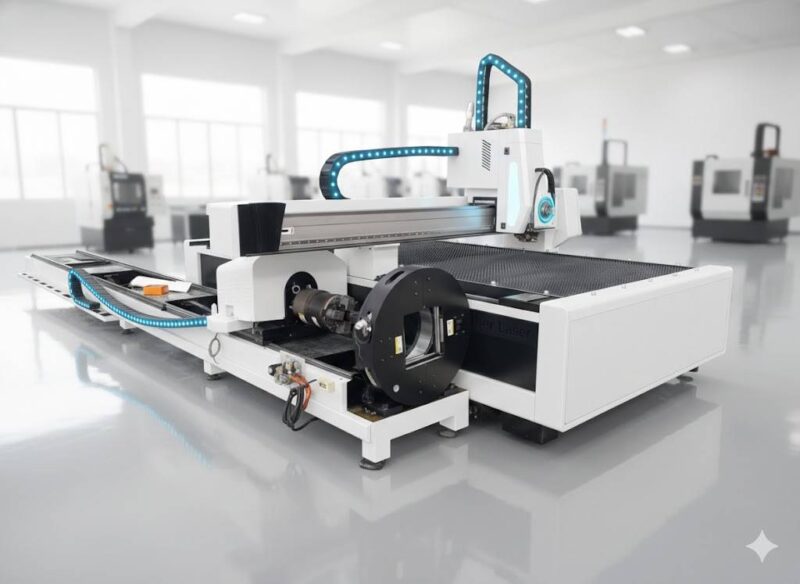
Intelligent tracking systems utilize high-speed optical sensors to scan the surface of the shell in real-time. This data is fed back to the CNC controller, which adjusts the Z-axis height and the beam focal point instantaneously. This closed-loop feedback mechanism compensates for “ovality” in rolled shells and ensures that nozzle holes are cut perpendicular to the surface tangent at every point. Without this tracking capability, the risk of focal shift increases, leading to dross formation and out-of-tolerance apertures that require manual rework.
The Triple-Function Workflow: Punch, Mark, and Cut
Efficiency in Pressure Vessel Fabrication is maximized when the machine performs multiple functions in one setup. Fiber laser systems are no longer restricted to simple profile cutting; they are multi-functional tools that replace traditional drilling and manual scribing.
Automated Hole Punching and Piercing
Unlike mechanical punching, which induces stress on the material, laser piercing is a non-contact process. High-frequency pulse piercing allows the fiber laser to penetrate thick-walled sections with minimal spatter. This is particularly vital for nozzle penetrations where the integrity of the base metal surrounding the hole must be preserved to ensure high-quality joints during subsequent assembly phases.
High-Definition Marking
The fiber laser can be de-focused or operated at lower power levels to perform surface marking. Industrial engineers utilize this feature to engrave assembly lines, orientation markers, and identification codes directly onto the shell. This eliminates the need for manual chalking or center-punching, which are prone to human error. Every attachment point is precisely mapped according to the CAD model, ensuring perfect alignment of manways and brackets.
Precision Cutting and Edge Quality
The final phase is the high-precision cut. Because the fiber laser delivers a high energy density, the material is vaporized or blown away by assist gases (Oxygen or Nitrogen) with extreme speed. The resulting edge is clean, square, and free of slag. This leads to the most significant cost-saving factor in the facility: the total elimination of grinding.
Eliminating Post-Processing: The No-Grind Mandate
In traditional fabrication shops, every thermal cut is followed by a team of operators using angle grinders to remove dross and smooth the edges. This process is not only labor-intensive but also creates significant noise and dust, impacting shop floor safety and ergonomics. From a process engineering perspective, grinding is a non-value-added activity.
Automated Hole Punching and cutting via fiber laser produce a surface finish that is often ready for assembly immediately after the cut. The edge roughness is kept within microns, and the squareness of the cut ensures that fit-up gaps are minimized. In a pressure vessel context, a tight fit-up is essential for maintaining the structural calculations defined during the design phase. By removing the grinding stage, manufacturers can reduce the total cycle time per vessel by 15% to 30% depending on the complexity of the internal and external attachments.
Technical Specifications and Power Considerations
To process the heavy-wall plates typically found in pressure vessel manufacturing (ranging from 10mm to over 30mm), high-kilowatt fiber laser sources are required. A 12kW to 30kW laser source provides the necessary power to maintain high feed rates on thicker materials while ensuring the kerf remains narrow. The use of nitrogen as an assist gas is preferred for stainless steel applications to prevent oxidation of the cut edge, further ensuring that the material properties remain unchanged.
Furthermore, the motion system of the machine must be robust. Large-format gantries or 5-axis robotic arms equipped with fiber heads allow for the processing of both flat plates and pre-formed dished heads. The synchronization between the motion controller and the laser source ensures that even at corner transitions or tight radii, the heat input remains constant, preventing over-burning and maintaining dimensional stability.
Economic Impact on the Industrial Lifecycle
The capital investment in a fiber laser system with seam tracking is justified by the reduction in Total Cost of Ownership (TCO). Labor costs are redirected from manual preparation to high-level machine operation and programming. Material utilization is also improved; the precision of the laser allows for tighter nesting of components, reducing the scrap rate of expensive alloys.
Moreover, the repeatability of laser cutting means that downstream assembly is streamlined. Components fit together with “Lego-like” precision, reducing the time spent on force-fitting or shimming. For an industrial engineer, this predictability is the foundation of a Lean manufacturing environment. The transition to fiber laser technology is not merely a hardware upgrade; it is a strategic overhaul of the pressure vessel production sequence that prioritizes accuracy, speed, and safety.
Conclusion
The integration of fiber laser cutting and laser seam tracking provides a comprehensive solution for the challenges of pressure vessel manufacturing. By executing punching, marking, and cutting in a single, high-precision pass, the technology eliminates secondary grinding and manual layout errors. This results in a cleaner, faster, and more profitable production line that meets the rigorous demands of modern heavy industry.
-


Cantilever Welding Robot solution
-


GF laser cutting machine
-

P3015 plasma cutting machine
-

LFP3015 Fiber Laser Cutter
-

pipe plasma cutting machine
-
LFH 4020 Fiber Laser Cutting Machine
-
LFP4020
-

gantry plasma air cutting machine
-

3D robot cutting machine
-

8 axis plasma cutting machine
-

5 axis plasma cutting machine
-

LT360 tube laser cutting machine
-

robot welding workstation
-

SF6060 fiber laser cutting machine
Advanced Fiber Laser Tube Processing Technology
Our CNC Fiber Laser Tube Cutting systems revolutionize metal fabrication by integrating high-precision cutting, punching, and profiling into a single automated workflow. Designed for versatility, this technology handles a wide array of profiles including Round, Square, Rectangular, and Oval tubes, as well as complex L-shaped and U-shaped channels.
- Precision Punching: High-speed hole punching with micron-level accuracy, eliminating the need for mechanical drilling or die-stamping.
- Complex Profiling: Advanced 3D pathing allows for intricate interlocking joints and specialized notch cuts, ideal for structural frames.
- High Material Efficiency: Intelligent nesting software minimizes scrap, reducing raw material costs across large production runs.
- Clean Finish: Delivers oxide-free, burr-free edges that require zero secondary grinding before welding.

Seamlessly processing multiple profiles with consistent precision.
Global Delivery & Logistics



From our high-tech manufacturing facility directly to your global site. PCL WeldCut ensures secure packaging, professional handling, and reliable international logistics to safeguard your equipment throughout the entire journey.