Technical Integration of Fiber Laser Systems in Pressure Vessel Manufacturing
In the specialized field of pressure vessel fabrication, structural integrity and dimensional accuracy are non-negotiable. Traditional manufacturing workflows often suffer from fragmentation, requiring separate stages for layout marking, piercing, and mechanical edge preparation. The transition to high-power fiber Laser Cutting machines represents a paradigm shift in how cylindrical shells, dished ends, and nozzles are processed. By utilizing a solid-state laser source, these machines deliver a high-density energy beam through a flexible fiber optic cable, allowing for extreme precision and a focused kerf that minimizes material waste.
The primary engineering advantage of a fiber laser lies in its wavelength—typically around 1.06 microns—which is highly absorbed by carbon steel, stainless steel, and aluminum alloys commonly used in vessel construction. This absorption rate enables faster travel speeds compared to older CO2 technologies and significantly reduces the Heat Affected Zone (HAZ). For a pressure vessel, maintaining the metallurgical properties of the base metal is critical for safety certifications; fiber lasers ensure the micro-structure of the steel remains largely unaltered near the cut line.
Laser Seam Tracking: Real-Time Precision for Non-Linear Surfaces
Pressure vessels are rarely perfectly flat. Large-diameter shells often exhibit slight ovality or surface irregularities due to the rolling process. Standard CNC cutting paths frequently fail to account for these deviations, leading to inconsistent cut depths or collisions. The implementation of laser seam tracking technology solves this through non-contact, real-time triangulation. A laser sensor precedes the cutting head, scanning the topography of the workpiece and feeding data back to the motion controller at millisecond intervals.
Active Height Control and Path Correction
The seam tracking system maintains a constant focal distance, which is essential for consistent kerf width and edge quality. In pressure vessel fabrication, where 5-axis heads are often used to cut holes for nozzles or to create beveled edges for weld preparation, the ability to track the curvature of the cylinder is vital. The sensor detects the exact position of the material, adjusting the Z-axis dynamically. This eliminates the risk of “head-crashes” and ensures that the bevel angle remains constant throughout the entire circumference of the cut.
Eliminating Pre-Process Calibration
Historically, operators had to manually probe the workpiece to establish a coordinate system. Modern fiber laser machines with integrated vision and seam tracking automate this “workpiece alignment.” By scanning the actual geometry of the shell, the CNC software can auto-nest the cutting patterns onto the rolled plate, compensating for any skew or deformation. This reduces setup time by up to 40% and increases the overall throughput of the production line.
The Multi-Functional Capability: Punch, Mark, and Cut
Efficiency in industrial engineering is measured by the reduction of “touches”—the number of times a workpiece is handled or moved between machines. High-end fiber laser systems for Pressure Vessels are designed as multi-functional workstations. They do not just cut; they perform three distinct operations in a single programmed cycle.
1. Precision Punching and Piercing
Unlike mechanical punching which can induce stress cracks in thick-walled vessels, fiber laser piercing uses controlled pulse modulation to create clean start points. This is particularly important for high-pressure applications where micro-fractures can lead to catastrophic failure under cyclic loading. The laser can pierce through plates exceeding 30mm with high repeatability, preparing the path for the subsequent cutting operation.
2. Surface Marking and Traceability
Traceability is a mandatory requirement under ASME and PED standards. Fiber lasers can be detuned to perform surface etching or marking. Part numbers, heat numbers, and assembly instructions are marked directly onto the vessel components during the cutting process. This removes the need for manual stamping or inkjet marking, ensuring that every component is identifiable throughout the entire assembly and inspection lifecycle.
3. High-Tolerance Cutting and Beveling
The final stage is the high-speed cut. For pressure vessel manufacturers, the ability to perform V, X, or K-shaped bevel cuts directly on the laser machine is a major competitive advantage. Because the fiber laser cutting process is so precise, the resulting edges are “weld-ready.” This means the edge surface finish is smooth enough to meet stringent NDT (Non-Destructive Testing) requirements without any secondary grinding.
Economic Impact: Removing the Grinding Bottleneck
In traditional fabrication shops, the grinding station is often the most significant bottleneck. Manual grinding to remove dross or to correct edge angles is labor-intensive, creates hazardous dust, and introduces human error into the dimensional tolerance. By utilizing a high-precision fiber laser with seam tracking, the “as-cut” quality is sufficient for immediate assembly.
From a cost-analysis perspective, the elimination of grinding reduces consumables (grinding discs) and significantly lowers labor costs. Furthermore, the accuracy of the laser-cut edge ensures a superior fit-up during the assembly of the vessel shells. When the gap between two plates is consistent and the bevel angle is precise, the subsequent automated welding processes (such as SAW or TIG) perform with much higher reliability, leading to fewer weld repairs and higher first-pass yield.
Optimization of Material Utilization
Industrial engineers focus heavily on material utilization rates, especially given the high cost of specialized alloys used in the oil and gas or chemical processing industries. Fiber laser software utilizes advanced nesting algorithms that can place nozzle cutouts and manway reinforcements in the most efficient layout possible. Because the laser kerf is extremely narrow (often less than 0.2mm), parts can be nested closer together than would be possible with any other thermal cutting method. This results in a 10% to 15% reduction in scrap material, which directly impacts the bottom line on large-scale projects.
Integration with Industry 4.0 and CAD/CAM
Modern fiber laser machines are not standalone units; they are nodes in a digital manufacturing ecosystem. CAD files for pressure vessels (often exported from software like SolidWorks or COMPRESS) are imported directly into the laser’s CAM environment. The seam tracking data can be logged for quality assurance purposes, providing a digital “as-built” record of the component’s dimensions. This level of data integration supports predictive maintenance and allows for real-time monitoring of OEE across the factory floor.
Conclusion: The Future of Pressure Vessel Fabrication
The integration of fiber laser cutting with intelligent seam tracking represents the pinnacle of modern vessel fabrication. By consolidating punching, marking, and bevel cutting into a single, high-precision operation, manufacturers can achieve tolerances that were previously impossible at scale. The elimination of secondary grinding and the reduction of the HAZ ensure that the structural integrity of the pressure vessel is maintained at the highest level. For the industrial engineer, this technology is not just about faster cutting; it is about creating a leaner, more predictable, and more profitable production environment where quality is engineered into the process rather than inspected after the fact.
-


Cantilever Welding Robot solution
-


GF laser cutting machine
-

P3015 plasma cutting machine
-

LFP3015 Fiber Laser Cutter
-

pipe plasma cutting machine
-
LFH 4020 Fiber Laser Cutting Machine
-
LFP4020
-

gantry plasma air cutting machine
-

3D robot cutting machine
-

8 axis plasma cutting machine
-

5 axis plasma cutting machine
-

LT360 tube laser cutting machine
-

robot welding workstation
-

SF6060 fiber laser cutting machine
Advanced Fiber Laser Tube Processing Technology
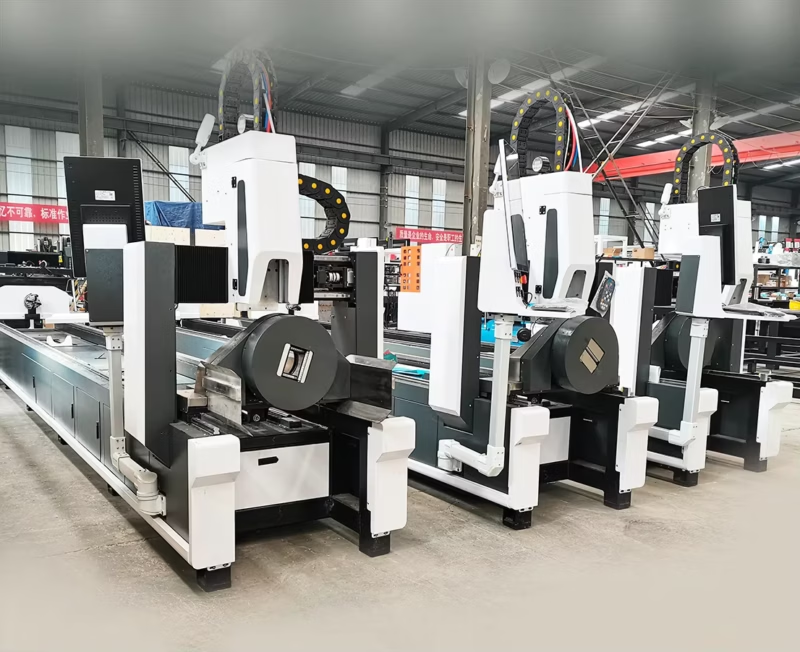
Our CNC Fiber Laser Tube Cutting systems revolutionize metal fabrication by integrating high-precision cutting, punching, and profiling into a single automated workflow. Designed for versatility, this technology handles a wide array of profiles including Round, Square, Rectangular, and Oval tubes, as well as complex L-shaped and U-shaped channels.
- Precision Punching: High-speed hole punching with micron-level accuracy, eliminating the need for mechanical drilling or die-stamping.
- Complex Profiling: Advanced 3D pathing allows for intricate interlocking joints and specialized notch cuts, ideal for structural frames.
- High Material Efficiency: Intelligent nesting software minimizes scrap, reducing raw material costs across large production runs.
- Clean Finish: Delivers oxide-free, burr-free edges that require zero secondary grinding before welding.

Seamlessly processing multiple profiles with consistent precision.
Global Delivery & Logistics



From our high-tech manufacturing facility directly to your global site. PCL WeldCut ensures secure packaging, professional handling, and reliable international logistics to safeguard your equipment throughout the entire journey.