Advanced Precision in Pressure Vessel Component Fabrication
In the current industrial landscape, the fabrication of pressure vessels demands a level of geometric accuracy and metallurgical integrity that traditional thermal cutting methods struggle to provide. The transition to high-wattage Fiber Laser Cutting has redefined the workflow for processing heavy-gauge plates, specifically those used for shells, heads, and nozzles. Unlike older technologies, the fiber laser utilizes a solid-state gain medium, resulting in a beam wavelength of approximately 1.07 microns. This specific wavelength allows for a high absorption rate in carbon steel, stainless steel, and non-ferrous alloys, which are the primary materials in vessel construction.
The primary advantage for an industrial engineer is the reduction of the Heat Affected Zone (HAZ). Because the laser beam is highly concentrated, the energy input is localized, preventing the thermal distortion common in large-diameter plate processing. for Pressure Vessels, where material grain structure and tensile strength are critical for safety, minimizing thermal stress during the cutting phase is a significant quality control improvement. This precision eliminates the need for post-cut mechanical edge preparation, allowing components to move directly from the cutting table to the assembly jig.
The Role of Laser Seam Tracking in Path Correction
Pressure vessel fabrication involves large-format plates and pre-formed dished heads that often exhibit minor surface irregularities or deviations from theoretical CAD models. Laser Seam Tracking (LST) technology serves as the sensory nervous system for the cutting head. By utilizing a non-contact triangulation sensor, the system scans the material surface ahead of the cutting nozzle, providing real-time feedback to the CNC controller.
This capability is particularly vital when cutting openings for nozzles on cylindrical shells or elliptical heads. In these applications, the height (Z-axis) and the lateral position (Y-axis) must be adjusted dynamically to compensate for the curvature of the vessel. The LST system ensures that the standoff distance between the nozzle and the plate remains constant, which is essential for maintaining a stable gas-assist pressure and consistent kerf width. Without this tracking, the focal point of the laser would drift, resulting in irregular dross formation and out-of-tolerance edge angles that would require manual grinding to correct.
Single-Pass Efficiency: Punch, Mark, and Cut
Modern fiber laser systems designed for the pressure vessel industry are not merely cutting tools; they are multi-functional processing centers. The industrial engineer looks for “all-in-one” cycles that reduce material handling. The standard workflow on these machines follows a three-stage sequence: punch, mark, and cut.
Integrated Piercing (Punch) Strategies
The “punch” phase refers to the initial piercing of the plate. High-power fiber lasers utilize multi-stage piercing sequences that ramp up power while modulating gas pressure. This ensures a clean entry point with minimal spatter. For thick-walled pressure vessels, the ability to create a “no-blowhole” pierce is essential. This protects the surrounding material surface and ensures that the start of the cut is as precise as the midpoint, maintaining the integrity of the seal surface for future flange fit-ups.
Traceability and Layout Marking
Traceability is a non-negotiable requirement in pressure vessel manufacturing (ASME Section VIII or EN 13445). The fiber laser can be de-focused or operated at lower power levels to “mark” the plate. This includes etching heat numbers, part IDs, and even layout lines for internal supports or baffles. By marking these directly on the cutting table, the facility eliminates manual layout errors and the labor-intensive use of ink-jet or physical stamping. These marks are permanent enough for fabrication but do not create stress-risers in the material.
High-Velocity Final Cutting
The final “cut” phase leverages high-pressure assist gases (typically Nitrogen for stainless or Oxygen for carbon steel) to eject molten metal at supersonic speeds. This results in a “ready-to-weld” edge finish. For an industrial engineer, the metric of success here is the Pressure Vessel Fabrication efficiency—specifically the linear meters cut per hour versus the total energy and gas consumption. The fiber laser’s high electrical-to-optical conversion efficiency (exceeding 30%) makes it the most cost-effective method for high-volume vessel production.
Eliminating Secondary Processes: The No-Grinding Mandate
In traditional fabrication shops, a significant portion of the “man-hours per ton” is dedicated to grinding. When a plate is cut with less precise methods, the edge is often characterized by heavy dross and a hardened layer that must be mechanically removed before welding. The fiber laser, coupled with Automated Piercing and Marking, produces an edge with a roughness value often below 30 microns.
This edge quality is clean enough that it requires no secondary grinding. The absence of dross means that the fit-up between the shell and the head is tighter, reducing the volume of weld metal required and decreasing the risk of weld defects such as lack of fusion or inclusions. From a lean manufacturing perspective, removing the grinding station from the workflow reduces dust, noise, and ergonomic risks, while simultaneously accelerating the throughput of the entire facility.
Technical Integration and CAD/CAM Optimization
The performance of a fiber laser system is heavily dependent on the software stack. Industrial engineers utilize nesting software to maximize material utilization on large plates. When cutting components for multiple vessels, nesting optimization can reduce scrap rates by 15% or more. The software also manages the “lead-ins” and “lead-outs” for the laser path, ensuring that the start and end points of a circular cut do not leave a notch or a bump on the finished part.
Furthermore, the integration of laser seam tracking data into the CAM software allows for the “unwrapping” of complex nozzle intersections. The software calculates the exact 3D path required to cut a hole in a curved shell so that the nozzle sits perfectly flush. This level of digital-to-physical synchronization is what allows fiber laser systems to outperform any manual or semi-automated cutting method in the pressure vessel sector.
Operational Sustainability and Long-Term ROI
From a CapEx perspective, a fiber laser machine is a significant investment, but the OpEx story is compelling. Fiber lasers have no moving parts in the resonator and no mirrors in the beam delivery system to align or replace. The beam is delivered via a flexible fiber optic cable directly to the cutting head, which is highly resistant to the vibrations and dust of a heavy fabrication environment. The maintenance intervals are significantly longer than those of CO2 systems, and the absence of expensive laser gases further reduces the hourly operating cost.
For a facility specializing in pressure vessels, the Return on Investment (ROI) is realized through three main channels: reduced labor costs due to the elimination of grinding, lower material waste through precision nesting, and increased shop capacity through faster cutting speeds. As vessel designs become more complex and material costs rise, the precision of fiber laser technology becomes a strategic advantage rather than just a technical preference.
Conclusion
The marriage of fiber laser technology with real-time seam tracking represents the pinnacle of modern plate processing for the pressure vessel industry. By mastering the punch, mark, and cut cycle, manufacturers can achieve a level of precision that satisfies the most stringent engineering codes while significantly improving operational efficiency. The move toward a “no-grind” production floor is no longer a goal but a reality for those who adopt these high-precision systems.
-


LT240S tube laser cutting machine
-
LT120S tube laser cutting machine
-
Sale

Tank Fillet Welding Machine
Original price was: $1,000.00.$900.00Current price is: $900.00. -
Sale

MAK100 tube laser cutting machine
Original price was: $5,500.00.$5,000.00Current price is: $5,000.00. -

portable plasma air cutting machine
$1,200.00 -

2in1 fiber laser cutting machine
-

Air cooling Laser welding machine
-

HF h beam laser cutting machine
-

LT240 laser cutting machine
-

Laser welding machine
-


Cobot Welding Station
-

Gantry welding robot solution
-

Tracked Wheeled AGV Welding robot
-

LFH6020 Fiber laser cutting machine
-
LFP6020
-

robotic welidng machine
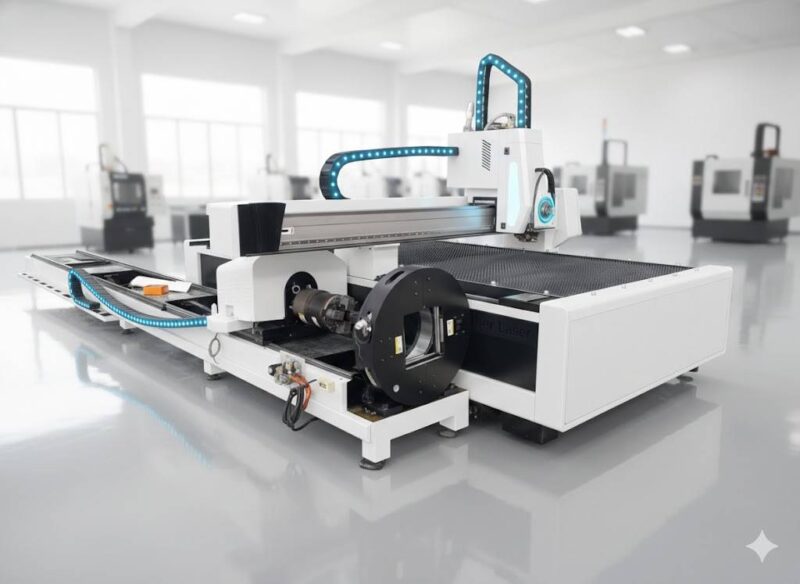
Advanced Fiber Laser Tube Processing Technology
Our CNC Fiber Laser Tube Cutting systems revolutionize metal fabrication by integrating high-precision cutting, punching, and profiling into a single automated workflow. Designed for versatility, this technology handles a wide array of profiles including Round, Square, Rectangular, and Oval tubes, as well as complex L-shaped and U-shaped channels.
- Precision Punching: High-speed hole punching with micron-level accuracy, eliminating the need for mechanical drilling or die-stamping.
- Complex Profiling: Advanced 3D pathing allows for intricate interlocking joints and specialized notch cuts, ideal for structural frames.
- High Material Efficiency: Intelligent nesting software minimizes scrap, reducing raw material costs across large production runs.
- Clean Finish: Delivers oxide-free, burr-free edges that require zero secondary grinding before welding.

Seamlessly processing multiple profiles with consistent precision.
Global Delivery & Logistics



From our high-tech manufacturing facility directly to your global site. PCL WeldCut ensures secure packaging, professional handling, and reliable international logistics to safeguard your equipment throughout the entire journey.